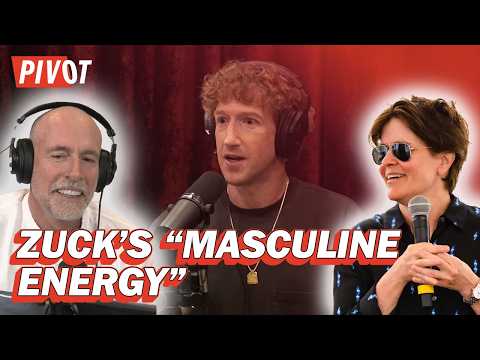
What Mark Zuckerberg Gets Wrong About "Masculine Energy" | Pivot
Kara Swisher (host), Mark Zuckerberg (guest), Scott Galloway (host)
In this episode of Pivot, featuring Kara Swisher and Mark Zuckerberg, What Mark Zuckerberg Gets Wrong About "Masculine Energy" | Pivot explores kara Swisher and Scott Galloway Dismantle Zuckerberg’s ‘Masculine Energy’ Rhetoric Kara Swisher and Scott Galloway critique Mark Zuckerberg’s recent comments on “masculine energy” from his Joe Rogan appearance and broader rightward rebranding. They argue that framing corporate culture in gendered terms is intellectually shallow and largely a cover for pragmatic, profit-driven moves like rolling back moderation and DEI. Galloway offers an alternative definition of masculinity centered on protection, service, and surplus value—traits he says Zuckerberg is not demonstrating. Swisher emphasizes that protective, aggressive energy isn’t inherently masculine and sees Zuckerberg’s posturing as a personal midlife crisis with significant societal consequences.
Kara Swisher and Scott Galloway Dismantle Zuckerberg’s ‘Masculine Energy’ Rhetoric
Kara Swisher and Scott Galloway critique Mark Zuckerberg’s recent comments on “masculine energy” from his Joe Rogan appearance and broader rightward rebranding. They argue that framing corporate culture in gendered terms is intellectually shallow and largely a cover for pragmatic, profit-driven moves like rolling back moderation and DEI. Galloway offers an alternative definition of masculinity centered on protection, service, and surplus value—traits he says Zuckerberg is not demonstrating. Swisher emphasizes that protective, aggressive energy isn’t inherently masculine and sees Zuckerberg’s posturing as a personal midlife crisis with significant societal consequences.
Key Takeaways
Gendering corporate culture obscures real motives.
Swisher and Galloway argue that talk of ‘masculine energy’ at companies is a distraction from substantive decisions—like cutting moderation budgets and DEI—driven by profit, not principle.
Get the full analysis with uListen AI
Masculinity is better defined by service and protection than aesthetics.
Galloway frames masculinity as being a protector, provider, and risk-taker in the service of others, contrasting this with Zuckerberg’s focus on image, wardrobe, and performative toughness.
Get the full analysis with uListen AI
Protective energy is not inherently masculine.
Swisher stresses that maternal and feminine energy can be just as, if not more, fiercely protective, undermining the idea that protection or aggression belong to one gender.
Get the full analysis with uListen AI
Zuckerberg’s ‘masculine’ turn is viewed as insecure cosplay.
They interpret his hunting, wardrobe changes, and rhetoric as beta-turned-aspiring-alpha performance rather than authentic confidence or leadership.
Get the full analysis with uListen AI
Rolling back moderation is framed as ‘free speech’ but driven by money.
Galloway suggests Zuckerberg is rebranding content moderation as censorship to justify cutting $5 billion in costs, boosting Meta’s profits and his own net worth under the guise of cultural values.
Get the full analysis with uListen AI
True masculinity often coexists with strong feminine influences.
Galloway contends the “most masculine” men are typically surrounded by smart, nurturing women—starting with their mothers—who bring nuance, care, and emotional grounding.
Get the full analysis with uListen AI
Public personal reinventions by tech leaders can have broad social impact.
Swisher sees Zuckerberg’s apparent midlife crisis as more than personal; his cultural signaling influences corporate policy, online discourse, and political dynamics.
Get the full analysis with uListen AI
Notable Quotes
“I had forgotten what a bad thinker he was until I listened to this interview.”
— Kara Swisher
“Anyone who's seen Mark Zuckerberg's new wardrobe realizes he's not bringing masculine energy, he's bringing Chechen molly dealer energy.”
— Scott Galloway
“I don't think companies should be gendered. I don't think it's a productive conversation.”
— Scott Galloway
“Masculinity means you're a protector, a provider, and a procreator, in my view… Your operating system, your default system is that you protect people.”
— Scott Galloway
“It’s like, are you a good person and a strong protector of people, male or female, Mark?”
— Kara Swisher
Questions Answered in This Episode
How should concepts like ‘masculine’ and ‘feminine’ energy be used, if at all, in discussions about corporate culture and leadership?
Kara Swisher and Scott Galloway critique Mark Zuckerberg’s recent comments on “masculine energy” from his Joe Rogan appearance and broader rightward rebranding. ...
Get the full analysis with uListen AI
To what extent is Zuckerberg’s rhetoric about masculinity a genuine belief versus a strategic political and financial calculation?
Get the full analysis with uListen AI
Can we meaningfully separate a tech leader’s personal midlife reinvention from the policies and cultural norms of the platforms they control?
Get the full analysis with uListen AI
What would a non-gendered framework for talking about protection, risk-taking, and service in leadership look like?
Get the full analysis with uListen AI
How do media critiques like this shape public perception of tech CEOs and potentially influence their future behavior and policy decisions?
Get the full analysis with uListen AI
Transcript Preview
Scott, we're back. Mark Zuckerberg's MAGA makeover continues with a return, uh, term visit to Mar-a-Lago last week and an appearance on Joe Rogan's podcast, possibly the most embarrassing one I've ever seen. Over the course of a three-hour chat with Rogan, Zuckerberg bashed his own company's fact-checking process, the, eh, bi- Biden administration's push for content moderation in Apple for lack of innovation, amidst the news that Meta ended its, uh, DEI efforts, also Zuck... and also took away all kinds of... eh, I'll get to that in a second. Zuckerberg lamented the rise of culturally neutered companies. Let's listen to him explain why masculine energy is so important.
I have three sisters, no brothers, um, I have three daughters, no sons. So I'm, like, surrounded by girls and women, like, my, my whole life. And it's like, so I think, um... I don't know, there's just something... the, the, the kind of masculine en- energy, I think, is, is good.
Yeah.
And obviously, you know, society has plenty of that. But, but I think corporate culture was really, like, trying to get away from it.
Yeah, it sounds like this guy is... has divorce vibes to me. (laughs) I don't know, that's what it... all over the, uh... like what i-... he just... eh, look how he juxtaposed them. "I have three sisters, no brothers, three daughters, no sons." And then he doesn't say, "This is great." He says, "And, uh, you know, we kinda need masculine energy again." It sounds like he feels like a fucking te- Ken Doll or something's happened here. And then makes no sense what... I, I had forgotten what a bad thinker he was until I listened to this interview. I've interviewed him many times so he's... as he's... I'm interviewing him, most of the time I'm thinking, "This guy has no intellectual heft in any way or an ability to think through a clear thought." Now... and, and he, he certainly doesn't anymore. So this was one big, I don't know, you know, puss ball of, "You need some therapy, dude." That's all I kept thinking when I was listening to it. But Scott, have you been, uh, talking to Mark about masculine energy, and what would you say?
Uh, first off, anyone who's seen Mark Zuckerberg's new wardrobe realized he's not bringing masculine energy, he's bringing Chechen molly dealer energy.
Yeah, that's, that's Jimmy Kimmel.
Yeah. A- and that's the best description of his, uh, of his look and feel. Uh, for the most part, like, I, I think masculinity and femininity are wonderful things. They're societal constructs that can help be great guideposts and aspirational behaviors for both men and women, not sequestered to either sex. And... but I'm not sure that it plays a role. Uh, I don't think companies should be gendered. I, I (laughs) I don't, I don't think it's a productive conversation.
Oh but, Scott, they're neutered. Oh my God, fuck you, Mark. Go ahead, sorry.
Install uListen to search the full transcript and get AI-powered insights
Get Full TranscriptGet more from every podcast
AI summaries, searchable transcripts, and fact-checking. Free forever.
Add to Chrome