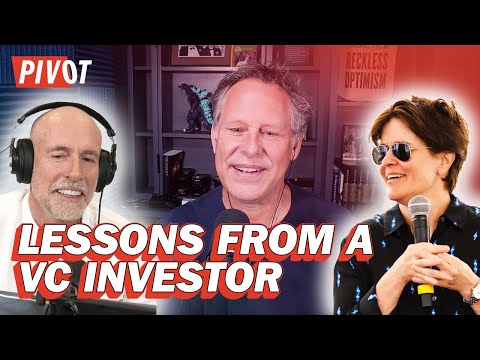
The Benefits of "Disagreeable" Leader at the Helm | Pivot
Kara Swisher (host), Mike Maples Jr. (guest), Scott Galloway (host)
In this episode of Pivot, featuring Kara Swisher and Mike Maples Jr., The Benefits of "Disagreeable" Leader at the Helm | Pivot explores why Disagreeable ‘Pattern Breakers’ Build Wild Startups That Reshape Futures VC Mike Maples Jr. discusses his concept of “pattern breakers” — founders and companies that deliberately defy conventional patterns to create radically new markets and products.
Why Disagreeable ‘Pattern Breakers’ Build Wild Startups That Reshape Futures
VC Mike Maples Jr. discusses his concept of “pattern breakers” — founders and companies that deliberately defy conventional patterns to create radically new markets and products.
He uses examples like Tesla’s Cybertruck and SpaceX to illustrate how contrarian, disagreeable leaders can unlock breakthrough outcomes while also veering into toxicity if unchecked.
Maples explains why many frontier startups look irrational or chaotic early on, recounting his famous miss on Airbnb and how it reshaped his investment philosophy.
He also touches on why he’s done relatively little AI investing so far, emphasizing his need for early-stage opportunities that can return 100x rather than late-stage, capital-intensive bets like OpenAI.
Key Takeaways
Pattern breakers force a choice between today’s norms and a new future.
Products like the Tesla Cybertruck don’t invite comparison to incumbents; they demand that users either opt into a radically different vision or opt out entirely, which is often how transformative companies emerge.
Get the full analysis with uListen AI
The right kind of disagreeableness is an asset for founders.
Founders who push back against consensus and social pressure are more likely to see and pursue non-obvious opportunities, but this trait must be channeled to avoid becoming personal or cultural toxicity.
Get the full analysis with uListen AI
Future-changing leaders are complex and can’t be painted with one brush.
Maples argues that figures like Elon Musk contain “multitudes”—they can deliver massive technical and economic breakthroughs (e. ...
Get the full analysis with uListen AI
Many great early-stage opportunities present poorly and look ‘crazy.’
Airbnb initially appeared disorganized and risky, with cereal-box funding and a clunky product, underscoring that investors must look past awkward pitches and early chaos to the underlying potential.
Get the full analysis with uListen AI
Missing a big winner should permanently change your decision process.
Passing on Airbnb led Maples to reorient his rules: in venture, the cardinal sin isn’t just losing money—it’s saying no to a company that could return thousands of times your investment.
Get the full analysis with uListen AI
Classical VC economics don’t fit every hot space, including many AI giants.
For funds like Floodgate, late-stage, capital-intensive AI players (OpenAI, xAI, Anthropic) may not offer the 100x-on-the-first-check profile needed to make the math of early-stage venture work.
Get the full analysis with uListen AI
Keeping ‘tribal affiliations’ small helps evaluate controversial founders clearly.
By avoiding strong ideological or social alignment with any camp, investors can more objectively separate a founder’s valuable contributions from their flaws or political stances.
Get the full analysis with uListen AI
Notable Quotes
“Pattern matching creates a bias. It causes you to not see other opportunities.”
— Mike Maples Jr.
“The right amount of disagreeableness can be a founder's ally in developing breakthrough ideas.”
— Mike Maples Jr. (quoted by Kara Swisher)
“People are just complicated — especially people who change the future.”
— Mike Maples Jr.
“In my business, rule number one is: don’t pass on Airbnb.”
— Mike Maples Jr.
“Quite often the best seed opportunities don’t present well.”
— Mike Maples Jr.
Questions Answered in This Episode
How can founders cultivate healthy disagreeableness without crossing into toxic behavior for their teams and communities?
VC Mike Maples Jr. ...
Get the full analysis with uListen AI
What practical frameworks can investors use to distinguish a ‘crazy’ idea that’s dangerous from one that’s merely non-consensus but breakthrough?
He uses examples like Tesla’s Cybertruck and SpaceX to illustrate how contrarian, disagreeable leaders can unlock breakthrough outcomes while also veering into toxicity if unchecked.
Get the full analysis with uListen AI
In an AI landscape dominated by giants, where are the true early-stage, 100x opportunities likely to appear?
Maples explains why many frontier startups look irrational or chaotic early on, recounting his famous miss on Airbnb and how it reshaped his investment philosophy.
Get the full analysis with uListen AI
How should investors and operators reconcile the moral complexity of backing or working with founders who create huge societal value but also cause harm?
He also touches on why he’s done relatively little AI investing so far, emphasizing his need for early-stage opportunities that can return 100x rather than late-stage, capital-intensive bets like OpenAI.
Get the full analysis with uListen AI
What concrete changes did Maples make to his sourcing, diligence, or decision-making process after missing Airbnb, and how could other investors apply those lessons?
Get the full analysis with uListen AI
Transcript Preview
Mike Maples Jr. is the co- founder of the venture, uh, capital firm, Floodgate. He's written a new book, Pattern Breakers: Why Some Startups Change the Future. And let me say, I was just telling Scott a second ago, you're one of my favorite people to talk to 'cause you're so smart. You've always given me good insights. And, although at the same time, with many VCs, it's a low bar. Um, so, uh, but I've always appreciated your insights. You- it was always different and unusual. So, let's just get into it. Just for people who don't know, you were an early investor. You've always been a very earlier investor. In Twitter, uh, when it was Odeo, Twitch, Lyft, and many others. What exactly defines a founder or company as a pattern breaker? I mean, that's... why- why'd you call your book Pattern Breakers?
Now, I'll, I'll give an example that's not even in the startup realm, but it would be a pattern-breaking example of recent times, the Tesla Cybertruck. Now, y- you may like it, you may dislike it, when I saw it a- announced, I thought he might be joking. Right? Like, I, I was like, "Is he really gonna ship that thing?" But nobody, when they see a Cybertruck ever says, "Well, so how does that compare to an F-150?" So, Elon kind of says, "Live in my future or don't, but you have to choose." Uh, so pattern breaker is... the idea was that we tend to operate according to consistent patterns. And that's actually not a bad thing. That help- helped us avoid saber-toothed tigers or it helps us fit in socially in communities and stuff. But, but pattern break- uh, pattern matching, uh, creates a bias as well. It causes you to not, not see other, other opportunities.
This is a quote from you. "The right amount of disagreeableness can be a founder's ally in developing breakthrough ideas." Now, at the same time, it can lead to toxicity. You mentioned Elon-
Yeah.
... he was, he was very disagreeable, but it's morphed into toxicity now-
Mm-hmm.
... right? In a way that's... everything is disagreeable, right? Talk about that balance. 'Cause I agree with you, uh, you know, I, I think I'm a disagreeable person. I think that's one of the reason I'm successful-
(laughs)
... 'cause I disagree. No, but I go-
Okay.
... I'm like, "I wanna do podcasts now 10 years ago." This is what I-
(laughs)
... even though... and a lot of people said no or-
Don't say anything. Don't say-
I'm just saying-
... anything.
Shush. Shush. Shush. Shush. Um, but we'll talk about this disagreeableness and when it becomes kind of, you know, I was right before and you'll see that I'm right again, 'cause it's not always the case for sure.
Yeah. So, um, so I'm gonna tread carefully on this question because, uh-
Install uListen to search the full transcript and get AI-powered insights
Get Full TranscriptGet more from every podcast
AI summaries, searchable transcripts, and fact-checking. Free forever.
Add to Chrome