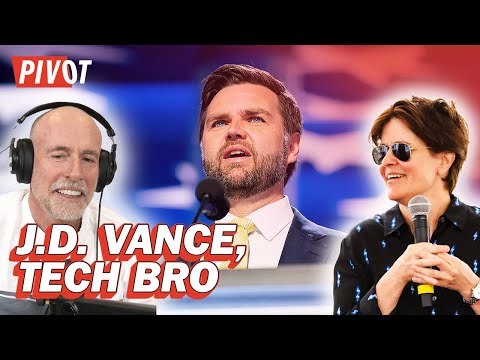
How J.D. Vance Got Tech Billionaire Backing | Pivot
Kara Swisher (host), Scott Galloway (host)
In this episode of Pivot, featuring Kara Swisher and Scott Galloway, How J.D. Vance Got Tech Billionaire Backing | Pivot explores tech Billionaires Bet on Trump: JD Vance, Crypto, and Power Kara Swisher and Scott Galloway discuss how a small circle of tech billionaires and VCs—particularly Peter Thiel, David Sacks, and Elon Musk—are aggressively backing Donald Trump and JD Vance, framing it as an attempt to effectively buy political outcomes.
Tech Billionaires Bet on Trump: JD Vance, Crypto, and Power
Kara Swisher and Scott Galloway discuss how a small circle of tech billionaires and VCs—particularly Peter Thiel, David Sacks, and Elon Musk—are aggressively backing Donald Trump and JD Vance, framing it as an attempt to effectively buy political outcomes.
They argue that JD Vance’s rise is less about merit and more about Peter Thiel’s patronage, portraying Vance as a “billionaire butler” whose limited business and legislative records contrast sharply with his rapid political ascent.
The hosts suggest that venture firms like Andreessen Horowitz and Sequoia must see enormous upside—especially around Bitcoin, crypto, and favorable regulatory or trade decisions—to justify overt political involvement that could alienate institutional investors.
They characterize this funding landscape as a shift toward pay‑to‑play kleptocracy, where tech elites seek targeted government favors (tariffs, crypto policy, attacks on competitors) rather than advancing coherent ideology, and warn that Vance’s hard-right views, especially on Ukraine and social issues, are particularly dangerous.
Key Takeaways
Tech political money is becoming overtly transactional, not ideological.
Swisher and Galloway argue that major donations are linked to specific expected policy favors—like tariffs on Chinese EVs or pro‑crypto rules—rather than broad political principles, resembling a kleptocratic pay‑to‑play system.
Get the full analysis with uListen AI
JD Vance’s ascent is portrayed as engineered by Peter Thiel.
They emphasize that Thiel arranged Vance’s jobs, funded his Senate run, and helped secure Trump’s endorsement, casting Vance as an instrument of billionaire interests rather than an independently accomplished leader.
Get the full analysis with uListen AI
Venture firms see massive potential upside in a Trump victory, especially via crypto.
The hosts infer that for firms like Sequoia and Andreessen Horowitz to risk alienating public pension LPs, they must expect transformational gains from a Trump administration’s crypto and monetary policy decisions.
Get the full analysis with uListen AI
Institutional limited partners may push back on politicized venture capital.
Because pension funds and similar LPs invest to earn returns, not to back political candidates, the hosts suggest these investors could pressure or question VCs who route capital or brand equity into partisan efforts.
Get the full analysis with uListen AI
Elon Musk’s political posture is tied to his global business interests.
Swisher, citing Mark Cuban, notes that Musk’s support for Trump and his use of X (Twitter) are part of a larger strategy to maximize influence with autocrats and regulators, not just culture‑war posturing.
Get the full analysis with uListen AI
JD Vance is seen as ideologically more extreme and dangerous than Trump on some fronts.
Galloway highlights Vance’s indifference to Ukraine and affinity for far‑right Christian thinkers, while Swisher frames him as “The Handmaid’s Tale guy,” suggesting he could accelerate regressive policies on women and LGBTQ+ rights.
Get the full analysis with uListen AI
Despite Republican momentum, the hosts see potential vulnerability with women voters.
Swisher believes that once women more fully understand Vance’s views and influences, his presence on the ticket could hurt Trump, especially among voters concerned about reproductive and civil rights.
Get the full analysis with uListen AI
Notable Quotes
“This has been a Peter Thiel operation the whole time.”
— Kara Swisher
“This feels like a kleptocracy. It's pay for play, it's not around ideology.”
— Scott Galloway
“He's a tech bro butler… a billionaire butler.”
— Kara Swisher on JD Vance
“For Sequoia and Andreessen to come out and be this political overtly must mean that they feel they have such extraordinary upside probably around Bitcoin.”
— Scott Galloway
“He’s the Handmaid’s Tale guy, not Trump necessarily.”
— Kara Swisher on JD Vance
Questions Answered in This Episode
How should regulators and voters respond when major policy decisions appear effectively purchasable by a small group of wealthy tech backers?
Kara Swisher and Scott Galloway discuss how a small circle of tech billionaires and VCs—particularly Peter Thiel, David Sacks, and Elon Musk—are aggressively backing Donald Trump and JD Vance, framing it as an attempt to effectively buy political outcomes.
Get the full analysis with uListen AI
What concrete mechanisms, if any, could institutional investors use to pressure venture firms away from overt partisan political activity?
They argue that JD Vance’s rise is less about merit and more about Peter Thiel’s patronage, portraying Vance as a “billionaire butler” whose limited business and legislative records contrast sharply with his rapid political ascent.
Get the full analysis with uListen AI
If JD Vance’s rise is heavily dependent on billionaire sponsorship, what does that imply about democratic meritocracy and candidate pipelines more broadly?
The hosts suggest that venture firms like Andreessen Horowitz and Sequoia must see enormous upside—especially around Bitcoin, crypto, and favorable regulatory or trade decisions—to justify overt political involvement that could alienate institutional investors.
Get the full analysis with uListen AI
How might a Trump–Vance administration reshape U.S. crypto regulation, and who stands to benefit or lose from those changes?
They characterize this funding landscape as a shift toward pay‑to‑play kleptocracy, where tech elites seek targeted government favors (tariffs, crypto policy, attacks on competitors) rather than advancing coherent ideology, and warn that Vance’s hard-right views, especially on Ukraine and social issues, are particularly dangerous.
Get the full analysis with uListen AI
To what extent are Elon Musk’s and other tech leaders’ political interventions driven by ideology versus pure business calculus and personal power?
Get the full analysis with uListen AI
Transcript Preview
So, here we have it, here they have. They're trying to buy a presidency, essentially. I, I think Trump doesn't get what just happened with, with J.D. Vance. Uh, let me just take a moment. We talked about him last week. He, his job record is not good in tech, let me just say. Uh, and, and including Steve Case saying he didn't do much, right, when he worked for him. Um, he had a, uh, he had a firm that didn't do well. Uh, he, he had one company took public that's gone bankrupt. Um, he essentially was, you know, it was really interesting because Rachel Maddow did a great thing on him, uh, this week where she basically called him an intern for Peter Thiel. Peter Thiel got him all his jobs and then gave him money to run for Senate, and now has pushed him right into Trump's arms, including getting the, the Senate, um, endorsement, which was critical to him, and then convincing Donald Jr. to press the president for this. So, you know, this has been a Peter Thiel operation the whole time. I, I have to tip my hat to him because I do think he's quite brilliant. Um, not so much David Sacks, but he certainly is. But you know, it's a small group of people. They put up a list of them, David Sacks did, and it's all like the Winklevosses and a bunch of other... (sighs) This Sean Maguire person who never shuts up. Um, is it VC? It's all these unpleasant VCs and, um, (smacks lips) when you, th- the, The Information did a, a poll of voters, uh, in Silicon Valley and it was overwhelmingly Biden over Trump, the average people, um, and startup people and this and that. It's mostly these incredibly afflicted, uh, VCs who think they're victims. Um, so you know, and there's, there's, there's others on the other side. Obviously, um, Reid Hoffman, Mark Cuban, et cetera, et cetera. Quietly, Sheryl Sandberg.
It is a dramatic shift red because in past, I think the past couple presidential elections, you've had like 80 plus percent of the dollar volume coming out of the valley has gone Democratic. These are real players. The thing that struck me was that I found it, a couple things. One, for Sequoia and Andreessen to come out and be this political overtly, um, must mean that they have such extraordinary, they feel they have such extraordinary upside probably around Bitcoin, probably around some sort of dialogue they've had with, with President Trump that if he's elected, he's gonna do something that, that totally legitimizes or integrates Bitcoin technology into whatever, the Federal Reserve or fiscal planning or some sort of monetary policy that would take the price of Bitcoin and crypto so far up that they've decided it's worth the risk. Because what I gotta think here is if I'm... Sequoia has like Ottawa Teachers-
Yeah.
... or the state pension fund from Michigan as limited partners. I gotta think right away they got letters saying, "Okay, let's be clear. We gave you money to get an above market return investing in startups."
Install uListen to search the full transcript and get AI-powered insights
Get Full TranscriptGet more from every podcast
AI summaries, searchable transcripts, and fact-checking. Free forever.
Add to Chrome