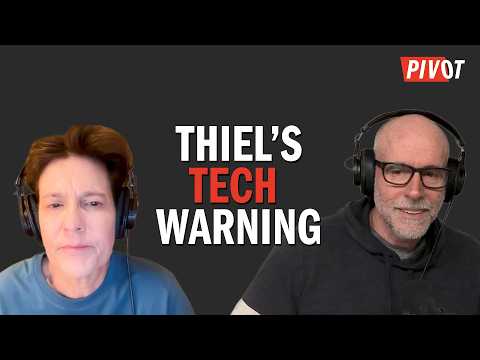
Why is Peter Thiel Warning About the Antichrist? | Pivot
Scott Galloway (host), Kara Swisher (host), Narrator, Bernie Sanders (guest)
In this episode of Pivot, featuring Scott Galloway and Kara Swisher, Why is Peter Thiel Warning About the Antichrist? | Pivot explores tech tycoons, Antichrist fears, and AI power collide in politics Kara Swisher and Scott Galloway range across U.S. politics, AI power, higher education, cyber security, and GLP‑1 weight‑loss drugs, tying them back to tech and power. They frame the massive No Kings anti‑authoritarian protests as a hopeful show of democratic resistance and contrast that with Trump’s juvenile AI‑generated response and clemency for George Santos. They dissect the Trump administration’s attempts to strong‑arm universities via funding conditions and to shape AI policy through loyalists like David Sacks, while critiquing Peter Thiel’s increasingly theocratic rhetoric about the ‘Antichrist’ and hostility to AI safety regulation. The episode closes with concerns about China‑linked cyberattacks, the physical and social costs of AI data centers, and the transformative potential of cheap, widely available GLP‑1 drugs.
Tech tycoons, Antichrist fears, and AI power collide in politics
Kara Swisher and Scott Galloway range across U.S. politics, AI power, higher education, cyber security, and GLP‑1 weight‑loss drugs, tying them back to tech and power. They frame the massive No Kings anti‑authoritarian protests as a hopeful show of democratic resistance and contrast that with Trump’s juvenile AI‑generated response and clemency for George Santos. They dissect the Trump administration’s attempts to strong‑arm universities via funding conditions and to shape AI policy through loyalists like David Sacks, while critiquing Peter Thiel’s increasingly theocratic rhetoric about the ‘Antichrist’ and hostility to AI safety regulation. The episode closes with concerns about China‑linked cyberattacks, the physical and social costs of AI data centers, and the transformative potential of cheap, widely available GLP‑1 drugs.
Key Takeaways
Mass, peaceful protest still matters as a signal of democratic health.
The No Kings marches, with millions participating across all 50 states, show Americans will mobilize against creeping authoritarianism; they energize organizing, signal to elites that voters are watching, and counter narratives that apathy has won.
Get the full analysis with uListen AI
Universities must coordinate and litigate together to resist political capture.
Scott argues MIT, Brown, Penn, USC, UVA, Dartmouth and peers should speak with one voice against Trump’s “Compact,” use the courts (First and Tenth Amendment arguments), mobilize alumni funding, and even leverage accreditation bodies so no school is isolated and picked off.
Get the full analysis with uListen AI
AI regulation is being shaped by insiders with financial stakes, not neutral referees.
The Anthropic–David Sacks clash illustrates how Trump’s AI czar is publicly menacing a single company for talking about safety—violating the norm that governments regulate sectors, not punish individual firms—which Kara and Scott see as textbook regulatory capture on behalf of favored tech players.
Get the full analysis with uListen AI
Peter Thiel’s religiously framed anti‑regulation stance shows a dangerous fusion of theology, tech, and state power.
His warnings that AI safety efforts might ‘summon the Antichrist’ recast opposition to unchecked tech dominance as apocalyptic evil, which Kara and Scott find alarming given his influence, his ties to top officials, and his increasingly theocratic worldview.
Get the full analysis with uListen AI
GLP‑1 drugs could be a bigger near‑term societal shift than AI—if made cheap and widespread.
Scott calls them “revolutionary,” arguing Medicare and the federal government should use bulk purchasing to drive prices near $50/month so obesity can be treated at scale, with huge benefits for health costs, mental health, labor participation, and inequality in a deeply looks‑biased culture.
Get the full analysis with uListen AI
Cyber and infrastructure risks are mounting as everything centralizes on a few platforms.
The F5 China‑linked breach and AWS outage underscore how concentrated tech stacks magnify the blast radius of attacks or failures, while U. ...
Get the full analysis with uListen AI
AI’s physical footprint quietly shifts costs onto poorer communities.
New data centers consume massive electricity and water while creating few permanent jobs; Kara notes they’re often sited in vulnerable areas, with the public ultimately subsidizing higher power bills, effectively transferring wealth from middle‑class ratepayers to already‑dominant tech firms.
Get the full analysis with uListen AI
Notable Quotes
““The No Kings protest isn’t about hating America, but about loving it enough to defend it… We will stand together peacefully, not to divide the country, but to remind it who we are.””
— Scott Galloway (quoting a viral line attributed online, then attributing it jokingly to Eric Cartman/South Park)
“Every accusation is a confession.”
— Kara Swisher, referring to David Sacks accusing Anthropic of ‘regulatory capture’
“Why should we be worried about the most powerful people in the world that have an unbelievable command of godlike technology, who basically own the vice president, who are becoming increasingly theocratic? No worries there.”
— Scott Galloway, on Thiel and other tech billionaires
“If you’re obese in America, on many levels, you’re fucked.”
— Scott Galloway, on looks‑based bias and why GLP‑1 access matters
“They don’t care about safety of anybody because they themselves are doing things and it’s really hurting individual communities… It’s the idea that if we want to talk about safety, it doesn’t mean we hate [technology]; it means that we care about the citizens more than lining the pockets of David Sacks and his friends.”
— Kara Swisher, on AI data centers, safety, and tech power
Questions Answered in This Episode
How should democratic societies balance AI innovation with meaningful safety regulation when regulators are tightly intertwined with the most powerful tech investors?
Kara Swisher and Scott Galloway range across U. ...
Get the full analysis with uListen AI
What concrete steps could universities take—beyond statements—to build a durable, collective shield against partisan federal pressure on admissions, hiring, and speech?
Get the full analysis with uListen AI
If GLP‑1 drugs were made cheap and widely available, what safeguards would be needed to prevent new forms of inequality, abuse, or unintended health consequences?
Get the full analysis with uListen AI
At what point do the political activities and religious agendas of tech billionaires like Peter Thiel pose a structural threat to liberal democracy rather than just being one faction in a pluralistic system?
Get the full analysis with uListen AI
Given the rising number of large‑scale breaches and outages, should critical cloud providers and security vendors be regulated more like public utilities, with higher transparency and redundancy requirements?
Get the full analysis with uListen AI
Transcript Preview
... why should we be worried about the most powerful people in the world that have an unbelievable command of godlike technology, who basically own the vice president, who are becoming increasingly theocratic? I mean-
I know. (laughs)
... no, no worries there.
No worries. (laughs)
No worries there. (laughs)
(instrumental music) Hi, everyone. This is Pivot from New York Magazine and the Vox Media Podcast Network. I'm Kara Swisher.
And I'm Scott Galloway.
Guess where I am?
I like this game. Where are you?
Las Vegas, your favorite place. Vegas, baby.
What are you doing in Vegas?
Oh, I'm giving a speech at a place you gave a speech at. I can't remember the... Stansberry? Anyway, uh, I'm here to talk about AI, of course, because that's the topic du jour of many of these events and stuff like that. So.
Uh, nice. And-
I didn't do-
... Vegas.
... anything in Vegas last night. I went to sleep and I watched The Diplomat before that. That's what I did. (laughs)
Oh, really?
It was an entire evening, yes. (laughs) Yeah.
Oh, wow. That's... uh, it does it... how does it feel?
Mm-hmm. To what?
Well, I mean, how does the mood... people say Vegas is dying because people now have Vegas in their pocket with their phones and people-
Yeah.
... have less money.
You know, it was full. You know, I was... I'm at, um... I, I ate at the, at the, um... it's not the Wynn, it's... I guess it's the Wynn. The one with all the trees that hang down. You know ho-... Las Vegas better than I do. But I'm staying, uh, at, at the Encore, that whole facility. And, um, it's, it's... was packed. I was surprised. It was very jolly. Um, although it wasn't... I wouldn't say the casino was packed, that's for sure. Um, but it was... it wasn't, like, unfull, I guess. I don't know. Is this the time of year for it to be full?
Um, I think Vegas is pretty much a year-round place.
Right, right.
And, um, conventions and everything.
Right.
And, um, I used to go there-
I've only been here... Oh, sorry. Go ahead.
What?
I've s-... I've only been here at, like, CES, so it's always full. It's not like that, like, by any means like that whatsoever. So.
I used to go there. My friendly lodess and I would get-
Mm-hmm.
... ridiculously fucking high and decide at 2:00 AM that it was a good idea to go to Vegas.
Oh.
And we'd jump in his Volkswagen Jetta-
Yeah.
... and head for five hours to-
Across the desert.
... um, to Vegas, across the desert.
Long.
And we'd stay at the, the Golden Nugget-
Install uListen to search the full transcript and get AI-powered insights
Get Full TranscriptGet more from every podcast
AI summaries, searchable transcripts, and fact-checking. Free forever.
Add to Chrome