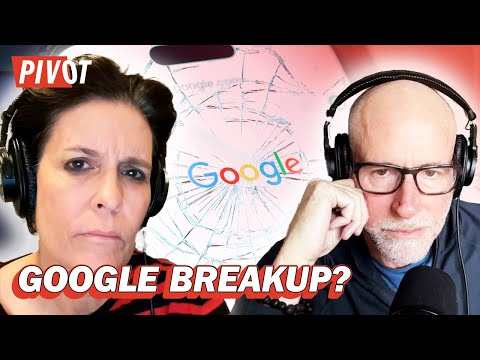
Google Forced to Sell Chrome? DOJ's Bombshell Breakup Plan | Pivot
Kara Swisher (host), Scott Galloway (host)
In this episode of Pivot, featuring Kara Swisher and Scott Galloway, Google Forced to Sell Chrome? DOJ's Bombshell Breakup Plan | Pivot explores dOJ Targets Google’s Chrome to Break Search Monopoly and Innovate The conversation explores the U.S. Department of Justice’s proposed remedy in its Google Search antitrust case, specifically a forced divestiture of the Chrome browser and bans on default-search payment deals with companies like Apple.
DOJ Targets Google’s Chrome to Break Search Monopoly and Innovate
The conversation explores the U.S. Department of Justice’s proposed remedy in its Google Search antitrust case, specifically a forced divestiture of the Chrome browser and bans on default-search payment deals with companies like Apple.
Kara Swisher and Scott Galloway argue that fines and oversight are ineffective, and that structural breakups are the only meaningful way to curb Google’s dominance and stimulate competition in search and browsers.
They discuss political and regulatory uncertainty, including changing antitrust leadership and the influence of figures like Trump, Elon Musk, and others on future enforcement.
The hosts frame breakups as historically beneficial for innovation, users, and employees, and extend the discussion to platform choice, content moderation, and the idea that computers—not humans—should have limited speech rights.
Key Takeaways
Structural breakups are seen as more effective than fines.
The hosts argue that monetary penalties and government monitors are too easy for tech giants to absorb or ignore, whereas forced divestitures directly reduce market power and change incentives.
Get the full analysis with uListen AI
Chrome’s dominance could be valuable to many buyers, not just Google.
Despite claims that Chrome is merely an appendage to Google, its roughly two-thirds share of the browser market represents massive user attention that many firms could monetize competitively.
Get the full analysis with uListen AI
Ending default-search payment deals could open the search market.
Blocking Google from paying companies like Apple to be the default search engine would reduce automatic steering to Google and create more room for rival search providers.
Get the full analysis with uListen AI
Search’s profitability amplifies the harm of monopoly control.
With search described as perhaps the largest, ultra–high-margin business in the world, concentrating that profit and data advantage in one player raises prices (rents) on advertisers and stifles innovation.
Get the full analysis with uListen AI
Historical breakups have generally benefited innovation and stakeholders.
Galloway contends that past U. ...
Get the full analysis with uListen AI
Distinguishing human from computer speech could help manage misinformation.
Referencing Eric Schmidt, they highlight the idea that humans should have strong free speech rights, while computers (and automated systems) should not, as much incendiary and polarizing content is machine-amplified or generated.
Get the full analysis with uListen AI
User choice among platforms is framed as the real free speech.
Swisher argues that the freedom to choose or avoid platforms like Twitter/X, and to prefer alternatives like Bluesky or Threads, is a truer expression of liberty than being compelled to participate in a single dominant forum.
Get the full analysis with uListen AI
Notable Quotes
“You can’t come up with fines big enough.”
— Scott Galloway
“It would immediately stop this default steering everyone towards their search engine.”
— Scott Galloway
“They should just cut them up and create new businesses and see what could be made.”
— Kara Swisher
“Ask any economist or ask any lawyer trying to fight against this, what breakup in US history did not end up being a good idea?”
— Scott Galloway
“The ability to make and choose your own adventure, to me, is freedom.”
— Kara Swisher
Questions Answered in This Episode
If Google were forced to sell Chrome, which types of companies should be allowed—or disallowed—to buy it to avoid simply recreating another monopoly?
The conversation explores the U. ...
Get the full analysis with uListen AI
How might banning default-search payment deals change consumer behavior, given many people never change default settings?
Kara Swisher and Scott Galloway argue that fines and oversight are ineffective, and that structural breakups are the only meaningful way to curb Google’s dominance and stimulate competition in search and browsers.
Get the full analysis with uListen AI
What safeguards would be needed to ensure a Chrome divestiture actually increases competition rather than just shifting power to another giant?
They discuss political and regulatory uncertainty, including changing antitrust leadership and the influence of figures like Trump, Elon Musk, and others on future enforcement.
Get the full analysis with uListen AI
How could regulators practically distinguish and regulate ‘computer speech’ versus human speech without undermining legitimate expression?
The hosts frame breakups as historically beneficial for innovation, users, and employees, and extend the discussion to platform choice, content moderation, and the idea that computers—not humans—should have limited speech rights.
Get the full analysis with uListen AI
What lessons from previous major breakups (like AT&T or Standard Oil) are most applicable to breaking up modern tech platforms such as Google?
Get the full analysis with uListen AI
Transcript Preview
The DOJ is asking a judge in the Google Search monopoly case to force the company to sell its Chrome browser as part of the remedy. Chrome has about 67% of the global market and could go for as much as $20 billion, according to some estimates. The government also wants to stop Google from getting into paid agreements with Apple and others to be the default search engine on phones and browsers. Uh, the DO- DOJ stopped short of requesting a full divestiture of Android. Google called the DOJ proposal extreme and is set to file its own suggestions by December 20th. Remedy hearings will be held in April, and the juz- judges are expected to rule over the summer. I, I know, you know, all these, all these, uh, agencies are sort of waiting for what happens with Trump, although you just never know because he's had some anti-Google, um, statements and everything else, and there'll be a new head of antitrust at the Justice Department. It's not clear who that's gonna be. Um, what do you... D- What do you think of this remedy? It seems like an unusual thing. Tech writer John Gruber noted Chrome and Android are not standalone businesses. They're appendages to Google. It's like saying, "I have to sell my left foot. It's very valuable to me but of no value to anyone else." Um, and if a buyer of Chrome is a company like OpenAI or Microsoft, could they be accused of creating, as you just... you know, another monopoly with this purchase?
I like this. The potential remedies were a fine. You can't come up with fines big enough. Uh, some sort of administrator from the government, bureaucrat that had to... They got to go into any meeting and tell them why they shouldn't do something, which they basically can ignore. Stick the, stick the fat, ugly, weird kid in the corner, and then finally, a breakup. So I was happy to see this. Now whether it holds or not... But I- I'm not sure I agree with the writer because, because Chrome, you know, has about two-thirds global share, I think, of the browser market.
Right, 67.
That's so much attention, um, that's so much attention that a lot of different people could monetize that. So it would have no shortage of bidders. It would, it would, um, uh, immediately stop this default, um, you know, steering everyone towards their search engine. It'd be more of a competition. So I like this. I think... I generally find that the FTC and the DOJ, and this is 'cause they bring in a lot of my colleagues from business schools, are pretty smart about trying to come up with solutions that grow the total market.
Mm-hmm.
Uh, so I, I like this. I hope it goes through.
Yeah, it's interesting.
I don't know if it'll hold.
Y- you know, there's so much uncertainty because, as I said, Cantor is, will be leaving, John Cantor, and Lina Khan's tenure may be over, or maybe not. It's very unclear. You might get someone like Brendan Carr, who's making a grab for power at the FCC, which it didn't have, but may be trying to do so. There's all kinds of uncertainty on who's going to be able to run this and then who is going to be the antitrust head. And it is all in the hands of a single judge, um, who's, who, which then can be appealed, et cetera, and the government can stop trying, right? The government can go a different direction, depending. Um, you know, it'll be interesting because Sundar Pichai, the head of Alphabet, was on the phone with Trump, and of course, guess who was on the phone with him? There's the whole Elon element. Elon was on a phone call with the CEO of Alphabet with Trump. I mean, there's all these different competing power centers, uh, happening here. So, uh, I, I agree with you. I think there sh- something should be cleaved off of these companies. That's, to me, the only... Because-
Install uListen to search the full transcript and get AI-powered insights
Get Full TranscriptGet more from every podcast
AI summaries, searchable transcripts, and fact-checking. Free forever.
Add to Chrome