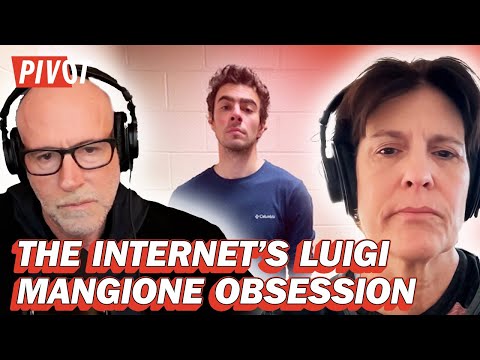
What's Behind the Internet's Fascination with Luigi Mangione? | Pivot
Kara Swisher (host), Scott Galloway (host)
In this episode of Pivot, featuring Kara Swisher and Scott Galloway, What's Behind the Internet's Fascination with Luigi Mangione? | Pivot explores luigi Mangione, Healthcare Rage, And America’s Boiling Point On Inequality The discussion uses the killing of UnitedHealthcare’s CEO by Luigi Mangione as a jumping-off point to examine America’s healthcare system, income inequality, and public reaction. Rather than focusing on Mangione’s psychology, the hosts emphasize that we know little about his mental state and that obsessing over his online life misses the real story. They argue the more revealing phenomenon is how quickly parts of the internet turned him into a folk hero, reflecting deep anger at insurers and the broader healthcare-industrial complex. The conversation frames this reaction as a symptom of structural failures—profit-driven healthcare, political capture, and widening inequality—that are pushing the country toward a kind of soft revolution.
Luigi Mangione, Healthcare Rage, And America’s Boiling Point On Inequality
The discussion uses the killing of UnitedHealthcare’s CEO by Luigi Mangione as a jumping-off point to examine America’s healthcare system, income inequality, and public reaction. Rather than focusing on Mangione’s psychology, the hosts emphasize that we know little about his mental state and that obsessing over his online life misses the real story. They argue the more revealing phenomenon is how quickly parts of the internet turned him into a folk hero, reflecting deep anger at insurers and the broader healthcare-industrial complex. The conversation frames this reaction as a symptom of structural failures—profit-driven healthcare, political capture, and widening inequality—that are pushing the country toward a kind of soft revolution.
Key Takeaways
Stop overinterpreting the killer’s digital footprint.
The hosts stress that Mangione’s online life looked typical for a young tech worker and gives no reliable insight into why he committed murder; any confident narrative about his inner state is speculation.
Get the full analysis with uListen AI
Focus on the systemic healthcare crisis, not just the individual crime.
The reaction to the killing reveals deep public fury at a healthcare system marked by high costs, profit extraction, and medical debt—conditions that are far more widespread and consequential than a single violent act.
Get the full analysis with uListen AI
Profit-driven healthcare produces both bad outcomes and public rage.
With U. ...
Get the full analysis with uListen AI
Internet heroization of Mangione reflects a proto-revolutionary mood.
Fan fiction, merchandise, and financial support for Mangione are interpreted as a kind of symbolic revolt by people who feel exploited by insurers and see the CEO as a stand-in for the whole industry.
Get the full analysis with uListen AI
Political capture blocks popular reforms despite broad public support.
Even though large majorities support universal healthcare and price caps, massive healthcare lobbying and campaign finance dynamics (e. ...
Get the full analysis with uListen AI
Inequality eventually ‘self-corrects’ in destabilizing ways.
Drawing on historical patterns, the hosts argue that extreme income inequality tends to trigger some form of self‑correction—through war, famine, or revolution—and see today’s anger at the 1% as part of that cycle.
Get the full analysis with uListen AI
Gradual Medicare expansion is proposed as a realistic reform path.
They advocate lowering the Medicare eligibility age stepwise each year until universal coverage is effectively achieved, as a pragmatic route to Medicare for All and away from profit-maximizing private insurance.
Get the full analysis with uListen AI
Notable Quotes
“Any speculation around what was going through his head, you’re just getting lost in the soup. We have no fucking idea.”
— Scott Galloway
“The most interesting thing here is how society has responded.”
— Scott Galloway
“We are trading despair and anguish for shareholder value.”
— Scott Galloway
“These CEOs of these companies are doing what they’re supposed to do… The people who are at fault here are voters who have failed to find elected representatives who have a backbone.”
— Scott Galloway
“This is a form of revolution… when they see insurance companies and their shareholders consistently getting richer, and they also know somebody whose wife got lung cancer… they start to get enraged.”
— Scott Galloway
Questions Answered in This Episode
To what extent does turning Mangione into an online folk hero normalize or encourage violence against perceived economic villains?
The discussion uses the killing of UnitedHealthcare’s CEO by Luigi Mangione as a jumping-off point to examine America’s healthcare system, income inequality, and public reaction. ...
Get the full analysis with uListen AI
How can policymakers realistically confront healthcare industry lobbying power while still winning elections financed under current campaign finance rules?
Get the full analysis with uListen AI
Where is the ethical line between legitimate anger at exploitative systems and sympathizing with those who commit extreme acts against individuals within those systems?
Get the full analysis with uListen AI
Would gradual Medicare expansion be politically feasible, or would entrenched interests block even incremental steps toward universal coverage?
Get the full analysis with uListen AI
How can the media cover incidents like this without amplifying mythologizing of the perpetrator while still grappling honestly with the structural issues behind public rage?
Get the full analysis with uListen AI
Transcript Preview
Anyway, let's get to our first big story. One of the biggest stories this week, obviously, Luigi Mangione, the 26-year-old man charged with the murder of UnitedHealthcare CEO Bryan Thompson. There's a lot of information out there about his online presence. Everyone's digging for clues. There's been stories about whether that means anything or not. I think one of the best story I read was about him being kind of a typical tech bro. If- if he hadn't shot this guy, he would have seemed relatively normal in his interests. What was your first reaction when you started hearing about this guy? He stopped communicating with friends and family about six months ago and really went offline. He was quite an active online person, like a lot of people his age in his sector, in the tech sector. I think he was... He worked for TrueCar. I think he was a video game aficionado. Um, he did have health issue over the last years on Reddit. He talked about this back problem he had and struggled with brain fog. John Hermon wrote in New York Magazine, "What's most striking about the... Mangione's, uh, extensive online dossier is that had it been studied before the shooting took place, it wouldn't have raised much alarm." Uh, very difficult to characterize. Um, what do you... Ta- talk about that first, then we'll talk about the reaction from people.
Well, okay, so first reaction is, in my opinion, and, you know, let me be arrogant here, I think the correct reaction is to feel, um, sympathy for the family of this man who was murdered. And then, and then what I immediately registered was everybody decided that they would use this event to speculate on what happened to confirm their current beliefs. So, people immediately went to, um, this is justified, uh, because this is an uprising or this is... You know, the most shocking thing about this isn't about the murderer. I mean, that's a tragedy 'cause when you're a young high school valedictorian with an engineering and computer science degree and master's degree, respectively, from an Ivy League university and you're handsome and in great shape, your li- and, and your life is over, that's a tragedy as well. But the reality is, any speculation around what was going through his head, you're just getting lost in the soup.
That's right.
We have no fucking idea.
No idea.
We don't know if he had a schizophrenic break. We don't know if he was a Ted Kaczynski-like character who was a genius, but came off the rail. We don't know. And you know what? It, it doesn't really matter, in my opinion, as much. What matters, or the most interesting thing here, is how society has responded. And I, I can tell you how someone feels about this based on, with 70 or 80% accuracy, based on one thing. Can you afford, pretty easily, health insurance? Because here's some data. Um, 60% of bankruptcies are related to medical debt, and the largest source of bankruptcy is medical debt. We pay $1,500 per person for pharmaceuticals versus $500 elsewhere, despite the fact that we manufacture and distribute them. We spend $13,000 a year on healthcare, despite the fact that everyone else pays $6,500 and we have lower health expectancies. People, people oftentimes compare healthcare to how I would describe San Francisco, expensive but bad, in the US, or healthcare in the US. And you have, you have essentially, again, going back to the prison system, when we have injected a for-profit motive, where the largest lobbying groups in Washington aren't big tech, they aren't the defense industry, they are the healthcare industry, which spends three quarters of a billion dollars. And what you end up with is, despite the fact that 70% of America supports price caps and universal healthcare, it doesn't happen.
Install uListen to search the full transcript and get AI-powered insights
Get Full TranscriptGet more from every podcast
AI summaries, searchable transcripts, and fact-checking. Free forever.
Add to Chrome