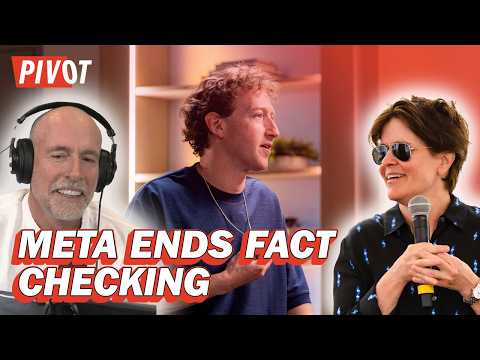
Mark Zuckerberg and Meta's Dangerous Decision to End Fact Checking | Pivot
Kara Swisher (host), Narrator, Scott Galloway (host)
In this episode of Pivot, featuring Kara Swisher and Narrator, Mark Zuckerberg and Meta's Dangerous Decision to End Fact Checking | Pivot explores meta Abandons Fact-Checking, Supercharges Political Lies And Social Harm Kara Swisher and Scott Galloway condemn Mark Zuckerberg and Meta for ending their formal fact‑checking program, loosening hate‑speech rules, and shifting toward a Community Notes–style system as the U.S. enters a volatile political period.
Meta Abandons Fact-Checking, Supercharges Political Lies And Social Harm
Kara Swisher and Scott Galloway condemn Mark Zuckerberg and Meta for ending their formal fact‑checking program, loosening hate‑speech rules, and shifting toward a Community Notes–style system as the U.S. enters a volatile political period.
They argue this move is framed as a return to ‘free expression’ but is really about cutting billions in safety and moderation costs, currying favor with Donald Trump, and shedding responsibility for the real‑world harms caused by Meta’s platforms.
Both hosts highlight how social media is eroding democratic institutions, shared narratives, and social capital, citing examples from Myanmar, India, Pizzagate, and U.S. election disinformation to illustrate the stakes.
They also warn that as traditional media weakens under legal and financial pressure, citizens will increasingly rely on unmoderated, engagement‑driven feeds for news, worsening polarization and vulnerability to conspiracy theories.
Key Takeaways
Meta’s ‘free expression’ pivot is fundamentally a cost‑cutting move.
Galloway argues that relocating moderation to Texas and ending robust fact‑checking allows Meta to quietly shed 30–60% of safety staff, potentially saving billions and boosting its market value, while dressing it up as a principled stand on speech.
Get the full analysis with uListen AI
Rebranding moderation as ‘censorship’ lets platforms dodge accountability.
The hosts note that Zuckerberg’s shift in language—from moderation to censorship—signals a deliberate effort to repudiate the idea that platforms are responsible for the ‘bad stuff’ they host, despite well‑documented links between online content and offline harm.
Get the full analysis with uListen AI
Weakening safeguards on massive platforms amplifies real‑world violence risks.
They point to Myanmar’s Rohingya persecution, lynchings in India driven by WhatsApp rumors, and Pizzagate as concrete examples of how unchecked misinformation on social media can quickly escalate into physical danger and political destabilization.
Get the full analysis with uListen AI
Social media is eroding key pillars of democracy and social trust.
Galloway outlines that democracy relies on respected institutions, shared stories, and local social capital; unmoderated, sensationalist feeds undermine all three by spreading conspiracies, delegitimizing institutions, and fracturing communities into hostile echo chambers.
Get the full analysis with uListen AI
Internal dissent at Meta suggests a deep values clash over this shift.
Swisher says many Meta employees are “sick to their stomach” over the changes and the appointment of figures like Dana White to the board, indicating that leadership’s priorities on speech, safety, and governance are at odds with parts of its own workforce.
Get the full analysis with uListen AI
The collapse of traditional media increases dependence on unvetted feeds.
As outlets like Fox, ABC, the BBC, and newspapers face legal, financial, and revenue pressures, they cut costs and staff, pushing more people toward social platforms whose algorithms favor novelty and conspiracy over accuracy and public interest.
Get the full analysis with uListen AI
Extraordinary wealth and power are being used to placate, not protect.
Galloway criticizes tech leaders for enjoying the benefits of American democracy while showing ‘no fidelity’ to its values, choosing instead to bend to a ‘kleptocrat’ and short‑term business interests rather than using their influence to bolster democratic norms.
Get the full analysis with uListen AI
Notable Quotes
“Four years ago, he called it moderation. Now they call it censorship.”
— Scott Galloway
“This guy is the most dangerous person on the planet. He has amplified and weaponized everything, and then he doesn't want to take responsibility.”
— Kara Swisher on Mark Zuckerberg
“Where are the men that recognize, ‘Okay, I've made tens of billions of dollars here… and yet I have absa‑fucking‑lutely no fidelity to those values’?”
— Scott Galloway
“Meta ending fact checks in the US… is the broader repudiation of the idea that a company is responsible for bad stuff on its platform.”
— Kara Swisher, paraphrasing Will Ramos’s Washington Post piece
“Congratulations. Your lamestream media is going extinct and you're gonna have to get all of your news from social media, which is a fucking food fight.”
— Scott Galloway
Questions Answered in This Episode
How should responsibility for preventing online harm be divided between platforms, governments, and users when traditional fact‑checking is stripped back?
Kara Swisher and Scott Galloway condemn Mark Zuckerberg and Meta for ending their formal fact‑checking program, loosening hate‑speech rules, and shifting toward a Community Notes–style system as the U. ...
Get the full analysis with uListen AI
Can a Community Notes–style system ever scale to the size and speed of Meta’s platforms without being gamed or politicized?
They argue this move is framed as a return to ‘free expression’ but is really about cutting billions in safety and moderation costs, currying favor with Donald Trump, and shedding responsibility for the real‑world harms caused by Meta’s platforms.
Get the full analysis with uListen AI
What regulatory or legal frameworks could realign Meta’s financial incentives with protecting democratic institutions and public safety?
Both hosts highlight how social media is eroding democratic institutions, shared narratives, and social capital, citing examples from Myanmar, India, Pizzagate, and U. ...
Get the full analysis with uListen AI
How can citizens and civil society compensate for the decline of traditional news outlets in an environment dominated by algorithmic feeds?
They also warn that as traditional media weakens under legal and financial pressure, citizens will increasingly rely on unmoderated, engagement‑driven feeds for news, worsening polarization and vulnerability to conspiracy theories.
Get the full analysis with uListen AI
What concrete steps could employees, investors, or board members take if they believe Meta’s speech and safety policies are endangering users and democracy?
Get the full analysis with uListen AI
Transcript Preview
Let's get to our first big story. As one headline put it this week, Mark Zuckerberg and Meta are finding new ways to kiss Trump's ass. I would move around to the front, actually, in that one. That followed, uh, Zuckerberg announcing on Tuesday that Meta is ending its fact-checking program, essentially. Meta's platforms will instead use community note systems, similar to X, that will apparently, quote, "reduce censorship." Rules on hate speech are being loosened. If you look at what they've done, it's an astonishing thing, the things they've taken out. And Meta's content moderation team will be moved from California to Texas, where there is less concern about bias, 'cause Texas people have no bias. I've never seen it ever. Texas people won't shut up about Texas to start with. Anyway, uh, Zuckerberg shared a video, explained his decision. Unfortunately, I have to listen to him, so let's listen.
The recent elections also feel like a cultural tipping point towards once again prioritizing speech. So, we're gonna get back to our roots and focus on reducing mistakes, simplifying our policies, and restoring free expression on our platforms.
I'm gonna let you stop- start, Scott, 'cause you ha- you went on Morning Joe and had quite a moment. I did the same thing over on the BBC- on the Beeb in London, but go ahead. Tell me your thoughts.
We're moving to a- uh, th- the, the keys to a thriving democracy are threefold. You have to have strong institutions that people respect, you have to have shared stories that we're the good guys and we won World War II for the right reasons and Americans' hearts are in the right place and believe in the Founding Fathers and the rights of people and, and you also have to have kind of a lot of social capital within smaller networks, whether it's your church or your neighbors, or maybe you served, you know, how you feel about people who also served in the Marines or whatever it might be. And slowly but surely, social media is eroding all of those things. And this is just another example of how those three things will continue to come down, um, and be eroded. You have somewhere between a half and two-thirds of Americans, depending upon their age, now get their news from social media.
Mm-hmm.
And today, when I was on Morning Joe, I called Trump an insurrectionist and a rapist. Mika had to stop the show and say that Trump was found liable for sexual abuse. Now, imagine in contrast what you're gonna be able to say about anything, health, elections, what you should do, uh, when a fire breaks out in the Pacific Palisades on, on Meta. I mean, we are all going into- we are all separating further and further. And to think that this doesn't have not only implications around candidates or politics, but violence. Look what happened in 2017.
Myanmar, everything.
Install uListen to search the full transcript and get AI-powered insights
Get Full TranscriptGet more from every podcast
AI summaries, searchable transcripts, and fact-checking. Free forever.
Add to Chrome