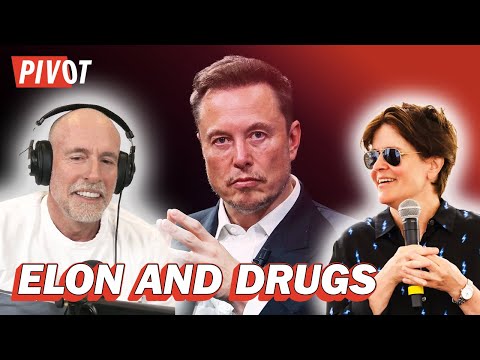
Elon Musk Drug Use Concerns Business Leaders | Pivot
Kara Swisher (host), Scott Galloway (host), Dr. Jeffrey Swisher (guest)
In this episode of Pivot, featuring Kara Swisher and Scott Galloway, Elon Musk Drug Use Concerns Business Leaders | Pivot explores elon Musk’s Ketamine Use Raises Governance, Safety, And Medical Questions Kara Swisher and Scott Galloway discuss a Wall Street Journal report alleging Elon Musk’s ongoing illegal drug use, particularly ketamine, and the resulting concerns among leaders at Tesla and SpaceX. They bring in anesthesiologist Dr. Jeffrey Swisher to explain what ketamine is medically, how it works, how it’s used therapeutically for depression, and the risks of recreational abuse. The conversation broadens into drug policy, societal hypocrisy around substances like alcohol versus ketamine, and the dangers of demonizing a useful medical drug due to high-profile abuse. They also probe the failures of corporate governance around Musk, the implications for his government contracts, and the importance of personal guardrails and interventions for powerful people struggling with addiction.
Elon Musk’s Ketamine Use Raises Governance, Safety, And Medical Questions
Kara Swisher and Scott Galloway discuss a Wall Street Journal report alleging Elon Musk’s ongoing illegal drug use, particularly ketamine, and the resulting concerns among leaders at Tesla and SpaceX. They bring in anesthesiologist Dr. Jeffrey Swisher to explain what ketamine is medically, how it works, how it’s used therapeutically for depression, and the risks of recreational abuse. The conversation broadens into drug policy, societal hypocrisy around substances like alcohol versus ketamine, and the dangers of demonizing a useful medical drug due to high-profile abuse. They also probe the failures of corporate governance around Musk, the implications for his government contracts, and the importance of personal guardrails and interventions for powerful people struggling with addiction.
Key Takeaways
Ketamine is a powerful but medically valuable dissociative anesthetic.
Dr. ...
Get the full analysis with uListen AI
Therapeutic ketamine for depression is promising but not first-line and easily abused.
Low-dose ketamine and esketamine (Spravato) show statistically significant short‑term benefits for unipolar and bipolar depression and PTSD, yet remain third‑line treatments; clinic dosing is tightly controlled, unlike unpredictable, higher recreational use that increases psychological dependency risk.
Get the full analysis with uListen AI
Recreational ketamine carries serious psychological, behavioral, and organ risks.
While not strongly physically addictive like opioids, chronic high‑dose use can lead to psychological dependence, dissociation that impairs normal functioning, and potential liver and kidney damage, especially when combined with other substances or binge patterns.
Get the full analysis with uListen AI
Demonizing ketamine because of celebrity abuse could harm legitimate medicine.
The hosts and Dr. ...
Get the full analysis with uListen AI
Corporate governance around Elon Musk appears unusually weak and deferential.
Galloway argues Musk’s boards function more as bystanders and beneficiaries than true fiduciaries, tolerating behavior—including public drug incidents and online attacks—that would be unacceptable for a conventional CEO, suggesting a governance failure rather than isolated misconduct.
Get the full analysis with uListen AI
Musk’s government contracts are unlikely to be policed by normal standards.
Despite formal security clearance rules and past objections (e. ...
Get the full analysis with uListen AI
Powerful individuals need real personal guardrails, not just admirers or beneficiaries.
Galloway emphasizes that interventions and life stability depend on people who genuinely care, not those enriched by someone’s power; he frames Musk’s reported isolation, large family, and erratic behavior as a cautionary tale about what happens when there are no trusted guardrails.
Get the full analysis with uListen AI
Notable Quotes
“The tech community likes to believe they have found a free lunch. There’s no such thing.”
— Scott Galloway
“Ketamine is not a dangerous drug in the right hands, but like any drug, it can be misused.”
— Dr. Jeffrey Swisher
“He doesn’t have any governance… they’re there to have dinner once every three months and collect a big check.”
— Scott Galloway on Elon Musk’s boards
“I would hate to see a drug like ketamine, which is so useful, being demonized… that would be the worst possible thing that could happen.”
— Dr. Jeffrey Swisher
“The most important thing you can have in your life is people who love you and serve as guardrails.”
— Scott Galloway
Questions Answered in This Episode
How should boards and investors realistically balance a visionary leader’s value against clear behavioral and substance-related risks?
Kara Swisher and Scott Galloway discuss a Wall Street Journal report alleging Elon Musk’s ongoing illegal drug use, particularly ketamine, and the resulting concerns among leaders at Tesla and SpaceX. ...
Get the full analysis with uListen AI
What regulatory or clinical frameworks could allow broader ketamine use for depression while minimizing the chances of Matthew Perry–style tragedies?
Get the full analysis with uListen AI
Where should society draw the line between acceptable, high-functioning substance use and behavior that should trigger serious professional consequences?
Get the full analysis with uListen AI
If Elon Musk publicly acknowledged a substance-use struggle, could that meaningfully shift public understanding and destigmatize treatment for addiction among high achievers?
Get the full analysis with uListen AI
How can institutions prevent the kind of governance capture seen with charismatic founders, ensuring that genuine guardrails exist even for the most successful leaders?
Get the full analysis with uListen AI
Transcript Preview
... our first big story, and we've gotta get to it, uh, is a, uh, a Wall Street Journal piece. It's a new piece that came out last night. Um, Elon Musk has used illegal drugs, worrying leaders at Tesla and SpaceX. The article cites people close to Musk who say his drug use is ongoing and includes board members, it feels like, and, uh, and one, uh, one name specifically, but it looks like they were all talking. Particularly the ketamine, and there are concerns it could cause a health crisis or damage the business. Uh, Musk has a lot of business, um, with, uh, with the government and he's already... I don't know if he was sanctioned, but he had to do drug tests after he smoked weed on Joe Rogan. This is seemingly more serious and it's interesting that, um, you know, this has been around. We've talked about it, uh, Ronan Farrow wrote about it. Like, lots of people have cited this issue, not so much in Walter Isaacson's book, uh, which it should've, uh, had more about it. Um, but i- it's, uh, it's sort of an open secret a- about this and, y- the Wall Street Journal obviously has lawyered up to, to be able to say this. Um, in a minute we're gonna bring on, uh, my brother, Jeff Swisher, to help us talk through this one. Uh, just first reactions, Scott? And then I'll bring on Jeff.
First reactions. Uh, look, uh, we talk a lot about substances. Uh, the majority of people, I believe, who use substances, manage them. And I'm not an anti-substance person, but, um, along those same lines, there's just no free lunch. And when I saw, um, when I saw Elon Musk in that interview at the Times Deal Book, I'm like, "He, he's fucked up."
Yeah.
And, and there, th- th- it all comes back to one saying. What I tell young people around their use of substances is, "There's just no free lunch." There-
Yeah.
And what I have... and I'll s- stop here, but the thing that really struck me was when I was in Aspen this summer. Um, I was alone and I was bored and a friend said, "I have a bunch of friends there," and we all went to dinner. Like, 12 of us, bunch of-
Hm.
... total players in technology and private equity. And we went to this lounge and I said, "What can I get everyone? I'm headed to the bar." And they said, and w- this guy goes, they all kind of nodded or laughed and said, "We're all on ketamine."
Yeah.
And I thought-
Yeah.
... "Oh my God. Everybody?" This is like six men-
Right.
... six women, and the tech, the tech community likes to believe-
Yeah.
... they have found a free lunch.
Mm-hmm.
And, uh, uh, uh, and we said this before.
Install uListen to search the full transcript and get AI-powered insights
Get Full TranscriptGet more from every podcast
AI summaries, searchable transcripts, and fact-checking. Free forever.
Add to Chrome