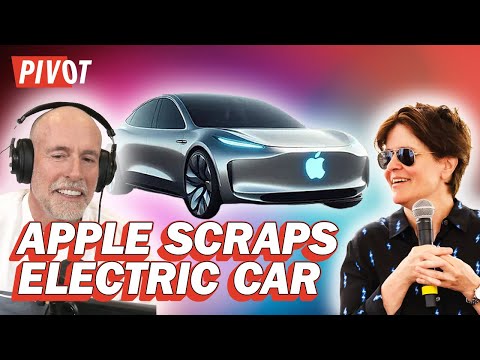
Was Apple's Car Project Doomed to Fail?
Kara Swisher (host), Scott Galloway (host)
In this episode of Pivot, featuring Kara Swisher and Scott Galloway, Was Apple's Car Project Doomed to Fail? explores apple Kills Its Electric Car, Refocuses on AI and Core Strengths Kara Swisher and Scott Galloway analyze Apple’s decision to cancel its long-running electric car initiative, Project Titan, and reassign many of its 2,000 staff to generative AI work.
Apple Kills Its Electric Car, Refocuses on AI and Core Strengths
Kara Swisher and Scott Galloway analyze Apple’s decision to cancel its long-running electric car initiative, Project Titan, and reassign many of its 2,000 staff to generative AI work.
Scott argues the move is strategically correct given slowing EV demand, brutal industry economics, and intensifying competition from Tesla and BYD, alongside the rise of AI as a higher-upside opportunity.
Kara maintains that EVs and, eventually, autonomous vehicles remain the inevitable future, but agrees the market is more crowded and slower to mature than many predicted.
They debate whether Apple should focus on vehicle software and AI integration instead of hardware, and explore the provocative idea of Apple buying Rivian to stay in the car market without building from scratch.
Key Takeaways
Exiting the Apple Car now is a rational strategic pivot.
Galloway notes that when underlying data changes—slower EV adoption, squeezed margins, and fierce subsidized competition—leaders are obligated to change course rather than persist in a ‘suicide pact’ vision.
Get the full analysis with uListen AI
The EV market is still the future, but on a slower curve.
Swisher argues EVs and eventual autonomy remain inevitable, but consumer adoption is lagging optimistic forecasts, creating a ‘valley of death’ period where investments outpace demand.
Get the full analysis with uListen AI
Auto manufacturing is structurally unattractive for a high-margin tech giant.
They highlight that cars are low-margin, capital-intensive, and heavily subsidized, with most major players needing bailouts or government loans—misaligned with Apple’s typical high-margin model.
Get the full analysis with uListen AI
Apple’s real opportunity may be in software and AI, not the car body.
Swisher suggests Apple should double down on operating systems for transportation and on embedding AI deeply across its products to keep users locked into the Apple ecosystem.
Get the full analysis with uListen AI
Generative AI now competes directly for Apple’s scarce talent and capital.
With AI emerging as a massive platform shift, Apple appears to be redeploying Project Titan engineers to AI, betting that smarter devices and assistants will deliver higher returns than an EV line.
Get the full analysis with uListen AI
Buying Rivian is an intriguing but culturally un-Apple move.
They discuss Gene Munster’s idea that Apple could acquire Rivian to stay in autos, but note Apple’s aversion to large, messy acquisitions and Rivian’s heavy losses as major obstacles.
Get the full analysis with uListen AI
Strategic advantage comes from what Apple refuses to do.
Galloway emphasizes that good strategy is as much about saying “no” as “yes,” and even Apple’s vast resources are finite, forcing hard choices about which giant markets to skip.
Get the full analysis with uListen AI
Notable Quotes
“A strategy and a vision is meant to be unifying, but not a suicide pact.”
— Scott Galloway
“When the data changes, as a good manager, you have the right and the obligation to change your mind.”
— Scott Galloway
“The key to strategy is not what you say yes to, but what you say no to.”
— Scott Galloway
“I still think it's the direction it's going, period... electric vehicles and then eventually autonomous vehicles.”
— Kara Swisher
“Apple's a tech company, and tech companies by definition need to grow.”
— Kara Swisher (referencing Gene Munster’s view)
Questions Answered in This Episode
If Apple had launched a car five years earlier, would the outcome have been different, or were the structural economics always a bad fit?
Kara Swisher and Scott Galloway analyze Apple’s decision to cancel its long-running electric car initiative, Project Titan, and reassign many of its 2,000 staff to generative AI work.
Get the full analysis with uListen AI
Can Apple build a dominant software and AI layer for cars without controlling the hardware, or does true disruption in autos require full-stack integration?
Scott argues the move is strategically correct given slowing EV demand, brutal industry economics, and intensifying competition from Tesla and BYD, alongside the rise of AI as a higher-upside opportunity.
Get the full analysis with uListen AI
How can Apple compete in generative AI while collecting far less user data than rivals like Google and Meta?
Kara maintains that EVs and, eventually, autonomous vehicles remain the inevitable future, but agrees the market is more crowded and slower to mature than many predicted.
Get the full analysis with uListen AI
Would acquiring a struggling but admired EV maker like Rivian ultimately strengthen or dilute Apple’s brand and business model?
They debate whether Apple should focus on vehicle software and AI integration instead of hardware, and explore the provocative idea of Apple buying Rivian to stay in the car market without building from scratch.
Get the full analysis with uListen AI
Over the next decade, will Apple’s biggest growth come from new hardware categories (like spatial computing) or from making existing devices dramatically smarter with AI?
Get the full analysis with uListen AI
Transcript Preview
Apple is scraping its multi-billion dollar plan to release an electric vehicle, a not-so-secret project that was in the works for almost a decade. The company told employees in an internal meeting this week that the plan, known as Project Titan, has been canceled, surprising the 2,000-person team who'd been working on it, according to reports. Many of those employees will now be reassigned to Apple's generative AI projects, um, which'll be interesting to see, 'cause they have a lot less data than other people, 'cause they don't collect it. Um, you were excited about the idea of an Apple Car, Scott. Um, I'm, uh, I'm surprised they canceled it. I... Maybe they're working on software? Apple's car was initially envisioned as an EV to compete against Tesla, and later, a self-driving car rival, Waymo, which is, comes from, uh, Google, the Google folks. Elon Musk rejected, uh, reacted to Apple's news on X, posting a saluting emoji and a cigarette. I don't... Uh, whatever. Fuck you. Um, what do you think, first of all? Do you consider it a failure? Are they smart to get out of the EV game, um, even though they never said they were doing it?
So, look, a, a, a strategy and a vision is meant to be unifying, but not a suicide pact, and you were right. Two years ago, I predicted they were gonna build the most valuable waiting list in history, that this made a ton of sense, and in order to move the needle on what was then a $1.6 trillion market cap company, they would need to go after big game, and the automobile industry was big. I felt that Tesla had unearned market cap at $700 billion, or whatever it was then, and that Apple was just salivating to go after some of that. But here's the thing. When the data changes, as a good manager, you have the right and the obligation to change your mind, and a step back from the wrong direction is a step in the right direction. And you know what, Kara? This was absolutely the right decision, because in the last 12 months, the atmospherics-
Yeah.
... have changed dramatically, and let's just talk about some of those. The EV market is plateauing, if not slowing. All the projections are way overestimated consumers' pivot to EVs. Toyota's looking like a genius right now, 'cause they did not go all in on EVs-
They went hybrid-
They-
... which are popular.
That's right, they went hybrids. Tesla is running up against margin compression, and then you have, um, you have the company which is probably, um, probably the most important company that no one talks about. BYD is now outselling-
That's right.
... Tesla. So Apple-
J-... Warren Buffett has a big stake in that.
Is that right?
Yeah.
I didn't know that.
Yeah.
But let's look at the market versus where it was, say, just even two years ago, much less when this project was probably approved. You have a low margin, capital-intensive product that is subsidized. Basically, every car company in the world has either gotten federal loans, Tesla, or has been bailed out, GM and Chrysler. It's a massively subsidized industry, which makes it incredibly economically inefficient. They have this enormous competitor with a $600 billion market capitalization that is doing really well, called Tesla. They have another gigantic low-cost competitor that's actually outselling Tesla right now, and the consumer seems to be pulling back from EVs, and EV... The prices of used EVs are plummeting. And they look at this, and i- in addition, what has popped up? Generative AI. And so, uh, the, the key to strategy is... Strategy is decisions that attempt to cut a swath between market dynamics and your internal competencies, in order to add shareholder value. And the key to strategy is not what you say yes to, but what you say no to. And even Apple has finite resources, both human and capital, and my guess is they've said, "Based on this market, which quite frankly looks increasingly difficult, we would rather take our finite resources-"
Install uListen to search the full transcript and get AI-powered insights
Get Full TranscriptGet more from every podcast
AI summaries, searchable transcripts, and fact-checking. Free forever.
Add to Chrome