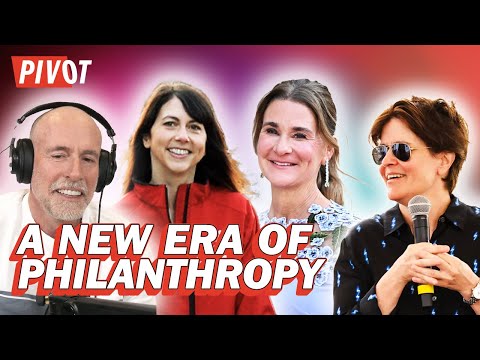
Melinda French Gates, MacKenzie Scott, and the New Era of Giving | Pivot
Kara Swisher (host), Scott Galloway (host), Narrator
In this episode of Pivot, featuring Kara Swisher and Scott Galloway, Melinda French Gates, MacKenzie Scott, and the New Era of Giving | Pivot explores women Billionaires Redefine Philanthropy While Men Chase Influence And Ego The conversation examines Melinda French Gates’ new $1 billion philanthropic initiative focused on women, families, and reproductive rights, including large, trust-based grants to individuals like Jacinda Ardern, Ava DuVernay, and Richard Reeves.
Women Billionaires Redefine Philanthropy While Men Chase Influence And Ego
The conversation examines Melinda French Gates’ new $1 billion philanthropic initiative focused on women, families, and reproductive rights, including large, trust-based grants to individuals like Jacinda Ardern, Ava DuVernay, and Richard Reeves.
Kara Swisher and Scott Galloway contrast this approach with Mackenzie Scott’s low-profile, fast, no-strings giving, arguing that women philanthropists are more willing to give big, ask less in return, and move money quickly to where it’s needed.
They sharply juxtapose this with male tech and finance figures who spend relatively small sums to buy political influence and status, calling that behavior vanity and PR rather than true philanthropy.
Galloway also critiques the Giving Pledge as largely symbolic, arguing that real virtue lies in giving money away while alive, once one’s financial “number” is met, rather than hoarding extreme wealth and promising posthumous generosity.
Key Takeaways
Trust-based, large-scale giving can accelerate real-world impact.
By giving sizable grants (e. ...
Get the full analysis with uListen AI
Female philanthropists in tech wealth circles often seek less recognition.
The hosts note that women like Mackenzie Scott tend to avoid ribbon-cutting, branding, and control, preferring to quietly deploy large sums without demanding influence, naming rights, or public credit.
Get the full analysis with uListen AI
Political “donations” by some wealthy men function more as vanity projects than philanthropy.
Comparing Silicon Valley fundraisers for Donald Trump to the work of Gates and Scott, they argue that small relative sums are deployed to buy access, status, and self-aggrandizement rather than to tangibly improve society.
Get the full analysis with uListen AI
Posthumous giving and the Giving Pledge are criticized as insufficient.
Galloway contends that pledging to give away wealth after death has little real cost to the donor’s life, can be intertwined with tax optimization, and allows virtue signaling without the discipline of giving in the present.
Get the full analysis with uListen AI
Once you’ve “hit your number,” hoarding more money adds little happiness.
Drawing on Kahneman’s work, Galloway argues that beyond a high but finite threshold (e. ...
Get the full analysis with uListen AI
Thoughtful inheritance aims to empower children without enabling idleness.
They advocate leaving enough for education, housing, and opportunities, often staggered over time, but not so much that heirs never need to work or build their own purpose.
Get the full analysis with uListen AI
Spending money—on others and on experiences—can be socially beneficial.
Beyond formal philanthropy, they endorse high spending that recirculates money into the economy and invests in relationships and experiences, as opposed to static accumulation of ever-larger fortunes.
Get the full analysis with uListen AI
Notable Quotes
“One is vanity, one is philanthropy.”
— Scott Galloway
“I've got a shit ton of money, it makes no sense to hoard wealth and I'm gonna start pushing it out and I'm gonna ask for almost nothing in return.”
— Scott Galloway (describing women philanthropists)
“These men are sad and dickless and these women have balls as big as all ever.”
— Kara Swisher
“There needs to be a movement in America that once you hit your number, you just start giving it away now.”
— Scott Galloway
“The difference between 100 million and a billion, there's no marginal increase in the quality of your life.”
— Scott Galloway
Questions Answered in This Episode
How could Melinda French Gates’ and Mackenzie Scott’s trust-based giving models be replicated by smaller foundations or individual donors?
The conversation examines Melinda French Gates’ new $1 billion philanthropic initiative focused on women, families, and reproductive rights, including large, trust-based grants to individuals like Jacinda Ardern, Ava DuVernay, and Richard Reeves.
Get the full analysis with uListen AI
Where is the line between strategic philanthropy and undue influence, and how do we distinguish it from the kind of political vanity spending the hosts criticize?
Kara Swisher and Scott Galloway contrast this approach with Mackenzie Scott’s low-profile, fast, no-strings giving, arguing that women philanthropists are more willing to give big, ask less in return, and move money quickly to where it’s needed.
Get the full analysis with uListen AI
Is the Giving Pledge fundamentally flawed, or can it be reformed to encourage more giving during donors’ lifetimes rather than after death?
They sharply juxtapose this with male tech and finance figures who spend relatively small sums to buy political influence and status, calling that behavior vanity and PR rather than true philanthropy.
Get the full analysis with uListen AI
What concrete policies or cultural norms would reduce extreme wealth hoarding and normalize ‘hitting your number’ and then giving the rest away?
Galloway also critiques the Giving Pledge as largely symbolic, arguing that real virtue lies in giving money away while alive, once one’s financial “number” is met, rather than hoarding extreme wealth and promising posthumous generosity.
Get the full analysis with uListen AI
How should ultra-wealthy parents balance the desire to provide security for their children with the risk of undermining their motivation and sense of purpose?
Get the full analysis with uListen AI
Transcript Preview
... Melinda French Gates. She announced her next chapter in philanthropy this week as she prepares to leave the Bill and Melinda Gates Foundation. She plans to donate $1 billion globally over the next two years to help support women and families as well as reproductive rights in the US. A portion of the money will also be distributed in the form of, uh, $20 million grants to individuals like former New Zealand Prime Minister, uh, uh, Jacinda Ardern and Director Ava DuVernay, uh, to use at their discretion. I think Melinda was a, a, a funder of her recent film, for example, and, uh, there's a whole bunch of people, The 19th, she's given all this, these grants to really terrific groups and it's a r- it's a fascinating move between her and Mackenzie Scott. Uh, we have entered a very interesting era of philanthropy. Mackenzie Scott, as you know, a former, uh, was, used to be married to Jeff Bezos, donated $640 million over, to over 300 nonprofits a few months ago. She donated $2.2 billion last year. She is burning up the, getting rid of her money off her plate as if it's like lava. Um, y- this is really interesting, um, th- these two women, and then obviously, uh, um, Laurene Powell Jobs is making media investments, she has a, her own Emerson Collective that does both philanthropy and investments. Um, what do you, what do you, what do you think? What do you think about this?
I think it's wonderful. Um, I think... I'm a sexist, I think there are certain behaviors that are more prone to people born as women and born as men, and one of the things I notice about, uh, philanthropy from women is they're not as big on the ribbon-cutting and believing that they should have input and influence into education 'cause they give, you know, $50 million to the Newark School District, not recognizing they don't know a fucking thing about public school education. I find that generally speaking when women give money away, it's in return o-... They ask for less in return and they're more promiscuous. They're like, "I've got a shit ton of money, it makes no sense to hoard wealth and I'm gonna start pushing it out and I'm gonna ask for almost nothing in return." And I think Mackenzie Scott is an outstanding American. I mean, look at... I- I- I'm here for Bill Gates'... uh, I'm sorry. I'm here for Jeff Bezos' midlife crisis. I actually enjoy watching it, I can relate to it, but while he's building super yachts for $300 million, you know, Mackenzie Scott is sending, sending $15 million to the JED Foundation to work on teen suicide. And by the way, she doesn't demand anything, she doesn't want to show up, she doesn't want her name on anything, she just wants to get, start helping people. And this feels, this feels like that. And then in another, what I think is just absolutely wonderful here and I think I'm going on Morning Joe on tomorrow to tal-
Install uListen to search the full transcript and get AI-powered insights
Get Full TranscriptGet more from every podcast
AI summaries, searchable transcripts, and fact-checking. Free forever.
Add to Chrome