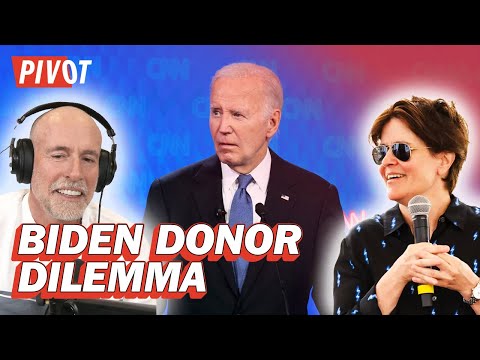
Will Donors Stick with Joe Biden? | Pivot
Kara Swisher (host), Brian Derrick (guest), Scott Galloway (host)
In this episode of Pivot, featuring Kara Swisher and Brian Derrick, Will Donors Stick with Joe Biden? | Pivot explores donor Backlash Reshapes Democratic Giving Amid Biden 2024 Uncertainty Political strategist Brian Derrick discusses how Democratic donors are reacting to President Biden’s shaky reelection prospects and where money is actually flowing in 2024.
Donor Backlash Reshapes Democratic Giving Amid Biden 2024 Uncertainty
Political strategist Brian Derrick discusses how Democratic donors are reacting to President Biden’s shaky reelection prospects and where money is actually flowing in 2024.
He explains Oath, his data-driven platform that redirects “rage donations” away from unwinnable or low-impact races toward high-leverage contests and down-ballot targets.
Mid-level and some major Democratic donors are increasingly withholding funds from Biden and shifting to Senate, House, state legislative, and state supreme court races, while Trump’s big-donor fundraising is surging.
Derrick warns that a Biden landslide loss could devastate Democrats up and down the ballot and argues that chaos within the party is already here; the real question is whether to emerge with Biden or a new nominee.
Key Takeaways
Channel donations strategically rather than reactively.
Instead of “rage donating” against high-profile villains, donors can use tools like Oath to identify competitive, high-stakes races where their money is likelier to change outcomes, especially in close state and local contests.
Get the full analysis with uListen AI
Mid-level and major Democratic donors are pressuring Biden by redirecting funds.
Many in the mid-tier donor class are halting direct contributions to Biden and moving money to Senate, House, and alternative efforts, using financial leverage to signal that they want a more viable nominee.
Get the full analysis with uListen AI
Down-ballot races may determine policy outcomes even if the top of the ticket falters.
State legislatures and state supreme courts in places like Michigan, North Carolina, and Arizona shape redistricting, abortion access, voting rights, and gun laws—so protecting these seats can mitigate a poor presidential result.
Get the full analysis with uListen AI
Biden’s campaign is financially buffered in the short term, but not invulnerable.
He has already raised historic sums and won’t face an immediate cash crunch before the convention, but whether donor taps fully reopen afterward depends on if he emerges as the nominee and whether donors feel they have alternatives.
Get the full analysis with uListen AI
Trump is capitalizing on billionaire backing and policy concessions.
Trump’s fundraising is stronger than in 2020, driven by huge checks from billionaires and industry interests (e. ...
Get the full analysis with uListen AI
RFK Jr.’s campaign is mostly a creation of a few wealthy backers.
There is little grassroots donor energy behind RFK Jr. ...
Get the full analysis with uListen AI
The Democratic “chaos” is already priced in; the choice is outcome, not calm.
After Biden’s debate performance, uncertainty is unavoidable through the convention, so the real decision for Democrats is whether to endure this turbulence to emerge with a new candidate or to double down on Biden and hope to survive November.
Get the full analysis with uListen AI
Notable Quotes
“People see something happen on the news and immediately run and donate to try and get that person out of office, when really those funds could be much better used somewhere else.”
— Brian Derrick
“I had my staff... prepare a memo that said the worst-case scenario. And so if Biden loses in a landslide... it's devastating to look at.”
— Brian Derrick
“You can’t make it work entirely without both. You need both [big and small donors] in order to put together the scale of campaign that is required to win in 2024.”
— Brian Derrick
“The damage has been done in terms of chaos, and unfortunately... it was done by President Biden. He entered this chaos into the conversation with his debate performance.”
— Brian Derrick
“He has spent the last three months in back rooms with billionaires, and they have really stepped up.”
— Brian Derrick on Donald Trump
Questions Answered in This Episode
How should an individual donor decide between giving to Biden, another national figure, or a down-ballot race to maximize impact?
Political strategist Brian Derrick discusses how Democratic donors are reacting to President Biden’s shaky reelection prospects and where money is actually flowing in 2024.
Get the full analysis with uListen AI
If Biden remains the nominee, what specific down-ballot strategies could realistically prevent a 2010-style Democratic wipeout?
He explains Oath, his data-driven platform that redirects “rage donations” away from unwinnable or low-impact races toward high-leverage contests and down-ballot targets.
Get the full analysis with uListen AI
At what point, if any, does withholding money from Biden become more harmful than helpful to broader Democratic goals?
Mid-level and some major Democratic donors are increasingly withholding funds from Biden and shifting to Senate, House, state legislative, and state supreme court races, while Trump’s big-donor fundraising is surging.
Get the full analysis with uListen AI
How might the growing reliance on billionaire donors for both parties affect policy choices and democratic accountability after the election?
Derrick warns that a Biden landslide loss could devastate Democrats up and down the ballot and argues that chaos within the party is already here; the real question is whether to emerge with Biden or a new nominee.
Get the full analysis with uListen AI
What safeguards, if any, could be implemented to prevent a small number of wealthy donors from artificially propping up spoiler or third-party candidates like RFK Jr.?
Get the full analysis with uListen AI
Transcript Preview
Brian Derrick is a political strategist and the CEO and founder of Oath, a fundraising platform that uses data to rate and identify high-stake elections. Um, the aim is to direct donors to campaigns where their money will have the maximum impact. Brian, welcome.
Thank you for having me on.
Okay. Uh, so let's talk about Oath. T- talk about how it works in terms of taking donations and directing the money, 'cause as Scott just said a second ago before you came on, money is where it's at. And he calls himself a porpoise, he will explain it to you, um, of a donation. But you said the problem Oath is trying to solve is a tendency for donors to rage donate into the abyss.
There are a lot of villains in the political ecosystem that get people very angry and that generate this emotional response, whether it's Marjorie Taylor Greene or Lauren Boebert or somebody else. And in the last eight years, that has really turbocharged this grassroots donor environment where people see something happen on the news or hear about it on a podcast, on Twitter, and then immediately run and donate to try and get that person out of office, when really those funds could be much better used somewhere else, maybe just to keep that person out of power. Um, and so what we set up with Oath is a free platform where people can go see what their donations are actually going to accomplish.
Mm-hmm.
Um, we, we do objective analysis to say where are dollars needed the most to advance the thing that you care about right now, whether that's repro rights or protecting democracy-
Mm-hmm.
... and how can you direct it as strategically as possible, um, without getting sort of the blowback of 1,000 text messages and phone calls asking for more money?
All right. Scott?
So before you came on, I trifurcated donors into three buckets, and my sense is the thing that gets him out probably the most quickly, let's assume that he's totally defiant and doesn't... sees Nancy, Speaker Pelosi at his door and just says, "Sorry, Nancy, I'm not interested in talking to anybody," and says, you know, it's Obama on line one and he says, "I'm not interested." He just goes totally defiant. If the money tap gets shut off, it gets very hard for him to stay in the race. And loosely speaking, three buckets. And by the way, tell me if these are the wrong buckets. Big donors, medium-sized, small donor. My sense are the big donors is they're just taking a wait-and-see attitude. They're not gonna throw millions of dollars into an abyss and not understand if and who it's going to. My sense are the medium-sized bo- donors, and this is anecdotal evidence and I'm one of them, is that we are in open revolt. We are not only signing letters and have stopped giving money to the Biden campaign, but are starting to give money and are ready and prepping to give money to other candidates. And then the small do- money donors are just getting inundated with desperate emails from the Biden campaign as they attempt to show some signs of life. Tell me w- where I got that wrong and, and what it means in terms of is the tap going to get... Has it been shut off?
Install uListen to search the full transcript and get AI-powered insights
Get Full TranscriptGet more from every podcast
AI summaries, searchable transcripts, and fact-checking. Free forever.
Add to Chrome