Nancy Guthrie Disappearance Raises New Surveillance Questions | Pivot
Kara Swisher (host), Scott Galloway (host)
In this episode of Pivot, featuring Kara Swisher and Scott Galloway, Nancy Guthrie Disappearance Raises New Surveillance Questions | Pivot explores surveillance, social media addiction, AI turmoil, and political accountability collide The episode moves from consumer-style economic protest (unsubscribing) to high-stakes governance failures, especially around DOJ handling of the Epstein files and Pam Bondi’s combative congressional testimony.
Surveillance, social media addiction, AI turmoil, and political accountability collide
The episode moves from consumer-style economic protest (unsubscribing) to high-stakes governance failures, especially around DOJ handling of the Epstein files and Pam Bondi’s combative congressional testimony.
They examine tariffs’ real incidence (arguing U.S. consumers pay most of the cost) and signs of shifting Republican incentives as political control tightens.
A centerpiece is the first major “social media addiction by design” trial against Meta and YouTube, framing platforms as dopamine-optimizing systems with measurable mental-health correlates for teens.
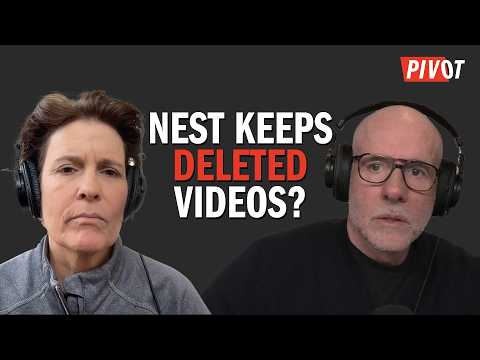
The show then connects a Nancy Guthrie abduction update to broader surveillance concerns—especially discrepancies between what devices claim about deletion and what’s recoverable—before closing with an AI industry roundup, Jimmy Lai’s sentencing, a DOJ antitrust leadership exit, and predictions about OpenAI and Kalshi.
Key Takeaways
Recurring subscriptions are a potent pressure point.
They argue that cancellations can quickly translate into meaningful market-cap impact because recurring-revenue models are sensitive to small changes in growth and churn; celebrities amplifying unsubscribes can scale the effect.
Get the full analysis with uListen AI
The Epstein-file controversy is as much about institutional legitimacy as scandal.
Their focus is on DOJ’s perceived failure to engage survivors, inconsistent redactions, and performative combativeness in oversight hearings—fueling a broader collapse in trust.
Get the full analysis with uListen AI
Tariffs function like a consumer tax more than a foreign penalty.
They cite analysis claiming ~94% of tariff costs are borne by U. ...
Get the full analysis with uListen AI
The youth social-media case may become “Big Tobacco” for platform design.
They frame Instagram/YouTube as engineered for compulsion (variable rewards, infinite feeds), and predict remedies similar to tobacco: age-gating, warnings, liability, and stronger enforcement norms.
Get the full analysis with uListen AI
“Deletion” promises in consumer surveillance products need plain-English truth-in-advertising standards.
The Nest recovery suggests video may persist in cloud workflows even without a subscription, creating a mismatch between user expectations and actual retention/recoverability.
Get the full analysis with uListen AI
Surveillance can reduce violent crime—but only with strict due process boundaries.
They agree public-space cameras can aid serious investigations, while emphasizing that access must be constrained (e. ...
Get the full analysis with uListen AI
AI’s near-term social risk may be psychological dependency more than job apocalypse.
They highlight reported numbers of users prioritizing chatbots over real relationships and possible psychosis/mania signals, and criticize vague “we’re in peril” warnings without specific, evidence-backed mechanisms.
Get the full analysis with uListen AI
Authoritarian crackdowns on journalists signal economic and innovation decline.
Jimmy Lai’s sentence is framed as a ‘canary in the coal mine’: jailing independent press chills talent, investment, and research, making societies poorer and angrier over time.
Get the full analysis with uListen AI
Antitrust leadership exits suggest rising politicization pressure.
Gail Slater’s reported clashes and resignation are treated as an alarm that enforcement priorities may be bent toward political outcomes rather than consistent legal standards.
Get the full analysis with uListen AI
Capital-market dynamics could block OpenAI’s path to an IPO.
Galloway argues late-stage valuation preferences create a veto problem: if OpenAI can’t plausibly IPO above the last private round, investors may resist liquidity events, forcing a strategic downshift in ambition.
Get the full analysis with uListen AI
Notable Quotes
“Any individual who unsubscribes from OpenAI right now is taking ten thousand dollars out of their market valuation.”
— Scott Galloway
“She’s a fucking attorney general. She clearly knows nothing about economics.”
— Scott Galloway
“The Department of Justice isn’t supposed to ruin people’s careers. It’s supposed to… put pedophiles in prison.”
— Scott Galloway
“They’re keeping your video… which everyone thought they were doing, and they said they weren’t.”
— Kara Swisher
“If they say permanently deleted, it needs to be deleted.”
— Kara Swisher
Questions Answered in This Episode
On the “unsubscribe protest”: which specific companies/products do you think are most vulnerable to churn pressure, and what metrics would signal it’s working (churn, CAC, ARPU, growth guidance)?
The episode moves from consumer-style economic protest (unsubscribing) to high-stakes governance failures, especially around DOJ handling of the Epstein files and Pam Bondi’s combative congressional testimony.
Get the full analysis with uListen AI
In the Bondi/Epstein segment, what concrete reforms would rebuild trust—mandatory survivor consultation, independent special counsel, standardized redaction rules, or something else?
They examine tariffs’ real incidence (arguing U. ...
Get the full analysis with uListen AI
Your tariff claim was that ~94% of costs fall on U.S. consumers—what data sources or studies support that number, and how does it vary by category (autos, food, industrial inputs)?
A centerpiece is the first major “social media addiction by design” trial against Meta and YouTube, framing platforms as dopamine-optimizing systems with measurable mental-health correlates for teens.
Get the full analysis with uListen AI
In the Meta/YouTube trial, what platform features are most “casino-like” in a legally provable way (infinite scroll, autoplay, streaks, notifications), and what internal documents would matter most to a jury?
The show then connects a Nancy Guthrie abduction update to broader surveillance concerns—especially discrepancies between what devices claim about deletion and what’s recoverable—before closing with an AI industry roundup, Jimmy Lai’s sentencing, a DOJ antitrust leadership exit, and predictions about OpenAI and Kalshi.
Get the full analysis with uListen AI
What would a workable, privacy-preserving age-gating regime look like (device-level attestations, third-party verification, digital IDs), and who should bear the compliance burden?
Get the full analysis with uListen AI
Transcript Preview
I'm glad they got these pictures of this guy. At the same time, this is an edge case. They're, they're keeping your video. That, which I- which everyone thought they were doing, and they said they weren't. [upbeat music] Hi, everyone. This is Pivot from New York Magazine and the Vox Media Podcast Network. I'm Kara Swisher.
And I'm Scott Galloway.
Scott, we just did a great On with Kara Swisher about resist and unsubscribe, but I'd like to-
You have another podcast. I found that out.
I do. You were quite substantive. Where are we right now? Give us a quick update.
Uh, it lulled Tuesday and Wednesday. It appears to have come back today because Chelsea Handler, who reached out to me, posted something of all the things she was unsubscribing to, and just to give you an example of how much impact one person can have, uh, I went on AI, I went onto my site analytics. I think she just, uh... one video she did on Instagram, that one post, is gonna inspire six to seven thousand unique site visits, conversion of five percent. That's three hundred people unsubscribing, average of two platforms, six hundred unsubscribes, average two hundred. That's twelve thousand dollars times... Excuse me, a hundred and twenty thousand dollars times ten, so one point two million dollars in market cap getting taken out of these companies because of one Insta post. So-
Right, exactly. And, you know, interest- I'm going to see her, uh, tomorrow night, I think? Um, tomorrow night. She's here in DC. We should get them all to do things like that. Let's, let's le- reach into the celebs we know and get them to do this.
There we go.
I'm gonna bug them all, okay?
I like it. Thank you.
Yeah-
Great, great
... 'cause if, if they do that and put even just one thing up, it matters, and it's an easy thing for a lot of them, and they kind of like it.
Well, what people don't realize about, about economic protests, the most famous one is the Montgomery Bus Strike.
Yeah.
It wasn't the one cinematic moment, it was a-
Yeah
... it was, um, a, an organization of thousands of carpools over the course-
Yep
... of a year.
Yeah.
So-
Yeah
... it takes, it takes a while, but-
Yeah
... any individual who subscri- unsubscribes from Open AI, A- OpenAI right now is taking ten thousand dollars out of their market valuation.
Which is great, and that adds up.
And there's a substitute, the free-
Yeah
... the free ChatGPT.
And also, all kinds of other free services, Gemini, all the others. You don't have to pay for it necessarily. And by the way, you can use things for free. You're taking stuff from them, right, without paying them. Like, paying is the issue, is what you pay for, so just keep that in mind. Everyone's like: "Oh, now I can't use Google." I'm like: "No, it's free."
Install uListen to search the full transcript and get AI-powered insights
Get Full TranscriptGet more from every podcast
AI summaries, searchable transcripts, and fact-checking. Free forever.
Add to Chrome