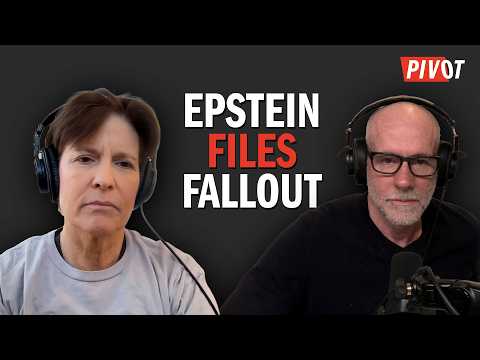
Epstein Files: How New Documents Expose a Wider Network | Pivot
Scott Galloway (host), Kara Swisher (host)
In this episode of Pivot, featuring Scott Galloway and Kara Swisher, Epstein Files: How New Documents Expose a Wider Network | Pivot explores epstein files, Fed shakeup, Musk mergers, AI race, Trump corruption The episode opens with “Resist and Unsubscribe February,” a consumer-pressure campaign encouraging people to cancel subscriptions and switch providers to reduce Big Tech and corporate influence with minimal personal sacrifice.
Epstein files, Fed shakeup, Musk mergers, AI race, Trump corruption
The episode opens with “Resist and Unsubscribe February,” a consumer-pressure campaign encouraging people to cancel subscriptions and switch providers to reduce Big Tech and corporate influence with minimal personal sacrifice.
They then unpack the DOJ’s large Epstein-related document dump, arguing it’s incomplete and messy while highlighting how the files depict a broad, cross-industry social network; they stress the need to distinguish criminal conduct from bad judgment and incidental association.
Next, they assess Trump’s pick for Fed chair (Kevin Warsh), viewing him as a relatively stabilizing, hawkish choice compared with worse alternatives, while noting political pressure risks and reputational crosscurrents.
The back half covers Musk’s reported SpaceX–xAI tie-up as a valuation/optics strategy, OpenAI’s fragile path to a huge IPO amid platform and open-model competition, and claims of escalating Trump-family monetization of the presidency; wins/fails include ICE detention conditions, Ukraine-war narratives, and a pop-culture detour into “Landman.”
Key Takeaways
Target subscription revenue to maximize political/economic pressure.
Galloway argues canceling Big Tech subscriptions can create outsized impact because these firms trade on high revenue multiples; small consumer actions can aggregate into meaningful market signals with relatively low sacrifice.
Get the full analysis with uListen AI
Audit your recurring payments—platforms profit from inertia.
They describe discovering duplicate subscriptions (e. ...
Get the full analysis with uListen AI
Epstein accountability requires clear categories, not an “amorphous blob.”
They emphasize separating alleged criminal abuse (which should trigger prosecution) from ethically poor association and from mere presence in documents (e. ...
Get the full analysis with uListen AI
Elite impunity is a core theme—power can breed rulelessness.
Galloway suggests the most disturbing element is not only sexual predation but a mindset among the powerful that laws and norms don’t apply to them—enabled by status, networks, and gatekeepers.
Get the full analysis with uListen AI
Reputation management strategies matter: apology vs denial vs counterattack.
They contrast Katie Couric’s public contrition with figures they say are spinning or rewriting history (e. ...
Get the full analysis with uListen AI
Warsh is seen as a market-calming pick—because he’s hawkish and experienced.
They interpret the market’s pullback in gold/silver as approval, and argue Fed independence plus long terms can buffer political pressure—though Kara flags risks of intimidation campaigns like those aimed at Powell.
Get the full analysis with uListen AI
Musk’s mergers can ‘launder’ weaker assets through SpaceX’s strength.
They frame the SpaceX–xAI combination (and potential Tesla/Twitter inclusion) as a narrative-and-valuation move: bundling “radioactive” businesses with SpaceX to create a must-own megastory for investors.
Get the full analysis with uListen AI
OpenAI’s IPO ambition is vulnerable to platform incumbents and free models.
They argue Google (distribution) and Microsoft (enterprise relationships) attack from above, while Chinese open-weight/free models attack from below—raising the risk that IPO disclosures reveal eroding leadership.
Get the full analysis with uListen AI
Presidential monetization and crypto ties are portrayed as systemic corruption risks.
They claim Trump-linked crypto/foreign deals normalize pay-to-play and degrade rule-of-law confidence, potentially chilling investment and increasing future abuses by signaling that large-scale misconduct faces little consequence.
Get the full analysis with uListen AI
Notable Quotes
““Inflict the maximum damage with a minimum amount of sacrifice.””
— Scott Galloway
““You have to… discern between… criminal acts, poor judgment, and people who are just unlucky.””
— Scott Galloway
““Everyone knew what this guy was back then… and they went anyway.””
— Kara Swisher
““This is Musk basically taking his radioactive meat… and wrapping it in… SpaceX.””
— Scott Galloway
““The rich are protected by the law, but not bound by it… all the rest of us are bound by the law, but not protected by it.””
— Scott Galloway
Questions Answered in This Episode
On “Resist and Unsubscribe February”: Which specific subscription categories (ride-share, cloud, streaming, telecom) do you believe create the largest measurable pressure fastest—and how would you measure success beyond anecdotes/screenshots?
The episode opens with “Resist and Unsubscribe February,” a consumer-pressure campaign encouraging people to cancel subscriptions and switch providers to reduce Big Tech and corporate influence with minimal personal sacrifice.
Get the full analysis with uListen AI
You describe Uber’s long-run price increases as ‘predatory pricing’ followed by consolidation. What policy or market interventions (if any) would actually prevent that lifecycle?
They then unpack the DOJ’s large Epstein-related document dump, arguing it’s incomplete and messy while highlighting how the files depict a broad, cross-industry social network; they stress the need to distinguish criminal conduct from bad judgment and incidental association.
Get the full analysis with uListen AI
On the Epstein files: What would a rigorous, fair “tiering” framework look like (criminal evidence threshold, ethics violations, incidental mentions), and who should administer it—DOJ, special counsel, independent commission?
Next, they assess Trump’s pick for Fed chair (Kevin Warsh), viewing him as a relatively stabilizing, hawkish choice compared with worse alternatives, while noting political pressure risks and reputational crosscurrents.
Get the full analysis with uListen AI
Kara calls out ‘enablers’ like social connectors and event organizers. What accountability should attach to facilitators who didn’t commit assaults but helped build access and legitimacy?
The back half covers Musk’s reported SpaceX–xAI tie-up as a valuation/optics strategy, OpenAI’s fragile path to a huge IPO amid platform and open-model competition, and claims of escalating Trump-family monetization of the presidency; wins/fails include ICE detention conditions, Ukraine-war narratives, and a pop-culture detour into “Landman.”
Get the full analysis with uListen AI
Warsh is labeled a hawk. Given Trump’s public pressure tactics (e.g., jokes about suing), what realistic mechanisms can protect Fed independence if intimidation escalates?
Get the full analysis with uListen AI
Transcript Preview
There needs to be more prison and more judgment around who was in the wrong place at the wrong time.
Yes, I agree, but there's a lot of people who knew exactly what they were doing. [upbeat music] Hi, everyone, this is Pivot from New York Magazine and the Vox Media Podcast Network. I'm Kara Swisher.
And I'm Scott Galloway.
Resist and Unsubscribe February has begun. How's it going? You, you've been putting up a lot-- You've been really [chuckles] getting rid of shit. I've been getting rid of a lot, but not like you.
Yeah.
I still have Uber. I was just going to pause it and use Lyft instead.
Yeah, it sucks when you've got to walk the walk, um.
I know, I know.
So, I mean, I'm inside-- You'd be a better judge of how it's going than me. I'm, I've literally, I've gotten hundreds, and I'm about to cross a thousand emails of people with screenshots of them unsubscribing. Obviously, you need hundreds of thousands, maybe millions. I'm going on CNN, MSNBC, PBS. I'm doing all-- I'm doing the rounds there. I've heard from about-
I think it's taken off. I have to tell you, I'm hearing it from lots of people.
Oh, thanks. I think-- Well, I hope you're right. You're probably being generous because you like me.
No.
But I've heard from about a third of the companies, either their CEOs, and they've been very polite, but they're like: "You realize that I supported this, and I'm against ICE?" And I'm like: "Yeah, to me, you are, but I haven't heard you say dick publicly."
Right. Not dick.
Um, and what's interesting is through the process, for example, I unsubscribed [chuckles] from Uber-
Mm-hmm.
Or I canceled my Uber account.
That was a big one. I thought that was a big deal.
Oh, my God! Before you go, it tells you, all right, I've ordered thirty-seven times from Uber Eats. How many Ubers have I taken in the last ten years? Guess.
I don't know. Thousands.
Thirty-seven hundred and forty-seven.
Yeah, yeah.
And I did some, I did some math here. When I start-
Everybody thought you had a private driver. I'm like: "He doesn't have a fucking private driver." [chuckles]
Yeah, it's called Uber.
He uses Uber Black.
It's called Dara Khosrowshahi.
Yeah, that's right.
Anyways, I absolutely love Uber Lux.
Mm-hmm.
And this is a story of privilege. Let me do my land acknowledgments.
Right.
Most people don't have the money I have. Anyways, but I've taken three hundred and fifty Ubers a year for the last ten years on average. The average price of Uber Lux has gone from forty to sixty dollars to eighty to one twenty, and this is what these companies do. They do predatory pricing, they price it below market, incredible value proposition. They wait till they consolidate the market, then they start raising prices, which Uber has done seven to ten percent a year for the last decade. So this year, in twenty twenty-five, do you know how much I'm spending a year on Uber?
Install uListen to search the full transcript and get AI-powered insights
Get Full TranscriptGet more from every podcast
AI summaries, searchable transcripts, and fact-checking. Free forever.
Add to Chrome