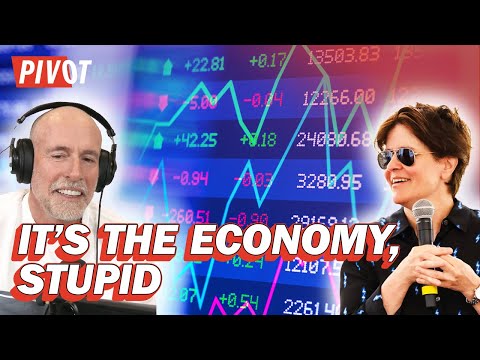
What Good News on the Economy Means for Investors
Kara Swisher (host), Scott Galloway (host)
In this episode of Pivot, featuring Kara Swisher and Scott Galloway, What Good News on the Economy Means for Investors explores booming Economy, Confused Consumers, and Smart Investing in Market Highs Kara Swisher and Scott Galloway discuss the paradox of strong U.S. economic data alongside persistent consumer pessimism. They highlight record stock market levels, falling inflation, solid job growth, and U.S. energy dominance, while noting that many citizens still blame government for past price spikes. Galloway argues most investors should avoid stock-picking and instead buy low-cost index or ETF funds to capture overall market returns. They also predict a housing market surge in transaction volume later in the year as life events collide with slightly lower mortgage rates and constrained supply.
Booming Economy, Confused Consumers, and Smart Investing in Market Highs
Kara Swisher and Scott Galloway discuss the paradox of strong U.S. economic data alongside persistent consumer pessimism. They highlight record stock market levels, falling inflation, solid job growth, and U.S. energy dominance, while noting that many citizens still blame government for past price spikes. Galloway argues most investors should avoid stock-picking and instead buy low-cost index or ETF funds to capture overall market returns. They also predict a housing market surge in transaction volume later in the year as life events collide with slightly lower mortgage rates and constrained supply.
Key Takeaways
Strong macroeconomic indicators contrast with lingering consumer frustration.
Despite record markets, low inflation relative to peers, and rising real wages, many Americans still feel squeezed, particularly by food and past price hikes, and tend to credit themselves for wage gains while blaming government for inflation.
Get the full analysis with uListen AI
U.S. energy independence is a major strategic advantage.
The U. ...
Get the full analysis with uListen AI
Don’t try to pick winning stocks; buy broad market funds.
Galloway stresses that a tiny group of stocks drove most of last year’s gains, making it unrealistic for average investors to identify them in advance; low-cost index and ETF funds efficiently capture overall market performance.
Get the full analysis with uListen AI
Focus personal energy on your career, not on trading.
He advises people to devote their mental and emotional resources to their day jobs and outsource investing to diversified, low-fee funds instead of chasing complex products or star managers who often “rip you off.”
Get the full analysis with uListen AI
Long-term compounding in index funds can be powerful.
Using post-2008 returns as an example, Galloway notes that an 11% annualized return roughly doubles money every seven years, especially impactful if you start investing in your prime earning years.
Get the full analysis with uListen AI
The housing market is constrained by ‘golden handcuff’ low-rate mortgages.
Ultra-low pandemic-era mortgages around 2. ...
Get the full analysis with uListen AI
A housing transactions boom is likely if mortgage rates ease slightly.
They predict that as rates drift below roughly 6% and more inventory appears due to life changes (death, divorce, kids, job moves), pent-up demand will be released, driving a surge in sales volume rather than another huge price spike.
Get the full analysis with uListen AI
Notable Quotes
“What strikes me is more so than all the good news, which is exceptional, is the consumer dissonance or the citizen dissonance.”
— Scott Galloway
“We are energy independent. We're not only energy independent, we produce more energy than we consume, which is remarkable given what gluttons we are.”
— Scott Galloway
“Don't try and pick the needle in the haystack. Pick the whole haystack and buy the whole market.”
— Scott Galloway
“Seven stocks were responsible for 70% of the gain last year. And you think you're smart enough to pick the seven of the 500?”
— Scott Galloway
“Life doesn't stop marching on... when you think about housing, the biggest component in housing are life events, and those have not stopped the last year. They're just building up.”
— Scott Galloway
Questions Answered in This Episode
Why does public perception of the economy remain negative even when most indicators are strong?
Kara Swisher and Scott Galloway discuss the paradox of strong U. ...
Get the full analysis with uListen AI
How sustainable is U.S. energy dominance, and what risks could undermine this advantage?
Get the full analysis with uListen AI
For a new investor, how should the balance between index funds and any individual stock positions be determined?
Get the full analysis with uListen AI
What factors could derail the predicted housing transaction boom later in the year?
Get the full analysis with uListen AI
To what extent will improving economic conditions actually influence voter behavior in the upcoming election?
Get the full analysis with uListen AI
Transcript Preview
The stock market is hitting record highs. Job numbers are good, inflation is falling, and the Federal Reserve might be cutting interest rates also. Um, consumer happiness is rising, according to all those consumer happiness, um, s-surveys. They're moving, it's ticking upward. Looks like the US economy might be able to avoid a recession according to a recent survey. Um, economists not even a soft landing. Um, what do you, uh, what do you think we... What's going on? Treasury Secretary Janet Yellen was touting soft landing weeks ago and said, "My hope is it will continue." I guess we're continuing to soft land if at all. Um, what is your take on all the good news?
It, what strikes me is more so than all the good news, which is exceptional, is the consumer dissonance or the citizen dissonance. And that is Americans have a unique ability to credit their character and their grit for the raise they're getting-
Mm-hmm.
... and then blame the government for inflation.
Mm-hmm.
And so even though the, even though the, uh, wages are rising faster than inflation now, there's real wage increases. They still blame the government.
Mm-hmm.
It's just this, this quandary. It must be driving-
Well, it's ticking up. It's ticking up. That, that Michigan survey just suddenly went the other direction.
I hope so.
Yeah. Yeah.
But it's just very strange. The White House doesn't get any credit for it.
Yeah, it's starting to.
And, uh, I hope you're right. But... And you know, this goes to my win. We literally have... Now granted, it's not distributed equally. We have a- a... No one could have predicted if someone had said America is gonna pull off this economy or they're gonna figure out a way to have the lowest inflation in the G7. By the way, they're gonna massively increase for all the shit posting and all the far right likes to say, "Drill, baby, drill."
Mm-hmm.
We're producing more energy than ever. We're the largest-
Yeah, yes.
... energy producer in the world.
We are, indeed. Yeah.
And if you look at, if you look at our competitive a- advantage against China-
Mm-hmm.
... if China decides to get into a hot war with anyone-
Yeah.
... uh, and they start su- s- uh, uh, and at any number of choke points their energy supply gets, gets, um-
Yeah.
... gets shut down-
They're gonna have to invade Russia. They're gonna have to invade Russia first. (laughs)
They would, they would be in such a world of hurt. And we are energy independent. We-
Yeah.
We're e- not only ener- energy independent, we produce more energy than we consume, which is remarkable given what gluttons we are.
Yeah.
So it's, you know, it's just striking that-
Install uListen to search the full transcript and get AI-powered insights
Get Full TranscriptGet more from every podcast
AI summaries, searchable transcripts, and fact-checking. Free forever.
Add to Chrome