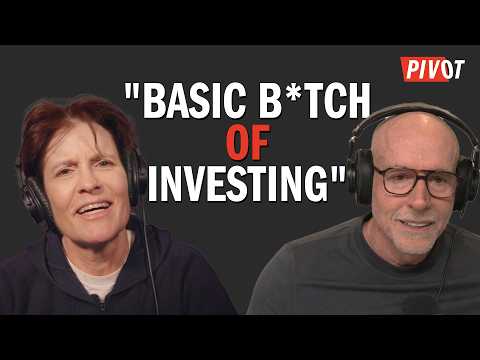
Kara Swisher and Scott Galloway Debate Their Money Strategies | Pivot
Scott Galloway (host), Kara Swisher (host), Lynn (guest), Liam (guest), Narrator, Lisa (guest)
In this episode of Pivot, featuring Scott Galloway and Kara Swisher, Kara Swisher and Scott Galloway Debate Their Money Strategies | Pivot explores kara Swisher and Scott Galloway Reveal Money, Policy, and Parenting Truths In this listener mail episode of Pivot, Kara Swisher and Scott Galloway tackle questions on taxing AI, the single policy that could fix the most U.S. problems, and how each of them approaches money, wealth, and spending.
Kara Swisher and Scott Galloway Reveal Money, Policy, and Parenting Truths
In this listener mail episode of Pivot, Kara Swisher and Scott Galloway tackle questions on taxing AI, the single policy that could fix the most U.S. problems, and how each of them approaches money, wealth, and spending.
They debate whether AI or robots should be taxed, but largely land on fixing the broader tax code, particularly capital gains and minimum tax rules for the ultra-wealthy.
Both open up about their very different relationships with money, shaped by childhood experiences of scarcity (Scott) and abundance plus financial dysfunction (Kara), and how that influences their saving, spending, and giving.
They also share deeply personal reflections on losing a parent, single parenting, the importance of male role models for boys, and end with a lighter segment brainstorming what kind of tongue‑in‑cheek tattoo Kara should get for Scott.
Key Takeaways
Fix the tax code broadly instead of targeting AI specifically.
Scott argues that taxing specific sectors like AI invites special‑interest capture and definitional loopholes; instead, he favors eliminating the capital gains preference, restoring a more progressive tax system, and applying higher rates across all income and firms.
Get the full analysis with uListen AI
Raise capital gains taxes and implement a real alternative minimum tax (AMT) for the ultra‑wealthy.
Both hosts criticize a system where investment income is taxed less than wage income and suggest a federal AMT (e. ...
Get the full analysis with uListen AI
A high minimum wage and more housing could unlock broad economic benefits.
Kara’s ‘one policy’ pick is a $25 minimum wage to raise living standards and consumer spending, with a second choice of dramatically expanding housing supply (millions of new homes) to address affordability and economic mobility.
Get the full analysis with uListen AI
Overturning Citizens United could reduce corporate capture of politics.
Scott sees the Supreme Court’s Citizens United decision as a central reason for policy gridlock and inequality, arguing that unlimited corporate money and lobbying have ‘weaponized’ Washington against the public interest.
Get the full analysis with uListen AI
Money philosophies are shaped by early life experiences with scarcity or excess.
Scott’s upbringing with financial scarcity fuels his ongoing fixation on earning and spending, while Kara’s childhood in a wealthy but financially chaotic household makes her largely indifferent to consumerism and focused on security and control over her own assets.
Get the full analysis with uListen AI
Wealth can be used aggressively for experiences and generosity instead of hoarding.
Scott spends heavily on homes and shared experiences, matches his annual spending with equivalent charitable giving, and has intentionally capped his net worth, arguing that hoarding money is “a virus” and that no one needs to be a billionaire.
Get the full analysis with uListen AI
After the death of a parent, keep their memory active and secure role models for kids.
Kara emphasizes preserving connections to the deceased parent’s family, friends, stories, and artifacts; Scott highlights that boys especially need active male role models after losing a father, and that consistent affirmation of a child’s value from a caregiver builds lasting confidence.
Get the full analysis with uListen AI
Notable Quotes
“There is no reason why someone working for money should be taxed at a higher rate than someone who is making money from investments.”
— Scott Galloway
“My approach to spending money is that we don’t own money, we rent it.”
— Scott Galloway
“I never let money get in the way of a good time. I am spending money like a ’50s gangster just diagnosed with ass cancer.”
— Scott Galloway
“You think about money less than almost anybody I know.”
— Scott Galloway (about Kara Swisher)
“If you tell your kids every day they have value, they start to believe you.”
— Scott Galloway
Questions Answered in This Episode
How realistic is a $25 minimum wage in the current U.S. political and economic climate, and what phased or regional approaches might achieve similar outcomes?
In this listener mail episode of Pivot, Kara Swisher and Scott Galloway tackle questions on taxing AI, the single policy that could fix the most U. ...
Get the full analysis with uListen AI
What concrete policy mechanisms could effectively overturn or neutralize the effects of Citizens United without triggering unintended consequences for free speech?
They debate whether AI or robots should be taxed, but largely land on fixing the broader tax code, particularly capital gains and minimum tax rules for the ultra-wealthy.
Get the full analysis with uListen AI
How could an AMT for ultra‑high earners be designed to minimize loopholes while avoiding capital flight or aggressive tax arbitrage?
Both open up about their very different relationships with money, shaped by childhood experiences of scarcity (Scott) and abundance plus financial dysfunction (Kara), and how that influences their saving, spending, and giving.
Get the full analysis with uListen AI
In an AI‑driven economy, what combination of tax, education, and labor policies would best support workers displaced by automation over the next decade?
They also share deeply personal reflections on losing a parent, single parenting, the importance of male role models for boys, and end with a lighter segment brainstorming what kind of tongue‑in‑cheek tattoo Kara should get for Scott.
Get the full analysis with uListen AI
For parents raising children after the loss of a partner, what practical steps can they take to cultivate healthy role models and preserve the lost parent’s legacy day‑to‑day?
Get the full analysis with uListen AI
Transcript Preview
I never let money get in the way of a good time. I am spending money like a '50s gangster just diagnosed with ass cancer.
(laughs) (instrumental music) Hi, everyone. This is Pivot from New York Magazine and the Vox Media Podcast Network. I'm Kara Swisher.
And I'm Scott Galloway.
And Scott, this is our end-of-the-year listener mail episode. We're probably both elsewhere doing fun things, but, uh, are you ready to hear some emails and voicemails from our lovely listeners who, by the way, we have a full new appreciation for after meeting so many of them on our Pivot Live Tour? I really enjoyed that. Are you ready?
Yeah, ready.
Okay, Scott. Let's kick off with a question about taxing AI. Let's listen. (screen whooshes)
Hi, this is Lynn. Um, I've been wondering, as artificial intelligence continues to replace human jobs, do you think we'll ever see a tax on AI itself or on the companies that use it as a way to offset its impact on displaced workers? And would that, in a sense, become a new way of taxing the rich? Thank you. Bye. (screen whooshes)
Gosh, Lynn, what a great question. Actually, I'm gonna start, you know, uh, many years ago, Bill Gates sort of set off a kerfuffle when he talked about taxing robots if they become workers, um, the same way, 'cause you aren't gonna get those money that you get from human workers, and so they should be taxed in the same way. I hadn't really thought about it about AI. Uh, Scott, I, I, I'm, I, I think I'm ... Yeah, I think you're more qualified to answer this.
I don't know if that's true. Uh, m- my view around taxation is that the moment you start taxing specific industries, you weaponize special interest groups to come to their defense, and you also create some confusion around, like, is Oracle AI? You know, if, if McKinn- ... I mean, at what point ... What qualifies as an AI company and not an AI company? Is Microsoft an AI company? What, what I'm a big fan of, and I think that the, the, the caller is alluding to, I wanna go back to Reagan-era taxation, and that is, there's no difference between ... I think the capital gains tax deduction is nothing but a transfer of wealth from young to old because somehow we've decided that sweat is less noble than money. And that is, the money I make on money gets taxed at a lower rate than the money that young people make on sweat. So, I would like to see an elimi- elimination of the capital gains tax deduction and raise those rates to current income and restore a progressive tax structure. In my view, you do it across all income and all firms because I think the moment you start getting into this notion of let's put a super tax on this type of firm, I think that's, I think you regulate them, I think you have an EPA, you have an AI Act, you have privacy, you have laws. But in terms of taxation, I just think you say, look, above a certain level of profitability when you sell a stock, you pay this much in tax.
Install uListen to search the full transcript and get AI-powered insights
Get Full TranscriptGet more from every podcast
AI summaries, searchable transcripts, and fact-checking. Free forever.
Add to Chrome