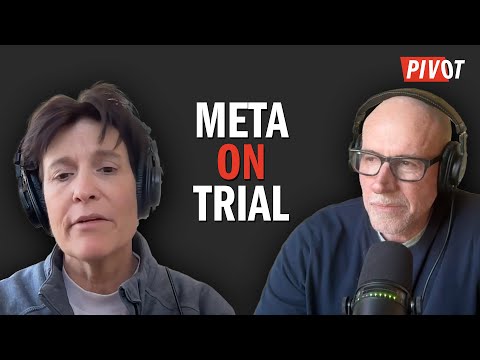
Will Meta Pay the Price for 'Buy or Bury' Strategy at Antitrust Trial? | Pivot
Scott Galloway (host), Kara Swisher (host), Narrator, Narrator, Narrator, Narrator
In this episode of Pivot, featuring Scott Galloway and Kara Swisher, Will Meta Pay the Price for 'Buy or Bury' Strategy at Antitrust Trial? | Pivot explores meta Faces Antitrust Reckoning Amid Trump Tariff Chaos And Stunts Kara Swisher and Scott Galloway dissect Trump’s chaotic tariff policy, arguing it has created historic economic uncertainty, risks stagflation, and is crushing small and mid-sized importers while sparing powerful firms like Apple. They then examine the FTC’s antitrust case against Meta over its “buy or bury” acquisitions of Instagram and WhatsApp, debating both the legal difficulty of unwinding old mergers and the economic and social costs of tech monopolies. The conversation widens to U.S.–China trade, global realignment as other countries sign new deals without America, and the broader erosion of rule of law through immigration roundups and defiance of Supreme Court rulings. They close by skewering Blue Origin’s all-female celebrity spaceflight as faux feminism, discussing Trump’s charm offensive on Bill Maher, and trading cultural wins and fails from politics, media, and entertainment.
Meta Faces Antitrust Reckoning Amid Trump Tariff Chaos And Stunts
Kara Swisher and Scott Galloway dissect Trump’s chaotic tariff policy, arguing it has created historic economic uncertainty, risks stagflation, and is crushing small and mid-sized importers while sparing powerful firms like Apple. They then examine the FTC’s antitrust case against Meta over its “buy or bury” acquisitions of Instagram and WhatsApp, debating both the legal difficulty of unwinding old mergers and the economic and social costs of tech monopolies. The conversation widens to U.S.–China trade, global realignment as other countries sign new deals without America, and the broader erosion of rule of law through immigration roundups and defiance of Supreme Court rulings. They close by skewering Blue Origin’s all-female celebrity spaceflight as faux feminism, discussing Trump’s charm offensive on Bill Maher, and trading cultural wins and fails from politics, media, and entertainment.
Key Takeaways
Tariff volatility is creating unprecedented economic uncertainty and risk of stagflation.
Galloway argues that abrupt, poorly signaled tariffs force companies to scramble for unexpected cash (e. ...
Get the full analysis with uListen AI
Small and mid‑sized businesses bear the brunt of tariff shocks while giants get carve‑outs.
Case studies of a big catalog retailer and a $10–12M promotional-products firm show them halting China orders, scrambling to reprice goods, and facing potential collapse, while firms like Apple win last‑minute exemptions and even benefit in the markets.
Get the full analysis with uListen AI
China is diversifying away from U.S. dependence faster than the U.S. is from China.
China has cut the U. ...
Get the full analysis with uListen AI
The Meta antitrust case highlights the danger of allowing dominant platforms to ‘buy or bury’ rivals.
Email trails about ‘neutralizing’ Instagram and WhatsApp bolster the FTC’s argument that Meta bought emerging threats instead of competing; Swisher and Galloway contend regulators erred by approving these deals and should now adopt a much lower bar for blocking future mergers by dominant firms.
Get the full analysis with uListen AI
Breakups of dominant firms typically work and often increase shareholder value.
Galloway notes that historic breakups (e. ...
Get the full analysis with uListen AI
U.S. institutions are being eroded by selective lawlessness in immigration and foreign policy.
They describe deportations to El Salvador’s harsh prisons, defiance of Supreme Court rulings, and the use of offshore detention as a ‘Guantanamo’ outsource—all framed as rounding up the vulnerable while wealthy violators remain untouched, undermining habeas corpus and constitutional norms.
Get the full analysis with uListen AI
Performative symbolism (like celebrity ‘women in space’ trips) shouldn’t be mistaken for structural progress.
Swisher criticizes the Blue Origin all‑female flight as branding dressed up as feminism, contrasting it with substantive ways to help women (e. ...
Get the full analysis with uListen AI
Notable Quotes
“Brand US has become toxic uncertainty.”
— Scott Galloway
“Countries don’t go out of business because they’re invaded, they go out of business because they go broke.”
— Scott Galloway
“They decided that competition was too hard and it'd be easier to buy out their rivals than compete with them.”
— Daniel Matheson, FTC lead litigator (quoted by Kara Swisher)
“This is self‑inflicted damage… an own goal.”
— Kara Swisher
“These companies have figured out a way to avoid all regulation. I don't see why this would be any different.”
— Scott Galloway
Questions Answered in This Episode
How sustainable is a U.S. economic strategy that relies on unpredictable tariff shocks while running massive deficits and high interest costs?
Kara Swisher and Scott Galloway dissect Trump’s chaotic tariff policy, arguing it has created historic economic uncertainty, risks stagflation, and is crushing small and mid-sized importers while sparing powerful firms like Apple. ...
Get the full analysis with uListen AI
If unwinding old mergers is so difficult legally, what specific merger rules or thresholds should change to prevent future ‘buy or bury’ acquisitions by dominant tech firms?
Get the full analysis with uListen AI
At what point do global trade realignments—ASEAN, EU, Latin America forming their own deals—materially reduce U.S. geopolitical and economic leverage?
Get the full analysis with uListen AI
How should regulators quantify and weigh non‑price harms—like mental health impacts on teens or the destruction of small ad businesses—when bringing antitrust actions against platforms like Meta?
Get the full analysis with uListen AI
Where is the line between symbolic representation (e.g., all‑female space flights) and genuine structural progress for women, and how can media better distinguish the two for audiences?
Get the full analysis with uListen AI
Transcript Preview
No one has ever described me as openly heterosexual. No one has ever said, "Openly heterosexual podcaster."
(instrumental music) Hi, everyone. This is Pivot from New York Magazine and the Vox Media Podcast Network. I'm Kara Swisher.
And I'm Scott Galloway.
Where are you, Scott? Are you just, you just, uh, you, you're somewhere strange with the wallpaper situation going on.
I am at the Colony Hotel in Palm Beach, where I just returned from getting, from the Department of Motor Vehicles at Palm Beach Gardens, where my son is now a licensed driver.
How exciting. That's great. I thought you were at Mar-a-Lago or something like that.
No, uh, it, uh-
(laughs)
... I ran into my friend, Mehmet Oz, yesterday, and he came over-
Mm-hmm.
... and he introduced me to RFK Jr. They're hanging out.
Oh, no.
And he gave me the cold shoulder. I think it's because I refused-
Good.
... to have him on my pod. I don't know.
Well, good idea.
He was definitely, like, cold to me.
Who? R- RFK?
RFK? No, Mehmet and I are friends.
Okay.
Uh, RFK, yeah, was su- was noticeably cold to me. He's very handsome though. I did notice that.
'Cause he's a crank. 'Cause he's a crank. The la- Did you see the latest? He's putting... I don't even wanna go into it. That-
Four, four months until autism is solved, is that what he's saying?
Not, not just that. All of the stuff. He's taking s- information off. He's saying vaccines aren't necessarily a good thing on the... I, just he's such a fucking disaster. These people are setting themself up for a lot of pain years from now. Um, it's just the, the murders he is committing right now, as far as I'm concerned.
In addition to the additional death, disease, and disability across our populous, it's made traffic much worse for me. That's what I'm really upset about.
Oh, okay. All right.
It's-
Okay. All right. Okay. And-
The traffic is awful down there. But anyways, I'm at the Colony Hotel, which I affectionately call-
R-
... I think there's a whole cadre or cohort of what I call 64 hotels and service establishments. And that is because of the unprecedented prosperity that we've started to believe is the normal operating system in America, and a series of fiscal and monetary policies that literally, and tax policies cram all this prosperity in the top 1%, and the fact there's a lag time. You can't build a four or five-star hotel in a year. It takes 10 years. These places are over capacity. And so I describe them as 64, as in that is six-star prices with four-star service.
Oh, okay.
And these places are so expensive, and I don't mind paying a lot of money if you get great service. And you do get great service at the Beverly's Hotel or, I don't know, at the Langham in London. I mean, there's just a, a ton of great hotels with great service. This is not one of them.
Install uListen to search the full transcript and get AI-powered insights
Get Full TranscriptGet more from every podcast
AI summaries, searchable transcripts, and fact-checking. Free forever.
Add to Chrome