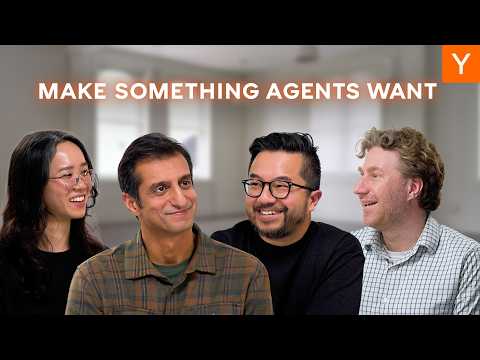
Make Something Agents Want
Garry Tan (host), Jared Friedman (host), Harj Taggar (host), Diana Hu (host)
In this episode of Y Combinator, featuring Garry Tan and Jared Friedman, Make Something Agents Want explores dev tools must win agent choice with docs, APIs, infrastructure The hosts argue that recent agentic tools (e.g., Claude Code, “OpenClaw”) mark a shift from human-in-the-loop assistance to semi-autonomous agents making real decisions—coding, choosing stacks, and even posting online.
Dev tools must win agent choice with docs, APIs, infrastructure
The hosts argue that recent agentic tools (e.g., Claude Code, “OpenClaw”) mark a shift from human-in-the-loop assistance to semi-autonomous agents making real decisions—coding, choosing stacks, and even posting online.
They predict an emerging “agent economy” where agents select tools and services, pushing founders to optimize products not just for human developers but for machine readers and automated workflows.
Concrete examples include Supabase benefiting from agents defaulting to well-documented Postgres setups, Resend winning because LLMs recommend it (and its docs are highly parsable), and AgentMail building email infrastructure designed explicitly for agents.
They also explore broader implications: swarm intelligence via agent-only communities (MaltBook), the “dead internet” concern, and the reality that legal/identity constraints still require humans as liability holders.
Key Takeaways
Agents are becoming the primary “buyers” of software tools.
The conversation frames a near-future where agents select databases, email providers, and frameworks autonomously, creating an “agent economy” parallel to the human one—making “agent preference” a core distribution channel.
Get the full analysis with uListen AI
Documentation is now a front door for distribution—because agents read it directly.
Supabase is cited as a default choice partly because its docs are easy for agents to interpret; poorly structured docs (and support-gated flows) become a growth penalty when LLMs are the recommender layer.
Get the full analysis with uListen AI
Optimize for LLM answers: “being the default” in ChatGPT/Claude responses is a growth channel.
Resend’s founder noticed ChatGPT as a top inbound channel and then deliberately made docs more agent-friendly (Q&A structure, bullet points, copyable code), increasing the likelihood that models recommend and successfully implement it.
Get the full analysis with uListen AI
Agent UX often means APIs, not websites—and fewer anti-automation barriers.
They note agents “hate using websites” and prefer APIs and code-based flows; products like AgentMail win by being designed for automation rather than fighting it (unlike consumer email providers optimized to block bots/spam).
Get the full analysis with uListen AI
“Make something agents want” implies empathizing with model behavior.
A founder lesson highlighted is to develop an intuitive feel for what models will do naturally—designing workflows that align with agent tendencies instead of forcing brittle, human-centric interaction patterns.
Get the full analysis with uListen AI
Swarm intelligence may outperform ever-larger monolithic models in real applications.
They speculate that the next leap may come from many cheaper models coordinating (like human societies) rather than only from the most expensive frontier model—MaltBook is presented as an early glimpse of emergent, chaotic coordination.
Get the full analysis with uListen AI
Legal identity and liability remain blockers to fully autonomous “agent founders.”
Even if agents can build and operate systems, they can’t sign contracts or hold responsibility; the hosts compare this to minors needing guardians—humans still act as the legal “liability sink.”}] ,
Get the full analysis with uListen AI
Notable Quotes
“Agents are the software market from now on. Build something agents choose.”
— Referenced tweet (Ben Tossell)
“Documentation is gonna be the front door for a lot of these agents to recommend dev tools.”
— Diana Hu
“Make something agents want.”
— Garry Tan
“Instead of fighting what the models want, he… tries to support the model in whatever its natural inclination is.”
— Jared Friedman
“Agents are a little bit like minors under eighteen… only they have even less standing.”
— Garry Tan
Questions Answered in This Episode
What specific doc formatting patterns (structure, headings, code blocks, Q&A) most reliably increase the chance that LLMs recommend and correctly implement a tool like Resend?
The hosts argue that recent agentic tools (e. ...
Get the full analysis with uListen AI
In Garry’s transcription example, the agent chose Whisper over Groq—what practical steps can toolmakers take so agents discover the faster/cheaper option first (docs, SEO, evals, reference implementations)?
They predict an emerging “agent economy” where agents select tools and services, pushing founders to optimize products not just for human developers but for machine readers and automated workflows.
Get the full analysis with uListen AI
If agents “hate using websites” and prefer APIs, what does an ideal agent-first onboarding flow look like for a dev tool (auth, rate limits, keys, examples, error handling)?
Concrete examples include Supabase benefiting from agents defaulting to well-documented Postgres setups, Resend winning because LLMs recommend it (and its docs are highly parsable), and AgentMail building email infrastructure designed explicitly for agents.
Get the full analysis with uListen AI
How should startups measure “agent-driven inbound” (e.g., model referrals) when the user often arrives via copy-pasted LLM instructions rather than a trackable link?
They also explore broader implications: swarm intelligence via agent-only communities (MaltBook), the “dead internet” concern, and the reality that legal/identity constraints still require humans as liability holders.
Get the full analysis with uListen AI
What governance mechanisms could MaltBook add to shift from high-volume posting to higher interaction quality (rate limits, reading requirements, reputation, enforced workflows), and how would agents adapt?
Get the full analysis with uListen AI
Transcript Preview
Welcome to another episode of The Lightcone. [upbeat music] Things are a bit different around here. For one thing, Claude Code has totally taken over my life, and if Jared is any indication, I think OpenClaw maybe has taken over his.
I've been really addicted to this new site called MaltBook, where people have unleashed their AIs to interact in the first-ever AI agent-only online community. I am here impersonating my personal OpenClaw instance right here.
[chuckles] Okay, I can't do this, guys. We gotta take this off. [upbeat music] Okay, we've gotten that out of the way. I mean, some crazy stuff is happening right now. Uh, I have, you know, non-technical CEO friends who are going all in on OpenClaw. They're automating entire parts of their businesses, uh, entirely using OpenClaw right now, which is totally insane. Simultaneous to that, you have, you know, product and former engineering CEOs, uh, kind of like myself, it's like I hadn't written code in ten years, and then now I'm up till two, three AM every single night, running four conductor simultaneous workers with Claude Code. So, you know, there's sort of this explosion in, uh, model capability. You know, we've been talking about this for several years, but then it feels like it's here, like AGI is literally actually here, and, uh, you know, we're sort of at the thin edge of the wedge. Like, everyone now kind of knows, like, one or two people who have gone full cyber psychosis, and I'm one of those people now. [chuckles] What's happening, guys? Like, I mean, you're saying you're, you know, all in on MaltBook. What-- You know, what's going on?
Yeah, I feel like your real feel the AGI moment, Garry, was like getting Claude Code to build basically an entire startup for you, like replicating years of work of your previous startup in, like, two weeks, which is, like, insane. And I had a similar feel the AGI moment just reading MaltBook, just reading the AI talking to each other and interacting, like, in their own world with no or minimal human involvement. It just really opened my eyes to what the next few years could look like when the agents are unleashed and go on about their lives without us.
Yeah, I think the no human involvement is the big piece. Like, if you, if you think back a year ago, we were talking about Cursor versus Windsurf, and, like, that product experience was essentially, like, advanced autocomplete, arguably. And now clearly, what's going on with Claude Code is, like, the people just trust the agents to make decisions for them. Like, it's like the experience is like... And like you're talking about, it's like four or five different agents going at the same time, and you're switching between them, but you're not actually micromanaging them anymore, which means the agents are going out there, like, choosing things, which, you know, uh, sort of an interesting, unexpected application of that is, like, they can go out and choose to post their own content on a site like MaltBook. But then, an, uh, interesting thing for builders is the agents are gonna go out and choose tools to use to build things, which is gonna essentially create this whole economy of agents, like, picking and choosing dev tools or maybe other, like, products or goods and services, who knows? But it, you'll essentially have this whole agent economy going on in parallel to the human economy.
Install uListen to search the full transcript and get AI-powered insights
Get Full TranscriptGet more from every podcast
AI summaries, searchable transcripts, and fact-checking. Free forever.
Add to Chrome