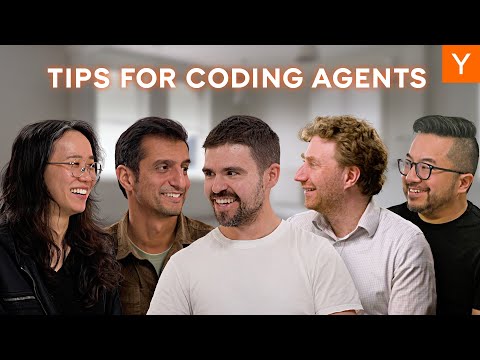
We're All Addicted To Claude Code
Calvin French-Owen (guest), Garry Tan (host), Garry Tan (host), Diana Hu (host), Calvin French-Owen (guest), Jared Friedman (host), Calvin French-Owen (guest)
In this episode of Y Combinator, featuring Calvin French-Owen and Garry Tan, We're All Addicted To Claude Code explores why Claude Code’s CLI agents are reshaping how engineers build YC’s Garry Tan and guests explore an intense adoption moment around Claude Code, describing it as a step-function productivity boost that makes coding feel fast, playful, and highly leveraged—especially for debugging and test writing.
Why Claude Code’s CLI agents are reshaping how engineers build
YC’s Garry Tan and guests explore an intense adoption moment around Claude Code, describing it as a step-function productivity boost that makes coding feel fast, playful, and highly leveraged—especially for debugging and test writing.
Calvin French-Owen (ex-OpenAI Codex, Segment founder) contrasts Claude Code’s CLI workflow and context-splitting sub-agents with IDE-first tools and Codex’s longer-horizon compaction approach, arguing context engineering is the core differentiator.
They dig into how bottoms-up distribution and “GEO” (showing up in LLM recommendations) changes go-to-market for developer tools, advantaging open source and great docs while raising new security/prompt-injection concerns.
The group forecasts a shift toward more “manager-like” engineers orchestrating agent flows, with testing/evals becoming the control plane for correctness and with future tooling enabling longer-running autonomous jobs and shared organizational agent memory.
Key Takeaways
Claude Code’s edge is product+model context orchestration.
French-Owen argues Claude Code is “underrated” because it pairs strong models with a workflow that spawns explorer sub-agents, each using separate context windows to traverse the repo and summarize findings—reducing context overload and improving outcomes.
Get the full analysis with uListen AI
The CLI is winning because it integrates with reality, not a sandbox.
Terminal-based agents can use your actual dev environment (databases, services, tooling) with fewer integration failures than isolated sandboxes—dramatically improving debugging and “just run the tests” loops.
Get the full analysis with uListen AI
Context engineering is the new secret sauce—for builders and users.
Whether you’re building an agent or using one, performance hinges on selecting and refreshing the right context (grep/ripgrep, gitignore discipline, sub-agent exploration) more than fancy retrieval in many codebases.
Get the full analysis with uListen AI
Long sessions degrade quality; proactive context resets help.
French-Owen describes a “dumb zone” as token usage climbs; he often clears context around ~50% utilization. ...
Get the full analysis with uListen AI
Testing turns agents from fun to dependable velocity.
Tan found that moving from minimal tests to high coverage made progress “speed up like crazy,” because agents can self-verify quickly—mirroring how prompt engineering increasingly relies on evals and test cases.
Get the full analysis with uListen AI
Bottoms-up distribution is crucial when tools change monthly.
Because enterprise security review is slow, the fastest-growing agent products spread by individual engineers installing them immediately. ...
Get the full analysis with uListen AI
GEO changes devtool marketing: docs and “LLM-visible” proof matter.
They note LLMs can be influenced by biased “top tools” pages and will default to what’s well-documented and widely referenced (e. ...
Get the full analysis with uListen AI
Notable Quotes
“When it's in your CLI, this thing can debug nested, delayed jobs… and then write a test for it, and it never happens again. This is insane.”
— Garry Tan
“Claude Code… is underrated how good the both product and model are working together.”
— Calvin French-Owen
“It’s weird… the CLIs… from twenty years ago, have somehow beaten out all the actual IDEs.”
— Diana Hu
“Context poisoning is a real thing… one thing that I often do is… very actively clear context.”
— Calvin French-Owen
“I was surprised how important testing was… then I just sped up like crazy.”
— Garry Tan
Questions Answered in This Episode
Claude Code “splits up context well”—what specific UX or system behaviors make that work (sub-agents, summaries, task decomposition), and what are the failure modes?
YC’s Garry Tan and guests explore an intense adoption moment around Claude Code, describing it as a step-function productivity boost that makes coding feel fast, playful, and highly leveraged—especially for debugging and test writing.
Get the full analysis with uListen AI
You mention Cursor uses embeddings/semantic search while Claude/Codex often rely on grep—when does semantic search actually beat grep in real repos?
Calvin French-Owen (ex-OpenAI Codex, Segment founder) contrasts Claude Code’s CLI workflow and context-splitting sub-agents with IDE-first tools and Codex’s longer-horizon compaction approach, arguing context engineering is the core differentiator.
Get the full analysis with uListen AI
What would a practical, built-in “context heartbeat” look like inside an agent (beyond the canary trick) to detect dumb-zone degradation automatically?
They dig into how bottoms-up distribution and “GEO” (showing up in LLM recommendations) changes go-to-market for developer tools, advantaging open source and great docs while raising new security/prompt-injection concerns.
Get the full analysis with uListen AI
For 24–48 hour autonomous runs, what’s the real blocker today: model capability, tool reliability, verification (tests/CI), or safety constraints like sandboxing?
The group forecasts a shift toward more “manager-like” engineers orchestrating agent flows, with testing/evals becoming the control plane for correctness and with future tooling enabling longer-running autonomous jobs and shared organizational agent memory.
Get the full analysis with uListen AI
If “GEO” becomes central, how should an honest devtool company optimize: docs structure, examples, OSS strategy, or community signals—without devolving into SEO-like manipulation?
Get the full analysis with uListen AI
Transcript Preview
I feel like when I'm using Claude Code, it's like, oh, I feel like I'm flying through the code.
When it's in your CLI, this thing can debug nested, delayed jobs, like, five levels in, and figure out what the bug was, and then write a test for it, and it never happens again. This is insane.
I think everyone who's experimenting with this stuff on, like, a hobbyist level or at, like, a very small start-up, they're just pushing the coding agents as far as they can go. 'Cause it's like you don't really have time to figure out anything else. Like, as a start-up, you have limited runway, you're just going to orient around speed. I think at a bigger company you have a lot more to lose.
What are some of the tips to become a top one percent user of coding agents?
Yeah, what's your stack? [laughing] Yeah. [upbeat music]
Hey, everyone, welcome back to another episode of The Lightcone. Garry, are you- are you ready to record?
Oh, I'm, I'm in plan mode right now, but okay, yeah.
[laughing]
I guess it's time. Sorry about that. Well, welcome to a- another episode of The Lightcone, and today we have an incredible guest, Calvin French-Owen. He's one of the first people to create Codex at OpenAI, and before that, he started Segment, which is a multi-billion dollar company that got to a very successful exit. Calvin, welcome back.
Thanks for having me.
I guess, what a crazy time for all of us. Uh, I recently got very, very addicted to Claude Code, and, uh, I would describe it as, like, ten years ago, I was a marathon runner, and I loved doing it, and then I suffered a catastrophic knee injury, which is called manager mode. [laughing]
[laughing]
And I, uh, stopped coding, which is tragic and horrible. Uh, but now the last nine days have been, like, this incredible unlock of all the things I remember being able to do. And it's like, you know, I got a new total knee replacement, and actually, it's a bionic knee, and it allows me to run five times faster. What's your take on it? Because you're, I mean, right out there at the forefront of it. I mean, Codex pioneered all of the... a lot of the ideas that now, like, everyone still uses, and Codex is still evolving, too.
For brief context, when I was at OpenAI, um, I was working on the Codex web project. At the time, Cursor was out in the market, and they had kind of built this shim, uh, around, I think it was Sonnet three point five, uh, and it was able to work in your IDE. Claude Code had just come out, uh, and it was working as a CLI. And we kind of had this idea, like, "Hey, in the future, coding is really gonna feel more like talking to a coworker." Like, you're gonna send off a question, and then they'll go off and do something and come back to you with a PR. Uh, and so that's where we started with this web view, uh, and that's what we were building. I think directionally, that's still kind of correct for where things should go, but obviously now everyone is coding with CLIs instead. Like, they're using those tools a lot more, whether it's Claude Code or whether it's Codex. And I think, at least for me, kind of the lesson in that is, I think in some sense you're right, that, like, everyone is going to become a manager in the future, or at least that's my hot take. But in order to get there, there are steps along the way, and you have to really build a lot of trust in the model and understand what it's doing.
Install uListen to search the full transcript and get AI-powered insights
Get Full TranscriptGet more from every podcast
AI summaries, searchable transcripts, and fact-checking. Free forever.
Add to Chrome