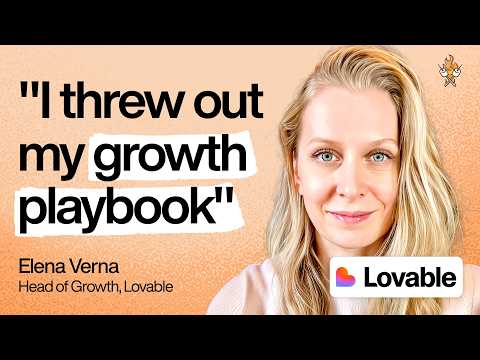
The new AI growth playbook for 2026 | How Lovable hit $200M ARR in one year
Lenny Rachitsky (host), Elena Verna (guest), Narrator
In this episode of Lenny's Podcast, featuring Lenny Rachitsky and Elena Verna, The new AI growth playbook for 2026 | How Lovable hit $200M ARR in one year explores aI growth reimagined: Lovable’s $200M ARR playbook in one year Lena Verna, Head of Growth at Lovable, explains how the company hit $200M ARR and 8M users in under a year with a ~100-person team, largely by discarding traditional growth playbooks. Instead of optimizing funnels, Lovable focuses on constant product innovation, building in public, and creating genuinely 'lovable' experiences that fuel word of mouth. They treat AI usage costs as marketing, aggressively give the product away, and rely on founder/employee socials, community, and influencer marketing rather than heavy paid spend or sales. Verna also argues that in AI, product‑market fit must be re-won roughly every three months as both capabilities and user expectations rapidly shift, reshaping hiring, careers, and who wins in this new landscape.
AI growth reimagined: Lovable’s $200M ARR playbook in one year
Lena Verna, Head of Growth at Lovable, explains how the company hit $200M ARR and 8M users in under a year with a ~100-person team, largely by discarding traditional growth playbooks. Instead of optimizing funnels, Lovable focuses on constant product innovation, building in public, and creating genuinely 'lovable' experiences that fuel word of mouth. They treat AI usage costs as marketing, aggressively give the product away, and rely on founder/employee socials, community, and influencer marketing rather than heavy paid spend or sales. Verna also argues that in AI, product‑market fit must be re-won roughly every three months as both capabilities and user expectations rapidly shift, reshaping hiring, careers, and who wins in this new landscape.
Key Takeaways
Prioritize innovation over optimization when the market is moving extremely fast.
Lovable spends ~95% of growth effort on creating new features and growth loops, and only ~5% on funnel optimization, because in an emerging, hyper-competitive AI category, the biggest gains come from reinventing solutions, not tweaking existing flows.
Get the full analysis with uListen
Build in public and turn your team into a distributed marketing engine.
Founder-led and employee socials on X and LinkedIn, plus frequent 'ship and share' releases, keep Lovable constantly in the conversation, acting as continuous re-engagement and resurrection for users without relying on a massive marketing team.
Get the full analysis with uListen
Aggressively give the product away to seed usage and word of mouth.
Lovable treats free credits, hackathon sponsorships, and generous freemium as core growth levers, accounting AI usage costs as marketing spend; this lowers barriers to trying a mind-blowing product and lets champions do distribution on Lovable’s behalf.
Get the full analysis with uListen
Design for a ‘wow’ moment, not just a ‘viable’ product.
Lovable optimizes for minimal lovable products that emotionally delight users and feel 'human', believing experience and brand-like product interactions are now the key differentiators as raw functionality becomes commoditized by AI.
Get the full analysis with uListen
Accept that product-market fit in AI is temporary and perishable.
Because LLM capabilities and user expectations shift every few months, Lovable assumes it must recapture PMF roughly quarterly; the same team must both rediscover fit and scale it, rather than treating PMF as a one-time milestone.
Get the full analysis with uListen
Use AI-native workflows internally to compress the product lifecycle.
Lovable prototypes features on Lovable itself, employs a dedicated 'vibe coder', and expects everyone to use AI (e. ...
Get the full analysis with uListen
Hire for passion, agency, and autonomy—not just pedigree.
Lovable favors AI-native new grads, ex-founders, and 'product engineers' who treat work as a calling, can self-direct, ship end-to-end, and even market what they build, which is crucial in a chaotic, high-velocity AI environment.
Get the full analysis with uListen
Notable Quotes
“I feel like only 30 to 40% of what I've learned in the last 15 to 20 years of being in growth transfers here.”
— Elena Verna
“Right now, I'm spending 95% innovating on growth, and only 5% on optimization.”
— Elena Verna
“The only way to create a word of mouth loop is just to blow their socks off.”
— Elena Verna
“Product-market fit is no longer what it used to be… every company basically has to recapture product-market fit every three months.”
— Paraphrased by Lenny, explained by Elena Verna
“We don't optimize for revenue at all. We ask, ‘How can we give more product away?’”
— Elena Verna
Questions Answered in This Episode
How can a non-AI startup practically adopt Lovable’s 'minimal lovable product' mindset and ship velocity without burning out the team?
Lena Verna, Head of Growth at Lovable, explains how the company hit $200M ARR and 8M users in under a year with a ~100-person team, largely by discarding traditional growth playbooks. ...
Get the full analysis with uListen AI
What specific frameworks or rituals does Lovable use to decide which new growth loops or features to bet on each quarter?
Get the full analysis with uListen AI
How should a founder think about balancing short-term revenue optimization versus long-term market share when AI usage costs are significant?
Get the full analysis with uListen AI
What concrete steps can women in tech take to become truly AI-native and avoid being left behind in this shift?
Get the full analysis with uListen AI
If product-market fit must be re-won every three months, how should org design, planning cycles, and hiring change to reflect that reality?
Get the full analysis with uListen AI
Transcript Preview
You're head of growth at Lovable, on track to be the fastest or one of the fastest growing companies in history.
We're over 200 million in ARR at this point. We're a hundred people large. The pace here is insane.
You said that you've had to throw out most of your growth playbook.
I feel like only 30 to 40% of what I've learned in the last 15 to 20 years of being in growth transfers here, because we just need to invest in such bigger bets and innovate and create new growth loops here. Everybody and their mother is starting a vibe coding business nowadays, and we need to figure out how to be ahead of them. And to be ahead of them is not optimization of the problem, it's reinvention of the solution. I just feel like I usually spend maybe 5% innovating on growth in my previous roles. Right now, I'm spending 95% innovating on growth, and only 5% on optimization.
What do you find is actually moving the needle?
One of our biggest strategy is building in public, and it's coupled with employee socials, founder-led socials. And another one is giving your product away a lot. This is part of our growth secret sauce. You have to remove the barrier of entry. If somebody, one of our users, stands up and say, "Hey, I'm gonna have a hackathon at my work on Lovable. Can you give us some free credits to play with?" Why would we prevent a person who wants to do all of the marketing and activating for us from using us? We're like, "Take it. How much do you need?"
The trick is get more people to try it. Just ship things you can talk about.
The only way to create a word of mouth loop is just to blow their socks off.
Today, my guest is Elena Verna, head of growth at Lovable. In under one year after launching, with fewer than 100 people, Lovable hit 200 million ARR, which is one of, if not the fastest ramp to 200 million ARR in history, and growth is still accelerating. They've also recently raised a Series B at a six billion dollar valuation. So with that, there's a lot to learn about what Lovable has figured out about growth. This is Elena's fourth visit to the podcast, a record. She is my favorite growth mind. And in our conversation, we talk about how the growth playbook has fundamentally changed for AI companies. What works now, what no longer works, and what has surprised her most about how Lovable grows. She also shares her advice about whether working at an AI company is right for you, some incredibly interesting insights into Lovable's secret sauce for growth, the unique ways they operate internally, their approach to building minimal lovable products. Also, how they hire, and also how product market fit as a concept is no longer what it used to be, and how every company basically has to recapture product market fit every three months. This episode is incredibly tactical, and you will leave this conversation smarter on so many levels. If you enjoy this podcast, don't forget to subscribe and follow it in your favorite podcasting app or YouTube. And if you become an annual subscriber of my newsletter, you get a year free of 19 incredible premium products, including a year free of Lovable, Replit, Bolt, n8n, Linear, Devon, PostHoc, Superhuman, Descript, WhisperFlow, Perplexity, Warp, Granola, Magic Patterns, Raycast, ChatBRD, Mobbin, and Stripe Atlas. Head on over to LennisNewsletter.com and click Product Pass. With that, I bring you Elena Verna after a short word from our sponsors. Here's a puzzle for you. What do OpenAI, Cursor, Perplexity, Vercel, Plat, and hundreds of other winning companies have in common? The answer is they're all powered by today's sponsor, WorkOS. If you're building software for enterprises, you've probably felt the pain of integrating single sign-on, SCIM, RBAC, audit logs, and other features required by big customers. WorkOS turns those deal blockers into drop-in APIs with a modern developer platform built specifically for B2B SaaS. Whether you're a seed stage startup trying to land your first enterprise customer or a unicorn expanding globally, WorkOS is the fastest path to becoming enterprise-ready and unlocking growth. They're essentially Stripe for enterprise features. Visit workos.com to get started or just hit up their Slack support, for they have real engineers in there who answer your questions super fast. WorkOS allows you to build like the best with delightful APIs, comprehensive docs, and a smooth developer experience. Go to workos.com to make your app enterprise-ready today. This episode is brought to you by v0 from Vercel. v0 is the web development assistant designed for professionals of all technical backgrounds. Whether you're a product manager, designer, or developer, transform how you bring products to life. With v0, everybody can cook. Don't just show up to reviews with docs and ideas. Arrive with working prototypes that demonstrate real functionality. v0 drafts project plans, generates interactive interfaces, and builds full stack applications without writing a single line of code. And with features like AI and database integrations, screenshot import, and sync with GitHub, v0 helps reduce development bottlenecks and enhance collaboration between technical and non-technical team members. The result? Faster iteration and a shorter path from idea to implementation. Vercel built v0 for the builders who want to create at the moment of inspiration. If you can dream it, you can ship it. Visit vercel.com/lenny to get started. That's vercel.com/lenny. Elena, thank you so much for being here, and welcome back to the podcast.
Install uListen to search the full transcript and get AI-powered insights
Get Full TranscriptGet more from every podcast
AI summaries, searchable transcripts, and fact-checking. Free forever.
Add to Chrome