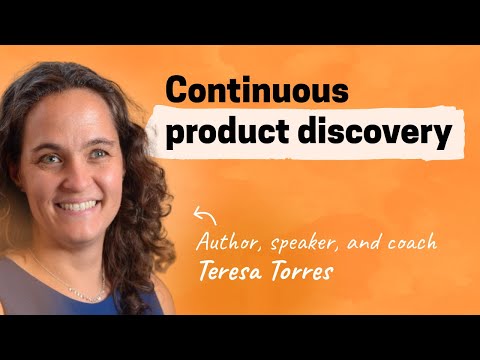
Build better products with continuous product discovery | Teresa Torres
Teresa Torres (guest), Lenny Rachitsky (host)
In this episode of Lenny's Podcast, featuring Teresa Torres and Lenny Rachitsky, Build better products with continuous product discovery | Teresa Torres explores continuous discovery turns product bets into smarter, customer-informed decisions Teresa Torres explains continuous product discovery as a way to constantly improve the quality of product bets by integrating ongoing customer learning into everyday work. She introduces the Opportunity Solution Tree, a visual framework that helps teams move from vague outcomes to concrete customer problems and multiple solution options. A major focus is on interviewing customers weekly, automating recruitment, and learning to elicit rich stories rather than shallow opinions. Throughout, she emphasizes empowered product trios, small and fast assumption tests, and shifting organizations away from project-based, feature-factory mindsets.
Continuous discovery turns product bets into smarter, customer-informed decisions
Teresa Torres explains continuous product discovery as a way to constantly improve the quality of product bets by integrating ongoing customer learning into everyday work. She introduces the Opportunity Solution Tree, a visual framework that helps teams move from vague outcomes to concrete customer problems and multiple solution options. A major focus is on interviewing customers weekly, automating recruitment, and learning to elicit rich stories rather than shallow opinions. Throughout, she emphasizes empowered product trios, small and fast assumption tests, and shifting organizations away from project-based, feature-factory mindsets.
Key Takeaways
Treat every backlog item as a bet and use discovery to improve bet quality.
Discovery doesn’t eliminate risk; it helps you make progressively better-informed decisions instead of blindly shipping features.
Get the full analysis with uListen
Run discovery and delivery in parallel, continuously, rather than as phases.
You should always be shipping and always be learning from customers, so that each new iteration benefits from fresher insight and reduced risk.
Get the full analysis with uListen
Use Opportunity Solution Trees to separate problem space from solution space.
Start from a clear outcome, map customer opportunities (needs, pains, desires) via an experience map, and only then generate and compare multiple solutions.
Get the full analysis with uListen
Anchor interviews in recent customer stories, not hypotheticals or opinions.
Ask people to walk through specific past experiences (“What happened next? ...
Get the full analysis with uListen
Automate weekly customer interviews so they appear on your calendar by default.
Use in-product prompts or customer-facing teams (sales, support, account managers) plus scheduling tools to let users opt in, making interviewing easier than not doing it.
Get the full analysis with uListen
Mitigate solution bias by exploring multiple options for the same opportunity.
When a problem is core or high-risk, generate and test several solution ideas in parallel, using lightweight assumption tests rather than one big, slow experiment.
Get the full analysis with uListen
Empower product trios to decide together instead of relying on a single decider.
High-functioning teams with a shared understanding of customers can reconcile disagreements by seeking better options, leading to more cohesive and innovative products.
Get the full analysis with uListen
Notable Quotes
“Everything in our backlog is a bet. Everything. Whether we do discovery or not, everything is a bet.”
— Teresa Torres
“No, you're always delivering and you're always discovering.”
— Teresa Torres
“The heart of good product is really getting comfortable in the problem space.”
— Teresa Torres
“If your interview feels like you're having a beer with a buddy, that's a good sign.”
— Teresa Torres
“I don’t know why product teams suddenly are held to a standard that nobody else is held to.”
— Teresa Torres
Questions Answered in This Episode
How can I introduce continuous discovery practices in a strong feature-factory culture without triggering organizational backlash?
Teresa Torres explains continuous product discovery as a way to constantly improve the quality of product bets by integrating ongoing customer learning into everyday work. ...
Get the full analysis with uListen AI
What are some concrete examples of well-structured opportunities versus disguised solutions in my own product area?
Get the full analysis with uListen AI
How do I train my team to interview for stories and behaviors instead of opinions, especially if they’re used to script-driven research?
Get the full analysis with uListen AI
Where in our product could small, fast assumption tests replace lengthy, high-cost experiments without sacrificing learning quality?
Get the full analysis with uListen AI
What would it take for our PM–design–engineering trio to truly share decision-making power, and what current habits or structures stand in the way?
Get the full analysis with uListen AI
Transcript Preview
Everything in our backlog is a bet. Everything. Whether we do discovery or not, everything is a bet. Discovery is helping us make a better bet. Now, sometimes in our organizations, we need to do a lot of discovery and make as good of a bet as we can. But there's other times we can make a risky bet. Like, there's times in business where it makes sense to make a risky bet. If you work somewhere where all of your bets have been risky 'cause you're doing zero discovery, the best way to kill any appetite for discovery is to say, "Let's stop making bets until we discover." No. Don't do that. Keep making bets. In parallel, start doing some discovery so that eventually, those bets get better. And I think the reason why people make this mistake is they think about it as phases. First I discover and then I deliver. No, you're always delivering and you're always discovering. And the more you build this discovery habit, the better those bets are going to get with time. So it's not that you do one first and then the other, it's you're always doing both. And the benefit of always doing both is with time you make better bets.
(instrumental music) Teresa Torres is a speaker, a teacher, a consultant, a product coach, and also the author of Continuous Discovery Habits, which is the number one most recommended book in my newsletter Slack community. I'm also pretty sure Teresa is in the top five people in the world when it comes to the number of product managers that she's worked with, taught, and impacted. In our chat, we get deep into two topics, the Opportunity Solution Tree framework, which is a really simple but incredibly powerful framework once you know it, and two, we go deep into how to create a system within your team where you're talking to customers regularly. We talk about ways to make a case for spending more time talking to customers and doing user research, the most common mistakes people make when interviewing and generally how to interview customers better, how to automate this process so that you don't spend a bunch of time, and so many other ways to bring you and your organization closer to your customers. Teresa is amazing, and I can't wait for you to learn from her. This episode is brought to you by Persona. Persona helps founders, product managers, and engineers easily solve any identity related problem, including handling KYC, AML, and basically all manner of identity fraud. You can integrate Persona in an afternoon and personalize your flows using their SDK to meet your users on any device. Persona's identity building blocks allow you to manage your entire end-to-end onboarding flow, verifying that each new user and their data are legitimate. Persona is trusted by both startups and the world's largest companies, including Square, BlockFi, Gusto, and Udemy. And for a limited time, Persona is offering listeners of this podcast a free end-to-end KYC and AML solution where you can collect a user's government ID and/or their selfie and automatically verify that those two pieces of data are legitimate. You can also enrich that information to automatically see if the person exists on various watchlists. Just go to withpersona.com/lenny to get started. So many product managers are basically treated like project managers. They get hired thinking they'll be deep in product strategy, vision, and getting to know their customers, only to wind up organizing other people's work and refining backlogs and organizing tiny, tiny features. If that sounds familiar, you need Dovetail, because Dovetail gets that the true heart of product management is understanding what customers want, why they want it, and how to give it to them. That's why Dovetail built a suite of user research products that help you get to the core of what your customers really want and why they want it. Dovetail offers powerful analysis tools to help you identify themes, patterns, and insights in your customer interviews, allowing you to make better data-informed decisions about what solutions you should build next. Organizations the world over, like Atlassian, Canva, DataDog, GitLab, Nielsen Norman Group, Sketch, Deloitte, all use Dovetail to get a better understanding of their customers and build better products. Try Dovetail's products for free for as long as you need. You can sign up and dive straight in at dovetailapp.com/lenny. Teresa, thank you so much for being here. I don't know if you know this, but your book is consistently the number one most recommended book in my Slack community, and also I've personally learned so much from you, from your writing and just your tweets and all the ways that you share your lessons. And so I'm really excited to delve into continuous discovery and all the things that you teach. And so again, thank you for being here, and welcome.
Install uListen to search the full transcript and get AI-powered insights
Get Full TranscriptGet more from every podcast
AI summaries, searchable transcripts, and fact-checking. Free forever.
Add to Chrome