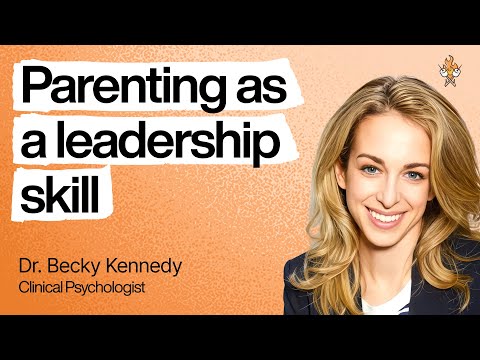
A child psychologist’s guide to working with difficult adults | Dr. Becky Kennedy
Lenny Rachitsky (host), Dr. Becky Kennedy (guest)
In this episode of Lenny's Podcast, featuring Lenny Rachitsky and Dr. Becky Kennedy, A child psychologist’s guide to working with difficult adults | Dr. Becky Kennedy explores parenting principles for leading adults, building sturdy workplace relationships daily Lenny Rachitsky and Dr. Becky Kennedy explore why many workplace conflicts resemble child-development dynamics: unmet needs, big feelings, and missing skills driving “bad behavior.”
Parenting principles for leading adults, building sturdy workplace relationships daily
Lenny Rachitsky and Dr. Becky Kennedy explore why many workplace conflicts resemble child-development dynamics: unmet needs, big feelings, and missing skills driving “bad behavior.”
Kennedy argues that the healthiest cultures (at home or work) prioritize resilience over short-term happiness, using repair, connection-before-correction, and clear boundaries to build trust and cooperation.
She introduces actionable frameworks—separating identity from behavior (“good inside”), the Most Generous Interpretation (MGI), and “I believe you / I believe in you”—to replace judgment with curiosity while still holding standards.
The conversation ends with practical boundary scripts, a “sturdy leader” metaphor (the pilot in turbulence), and a glimpse into Kennedy’s Good Inside product ecosystem and how she uses AI to prototype ideas quickly.
Key Takeaways
Repair is the fastest path back to trust and productivity.
Secure relationships aren’t built on perfection; they’re built on returning after a misstep, taking responsibility, naming impact, and stating what you’ll do differently. ...
Get the full analysis with uListen
Connection creates the bridge that makes correction possible.
People (kids and adults) resist when they feel treated like an object in someone else’s agenda. ...
Get the full analysis with uListen
Assume “good inside” to keep behavior conversations from becoming identity battles.
When feedback sounds like an indictment of character (“you’re lazy”), people get defensive and behavior change stalls. ...
Get the full analysis with uListen
Use the Most Generous Interpretation (MGI) to replace blame with actionable diagnosis.
MGI isn’t excusing behavior; it’s choosing a working hypothesis that reveals what skill/need is missing (e. ...
Get the full analysis with uListen
Bad behavior is often ‘feelings overpowering skills,’ not deliberate ‘bad choices.’
Kennedy reframes misconduct as a signal of underdeveloped regulation skills (jealousy, shame, anxiety, control threats). ...
Get the full analysis with uListen
Sturdy leaders validate emotions without handing over the cockpit.
The “pilot in turbulence” metaphor distinguishes three styles: dismissive (“stop freaking out”), collapsed (“you fly the plane”), and sturdy (“I hear you; it’s bumpy; I know what I’m doing”). ...
Get the full analysis with uListen
A boundary is what you will do; a request depends on them.
If success requires the other person to comply, you’re making a request—not setting a boundary. ...
Get the full analysis with uListen
Optimize for resilience, not comfort—especially early in relationships.
Avoiding hard feedback or discomfort builds fragile foundations; later corrections feel like betrayal. ...
Get the full analysis with uListen
The ‘I believe you / I believe in you’ formula de-escalates and empowers.
One foot in the hole (validate: “This makes sense”) and one foot out (confidence: “You can handle this; I’ll support you”) helps people regulate and act. ...
Get the full analysis with uListen
Clarify ownership to reduce control-triggered resistance.
Some people are especially sensitive to perceived control loss (“resilient rebels”). ...
Get the full analysis with uListen
Notable Quotes
““All humans need the same things, whether we’re one or five or forty-five or eighty-five.””
— Dr. Becky Kennedy
““Perfect is creepy.””
— Dr. Becky Kennedy
““Boundaries are what you tell someone else you will do, and it requires the other person to do nothing.””
— Dr. Becky Kennedy
““You can’t be judgmental when you’re curious, and when you’re judgmental you’re not curious.””
— Dr. Becky Kennedy
““This feels hard because it is hard, not because I’m doing something wrong.””
— Dr. Becky Kennedy
Questions Answered in This Episode
In a real workplace example, what does a ‘repair’ script look like when the power dynamic is uneven (e.g., CEO to IC vs. IC to manager)?
Lenny Rachitsky and Dr. ...
Get the full analysis with uListen AI
How do you apply ‘connect before correct’ without it feeling manipulative or like a prelude to criticism (especially in performance conversations)?
Kennedy argues that the healthiest cultures (at home or work) prioritize resilience over short-term happiness, using repair, connection-before-correction, and clear boundaries to build trust and cooperation.
Get the full analysis with uListen AI
Where’s the line between ‘most generous interpretation’ and ignoring repeated poor performance—how many cycles before you change your interpretation?
She introduces actionable frameworks—separating identity from behavior (“good inside”), the Most Generous Interpretation (MGI), and “I believe you / I believe in you”—to replace judgment with curiosity while still holding standards.
Get the full analysis with uListen AI
If boundaries require the other person to do nothing, what are the best boundary formulations for common work issues (missed deadlines, meeting hijacking, disrespectful tone)?
The conversation ends with practical boundary scripts, a “sturdy leader” metaphor (the pilot in turbulence), and a glimpse into Kennedy’s Good Inside product ecosystem and how she uses AI to prototype ideas quickly.
Get the full analysis with uListen AI
How would you coach a leader who over-indexes on ‘I believe you’ (validation) and avoids the ‘I believe in you’ part (standards/expectations)?
Get the full analysis with uListen AI
Transcript Preview
Most adults in the corporate environment are really just babies in disguise.
All humans need the same things, whether we're one or five or forty-five or eighty-five. When you look at bad behavior, the actual problem is someone doesn't have the skill they need to manage something happening internally.
Love your advice. It works not just for kids, it works for adults.
Our whole parenting philosophy is resilience over happiness. When we're thinking about a resilient work culture, we want people who can say, "This is hard, and I can do hard things."
You teach kids are good inside, no matter their behavior. Is that useful in work?
The idea of being good inside inherently requires us to separate behavior and identity. We infer a lot from people's behavior. Someone's late to work a lot, "Oh, that person's lazy." The quickest way to have an unproductive conversation is to lose sight of the fact that someone's good inside.
I definitely wanted to ask you about this idea of boundaries.
Boundaries are what you tell someone else you will do, and it requires the other person to do nothing. Making a request, it's not a boundary.
Is there a corollary to adult work environments in potty learning? [upbeat music] Today, my guest is Dr. Becky Kennedy, a clinical psychologist, author, and CEO of one of the most popular parenting books, podcasts, communities, and apps called Good Inside. Why would I have a parenting expert on this podcast? Because if you think about it, many of the people that we work with in the workplace act a lot more like babies than adults, and I'm half joking, but I'm half not. Think about coworkers that got really mad when they had to share their stuff, that always need to be the center of attention, that get really upset about not getting their way, that need other people to fix things for them. These are just a few examples, and there is a lot that we can learn about how to effectively deal with people at work from a parenting expert like Dr. Becky. I have never heard a conversation like this anywhere that bridges the gap between parenting advice and leadership advice, and you will leave this conversation both a better leader and a better parent. We talk about the power of repair, the importance of building long-term resilience versus short-term happiness, why your goal as a leader is to become sturdy, the power of curiosity over judgment, a framework Dr. Becky calls the most generous interpretation. Also, a ton of really specific phrases that work really well with kids and adults who you're having a hard time with, and so much more. I am so honored to have Dr. Becky on this podcast, and I hope you have as much fun listening to this conversation as I had recording it. If you enjoy this podcast, don't forget to subscribe and follow it in your favorite podcasting app or YouTube. That helps tremendously. And if you become an annual subscriber of my newsletter, you get a year free of a ton of incredible products, including a year free of Devin, Lovable, Replit, Bolt, n8n, Linear, Superhuman, Descript, Whisperflow, Gamma, Perplexity, Warp, Granola, Magic Pattern, Drake, Cast, Chapia, dMob, PostHog, and Stripe Atlas. Head on over to lennysnewsletter.com and click Product Pass. With that, I bring you Dr. Becky, after a short word from our sponsors. This episode is brought to you by Merge. Product leaders hate building integrations. They're messy, they're slow to build, they're a huge drain on your roadmap, and they're definitely not why you got into product in the first place. Lucky for you, Merge is obsessed with integrations. With a single API, B2B SaaS companies embed Merge into their product and ship two hundred and twenty-plus customer-facing integrations in weeks, not quarters. Think of Merge like Plaid, but for everything B2B SaaS. Companies like Mistral AI, Ramp, and Drata use Merge to connect their customers' accounting, HR, ticketing, CRM, and file storage systems to power everything from automatic onboarding to AI-ready data pipelines. Even better, Merge now supports the secure deployment of connectors to AI agents with a new product, so that you can safely power AI workflows with real customer data. If your product needs customer data from dozens of systems, Merge is the fastest, safest way to get it. Book and attend a meeting at merge.dev/lenny, and they'll send you a fifty-dollar Amazon gift card. That's merge.dev/lenny. Who says hiring has to be fair? Every founder and hiring manager I've been speaking with these days is feeling the same pressure: hire the best people as fast as possible. But recruiting is time-consuming, alignment is hard, and competition for great talent keeps getting tighter. That's why teams like Eleven Labs, Brex, Replit, Deal, and five thousand other organizations use Metaview, the AI company giving high-performance teams a real unfair advantage in hiring. They give you a suite of AI agents that behave like recruiting coworkers. They find candidates for you based on your exact criteria, take interview notes automatically, gather insights across your hiring process, and help you identify the best candidates in your pipeline. AI handles the recruiting toil and gives you a real source of truth. That means hours saved per hire and a team focused on what matters most: winning the right candidates. Don't let your competitors outhire you. Metaview customers close roles thirty percent faster. Try Metaview today for free and get an extra month of sourcing at metaview.ai/lenny. That's M-E-T-A view.ai/lenny. [upbeat music] Dr. Becky, thank you so much for being here, and welcome to the podcast.
Install uListen to search the full transcript and get AI-powered insights
Get Full TranscriptGet more from every podcast
AI summaries, searchable transcripts, and fact-checking. Free forever.
Add to Chrome