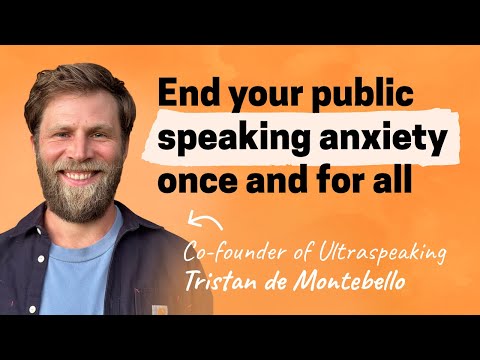
Why most public speaking advice is wrong—and how to finally overcome anxiety | Tristan de Montebello
Tristan de Montebello (guest), Lenny Rachitsky (host)
In this episode of Lenny's Podcast, featuring Tristan de Montebello and Lenny Rachitsky, Why most public speaking advice is wrong—and how to finally overcome anxiety | Tristan de Montebello explores transform Public Speaking: Flow, Games, And Ditching Bad Advice Forever Tristan de Montebello, co‑creator of UltraSpeaking, argues that public speaking is a meta-skill that, once improved, upgrades nearly every area of life—from work to relationships and self-confidence.
Transform Public Speaking: Flow, Games, And Ditching Bad Advice Forever
Tristan de Montebello, co‑creator of UltraSpeaking, argues that public speaking is a meta-skill that, once improved, upgrades nearly every area of life—from work to relationships and self-confidence.
He reframes speaking as a subconscious, flow-oriented activity we’re evolutionarily built for, and claims most advice overemphasizes scripts, tactics, and memorization instead of fixing root causes like anxiety, overthinking, and lack of conviction.
Through live on-air exercises, he demonstrates game-based training (e.g., Conductor, Triple Step, conviction prompts) that create ‘safe turbulence’ so people can practice staying present, expressive, and confident under pressure.
He also shares practical preparation frameworks like the Accordion Method and Bow-and-Arrow Technique to craft talks that are clear, memorable, and internalized rather than rigidly memorized.
Key Takeaways
Treat public speaking as a meta-skill, not a niche talent.
Improving speaking doesn’t just help with presentations; it boosts confidence, leadership, relationships, and how you show up in every room. ...
Aim for flow, not perfection or tactics overload.
We speak best when we’re not thinking about speaking—when we’re immersed in the message and the audience. ...
If you don’t enjoy speaking, you’re probably doing it wrong.
Enjoyment is a barometer: when you’re speaking like yourself (conversationally, not in a ‘public speaking voice’), communication is naturally rewarding and connecting. ...
Look up, end strong, and stay in character to project confidence.
Three simple behavioral shifts: ‘think up’ instead of looking down when searching for words, use summary prompts to land your answers decisively (“So my point is…”), and never voice your insecurities mid-talk. ...
Use games to create low-stakes ‘turbulence’ and build resilience.
Exercises like Conductor (varying intensity), Triple Step (weaving in random words), and conviction prompts intentionally disrupt your comfort so you can practice recovering gracefully. ...
Prepare talks by speaking, not writing: apply the Accordion Method.
Instead of scripting, repeatedly give your talk in shrinking time windows (e. ...
Design every talk—and every slide—around a single ‘one thing’.
Using the Bow-and-Arrow Technique, define the one sentence you’d be happy for people to remember, then add only the stories, data, and examples that add weight to that idea. ...
Notable Quotes
“Speaking is not a specialized skill, it's a meta-skill. That means that the better you get at speaking, the better your life gets.”
— Tristan de Montebello
“The day I understood that speaking was a subconscious, flow-oriented process and not a conscious process completely changed the way I approached it.”
— Tristan de Montebello
“If you don't enjoy speaking, you're doing it wrong.”
— Tristan de Montebello
“Pros are just amateurs who've learned to recover gracefully from their mistakes.”
— Tristan de Montebello (quoting Kevin Kelly)
“Most of us focus more on what we want to say than what we want our audience to remember.”
— Tristan de Montebello
Questions Answered in This Episode
How would your speaking change if your only goal was to enjoy it more instead of to “do it right”?
Tristan de Montebello, co‑creator of UltraSpeaking, argues that public speaking is a meta-skill that, once improved, upgrades nearly every area of life—from work to relationships and self-confidence.
In your next talk or meeting, what is the single ‘one thing’ you actually want people to remember afterward?
He reframes speaking as a subconscious, flow-oriented activity we’re evolutionarily built for, and claims most advice overemphasizes scripts, tactics, and memorization instead of fixing root causes like anxiety, overthinking, and lack of conviction.
Where do you most often ‘leak’—apologizing, hedging, or undercutting yourself—and what would it look like to stay in character instead?
Through live on-air exercises, he demonstrates game-based training (e. ...
Which part of your speaking software feels most ‘buggy’ right now: pausing, expressing emotion, conviction, or handling surprises?
He also shares practical preparation frameworks like the Accordion Method and Bow-and-Arrow Technique to craft talks that are clear, memorable, and internalized rather than rigidly memorized.
If you used the Accordion Method on a key story or pitch you give often, what might you cut—and what powerful core might emerge?
EVERY SPOKEN WORD
Install uListen for AI-powered chat & search across the full episode — Get Full Transcript
Get more out of YouTube videos.
High quality summaries for YouTube videos. Accurate transcripts to search & find moments. Powered by ChatGPT & Claude AI.
Add to Chrome