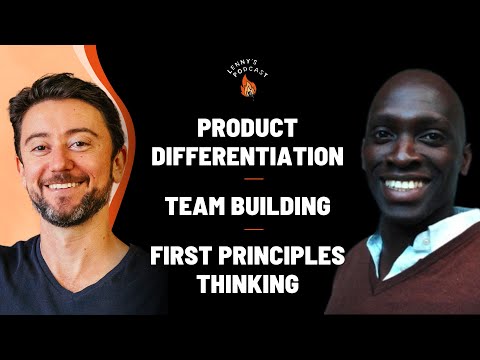
Frameworks for product differentiation, team building, and first principles thinking | Ayo Omojola
Ayo Omojola (guest), Lenny Rachitsky (host)
In this episode of Lenny's Podcast, featuring Ayo Omojola and Lenny Rachitsky, Frameworks for product differentiation, team building, and first principles thinking | Ayo Omojola explores building Cash App: Differentiation, founder-led teams, and deep execution discipline Lenny interviews Ayo Omojola about how Cash App became a rare breakout consumer product and what he’s now applying at Carbon Health. Ayo explains that Cash App’s success came from a stack of disciplines—clear differentiation, small senior teams, strong design, and deep understanding of regulation and infrastructure—rather than a single silver bullet. He shares practical frameworks for product differentiation, how to run a true “startup within a startup,” and why he intentionally hires ex-founders despite the challenges. The conversation closes with lessons for health-tech founders, Carbon Health’s vertically integrated model, and Ayo’s philosophies on hiring, networking, and going deep on problems.
Building Cash App: Differentiation, founder-led teams, and deep execution discipline
Lenny interviews Ayo Omojola about how Cash App became a rare breakout consumer product and what he’s now applying at Carbon Health. Ayo explains that Cash App’s success came from a stack of disciplines—clear differentiation, small senior teams, strong design, and deep understanding of regulation and infrastructure—rather than a single silver bullet. He shares practical frameworks for product differentiation, how to run a true “startup within a startup,” and why he intentionally hires ex-founders despite the challenges. The conversation closes with lessons for health-tech founders, Carbon Health’s vertically integrated model, and Ayo’s philosophies on hiring, networking, and going deep on problems.
Key Takeaways
Differentiation must be both different and better in a way that matters.
Ayo argues that simply being different is trivial, and being “better” but more expensive isn’t enough; winning products are different and better in a dimension the end user deeply values (e. ...
Get the full analysis with uListen
Compound advantages beat single “silver bullets.”
Cash App’s outcome came from many things done well—talent density, design excellence, fraud competence, consumer-first tradeoffs, regulatory depth, and organizational firewalls from the core business—rather than one magic feature.
Get the full analysis with uListen
Small, senior, tightly knit teams outperform bloated internal startups.
The early Cash App team was ~11–12 people for a long time, with high trust and experience; they achieved real scale before large headcount, avoiding the “startup within a startup” trap where team size grows faster than validated value.
Get the full analysis with uListen
In regulated, complex domains, someone must truly go to the bottom of the problem.
Whether it was physically touring card factories and testing thousands of combinations for Cash Card, or dissecting database fields and regulations at Carbon, Ayo insists that an execution owner must understand details end-to-end rather than accept shallow “expert” answers.
Get the full analysis with uListen
Intentionally hiring founders can dramatically raise output—but also churn and friction.
Ex-founders bring bias to action, depth, and bullshit detection, but they quickly spot waste, challenge the organization, and often leave after ~2–2. ...
Get the full analysis with uListen
Great hiring is long-game: you pick the people; they pick when.
Ayo treats hiring as ongoing relationship-building—meeting people early, adding value to their goals, and staying in touch so that when timing aligns, they’re eager to work together, instead of relying only on job postings and inbound résumés.
Get the full analysis with uListen
Health-tech success often hinges more on networks and crisp use cases than pure merit.
In healthcare, access to decision-makers at payers and large institutions is highly network-dependent; founders need sharply defined use cases and intros to the right buyers, or a strong direct-to-consumer wedge like Carbon Health to bypass institutional gatekeepers.
Get the full analysis with uListen
Notable Quotes
“Being different is not enough. Being better is not enough. It has to be better than what exists today in a way that matters to the end user.”
— Ayo Omojola
“For three or four years in the United States, the fastest and lowest cost way to move money between any two people with bank accounts was Cash App.”
— Ayo Omojola
“We had real scale and a real business before we had real headcount.”
— Ayo Omojola
“You can’t stop till you get to the end. In complex, regulated environments you just cannot avoid the details.”
— Ayo Omojola
“When you’re hiring, you pick the people, but they pick when.”
— Ayo Omojola
Questions Answered in This Episode
How can early-stage founders practically discover a differentiation that is both meaningfully different and clearly better to their target users, rather than just incrementally improved?
Lenny interviews Ayo Omojola about how Cash App became a rare breakout consumer product and what he’s now applying at Carbon Health. ...
Get the full analysis with uListen AI
What concrete mechanisms can leaders use inside large companies to protect a small, senior internal startup from organizational politics and resource bloat?
Get the full analysis with uListen AI
How do you decide which problems are worth the cost of going all the way to “the end” of the details, and which ones can be safely handled with heuristics?
Get the full analysis with uListen AI
What structures or career paths could help retain founder-type hires longer while still honoring their ambition to eventually build or lead something of their own?
Get the full analysis with uListen AI
In healthcare specifically, how can a technically strong but under-networked founder compensate for the industry’s heavy reliance on relationships with payers and large institutions?
Get the full analysis with uListen AI
Transcript Preview
... Cash App as a team, we really cared about what we could do that was different and better than what else existed in market. Being different is not enough 'cause it's very easy to build a thing that's different from what exists today 'cause you just have to look at what exists today and build something else. Being better is not enough because it's also easy to say, "Hey, I'm going to make this thing better and just charge you more money for it." (laughs) It has to be better than what exists today in a way that matters to the end user. And for us, for a long time, it was. When someone says, "Hey, why are you better than Venmo?" I'll be like, "Try and send me a dollar that I can use now." And there's only one app you can do it with.
(instrumental music) Welcome to Lenny's Podcast, where I interview world-class product leaders and growth experts to learn from their hard-won experiences building and growing today's most successful products. Today my guest is Ayo Omodola. Ayo co-created and scaled Square's popular Cash Card alongside the hugely popular Cash App. He's currently chief product officer at Carbon Health, one of the biggest and fastest growing health tech companies in the world. He's a former founder. He's on the board of Pinwheel, and he's an angel investor in companies like Mercury Bank, Fair, Modern Treasury, and dozens of other startups. In today's episode, we dig into lessons from building and scaling the Cash Card and the Cash App, the importance of differentiation when you're building a consumer product or any sort of product, how to successfully build a startup within a startup, how to succeed in both fintech and in health tech, plus my favorite part of the conversation, a handful of incredibly insightful and practical principles and philosophies around hiring, team building, leadership, and going deep on problems. Ayo is such a fascinating human and leader, and I am excited for you to learn from him. With that, I bring you Ayo Omodola after a short word from our sponsors. This episode is brought to you by Microsoft Clarity, a free, easy-to-use tool that captures how real people are actually using your site. You can watch live session replays to discover where users are breezing through your flow and where they struggle. You can view instant heat maps to see what parts of your page users are engaging with and what content they're ignoring. You can also pinpoint what's bothering your users with really cool frustration metrics like rage clicks, and dead clicks, and much more. If you listen to this podcast, you know how often we talk about the importance of knowing your users. And by seeing how users truly experience your product, you can identify product opportunities, conversion wins, and find big gaps between how you imagine people using your product and how they actually use it. Microsoft Clarity makes it all possible with a simple yet incredibly powerful set of features. You'll be blown away by how easy Clarity is to use. And it's completely free forever. You'll never run into traffic limits or be forced to upgrade to a paid version. It also works across both apps and websites. Stop guessing. Get Clarity. Check out Clarity at clarity.microsoft.com. This episode is brought to you by Eko. Last month, Eko users earned an average of $84 in cash back rewards. How? With Eko, the future of personal finance. Eko is the update to a misaligned financial system, providing an app that works just like your bank but removes almost all of the middlemen, helping even the best money optimizers optimize in less time automatically. What if you earned rewards for paying your rent or got rewarded for ordering food and shopping online or even earned rewards for saving each month? And then imagine if you got rewarded again just for getting rewarded. With Eko, you can spend at some of your favorite merchants and automatically get 5% cash back. Plus Eko's APY rewards look more like $80 not 80 cents. And then there are Eko Points, the world's first open reward system. You earn them whenever you do almost anything in the Eko app. Eko is working to make these points the most rewarding points ever, so it pays to be early. Sound too good to be true? Go to eko.com/lenny, sign up for an onboarding, and find out why it isn't. Lenny's Podcast listeners who attend an Eko welcome session will get an exclusive 4% APY on deposits over $1,000. Learn more at eko.com/lenny. That's eko.com/lenny. Ayo, welcome to the podcast.
Install uListen to search the full transcript and get AI-powered insights
Get Full TranscriptGet more from every podcast
AI summaries, searchable transcripts, and fact-checking. Free forever.
Add to Chrome