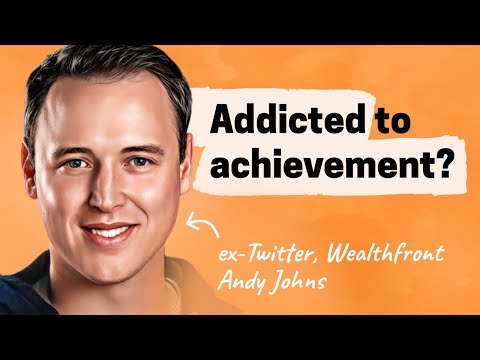
When enough is enough | Andy Johns (ex-FB, Twitter, Quora)
Andy Johns (guest), Lenny Rachitsky (host)
In this episode of Lenny's Podcast, featuring Andy Johns and Lenny Rachitsky, When enough is enough | Andy Johns (ex-FB, Twitter, Quora) explores ex-growth leader Andy Johns on burnout, suffering, and true change Former Facebook, Twitter, Quora, and Wealthfront executive Andy Johns shares how severe burnout and unprocessed childhood trauma led him to walk away from a peak career and income to focus on mental health advocacy. He describes what real burnout looks like, how to recognize when "normal" stress has crossed into danger, and why so many high achievers tie their self-worth to performance. Andy lays out a four-step framework for deep personal transformation—suffering, seeking truth, self-compassion, and compassion for others—and explains why this process is long, difficult, and often resisted. He now helps burned-out high performers and veterans, arguing that each person must find their own unique path to healing rather than copying others’ playbooks.
Ex-growth leader Andy Johns on burnout, suffering, and true change
Former Facebook, Twitter, Quora, and Wealthfront executive Andy Johns shares how severe burnout and unprocessed childhood trauma led him to walk away from a peak career and income to focus on mental health advocacy. He describes what real burnout looks like, how to recognize when "normal" stress has crossed into danger, and why so many high achievers tie their self-worth to performance. Andy lays out a four-step framework for deep personal transformation—suffering, seeking truth, self-compassion, and compassion for others—and explains why this process is long, difficult, and often resisted. He now helps burned-out high performers and veterans, arguing that each person must find their own unique path to healing rather than copying others’ playbooks.
Key Takeaways
Achievement can become an unhealthy adaptation that eventually turns against you.
Andy used achievement to cope with the trauma of losing his mentally ill mother, which worked for decades but later morphed into a compulsive need to succeed that drove him into severe burnout and health scares.
Get the full analysis with uListen
Deep burnout is usually signaled by breakdowns in core life functions.
It’s time to take your mental health seriously when sleep, physical health, relationships, basic enjoyment, or socialization are consistently impaired—these are the body’s “flashing red alarms” that something must change.
Get the full analysis with uListen
Lasting personal transformation tends to follow four stages.
Andy’s framework: (1) Suffering, often severe enough to force change; (2) Seeking the truth about why you suffer, especially in your history and subconscious patterns; (3) Developing self-compassion once you see it’s often “not your fault”; and (4) Extending that compassion outward as you recognize others are acting from their own wounds.
Get the full analysis with uListen
Therapy isn’t the only path; honest, structured self-reflection also works.
If you’re not ready for a therapist, Andy recommends daily writing with pen and paper—especially exploring moments when you’re most emotionally reactive and repeatedly asking “why? ...
Get the full analysis with uListen
Choosing the right therapist is more like speed dating than following credentials.
The most important factor is feeling genuinely safe and seen; ideally, you also respect their intellect so you can be influenced by their insights. ...
Get the full analysis with uListen
Societal conditioning often blocks change by trading authenticity for acceptance.
From childhood, we learn to suppress our individuality to be loved and fit into family, school, and work; real transformation often requires consciously breaking with these inherited scripts and risking disapproval to rediscover who you were before the world told you who to be.
Get the full analysis with uListen
Allowing change means surrendering control and trusting life’s “current.”
Andy contrasts his old life of endlessly climbing new mountains of achievement with his new approach of “floating downriver”—letting go of over-planning and optimization, paying attention to inner signals, and allowing the next right step to emerge rather than forcing it.
Get the full analysis with uListen
Notable Quotes
“As my career reached its pinnacle, I was arguably at my lowest.”
— Andy Johns
“I learned very early on that if I wanted to feel good and be considered lovable, I needed to achieve.”
— Andy Johns
“When your sleep always sucks, your relationships are strained, or your physical health is failing, your body is telling you, ‘Stop. Something needs to change.’”
— Andy Johns
“My stepping away from the high salary and everything I’d worked so hard to obtain wasn’t running from something; I was running back towards myself.”
— Andy Johns
“Everyone’s trying to make it to Bangkok. The problem is, they’re getting there by following somebody else’s road. The whole point is to find your own path to Bangkok.”
— Andy Johns (relaying a story from a Thai farmer)
Questions Answered in This Episode
How do I distinguish between normal, cyclical work stress and the kind of burnout that calls for major life changes?
Former Facebook, Twitter, Quora, and Wealthfront executive Andy Johns shares how severe burnout and unprocessed childhood trauma led him to walk away from a peak career and income to focus on mental health advocacy. ...
Get the full analysis with uListen AI
If my identity and income are tightly tied to my role, how can I realistically explore transformation without blowing up my financial stability?
Get the full analysis with uListen AI
What specific journaling prompts or practices can help me surface subconscious beliefs about my self-worth and achievement?
Get the full analysis with uListen AI
How do I know whether I’m making a necessary micro-transition (like changing jobs) versus avoiding a deeper identity-level shift?
Get the full analysis with uListen AI
In practical terms, what does it look like to “float downriver” and surrender control while still acting responsibly in career and family life?
Get the full analysis with uListen AI
Transcript Preview
Th- there are day-to-day stresses that are normal and we just have to put up with, you know? (laughs) But then there's the other stuff that's kind of the, the flashing red alarm. Again, and you can go back to animals, it's like when their fundamental functions, when their core behaviors of diet, exercise, playfulness, socialization, sleep, when those things get disrupted, it, it's a sign that there is something going on here that you need to take a look at. And so the, the same is true with people. If your sleep always sucks, if your relationships are constantly strained or frequently strained, if your physical health is failing, you know? (laughs) There's so many ways that, that can be measured. So there's really no excuse for that, to say like, "Oh, I just didn't know." I'd say it's to look at those things. Like when those are suffering or when they're really out of whack, it's undeniable that there is something that is detrimental to your well-being that's going on right now, and your body is telling you, like, "Stop. Something needs to change."
(instrumental music) Welcome to Lenny's Podcast, where I interview world class product leaders and growth experts to learn from their hard won experiences building and growing today's most successful products. Today my guest is Andy Johns. This is gonna be a very different type of episode and maybe the most meaningful and important episode of the podcast. Andy was a legendary product and growth leader at Facebook, Twitter, Quora and Wealthfront where he was VP of Growth and VP of Product and then President and as you'll hear, was in line to be CEO of Wealthfront until he came to realize that this path was not right for him. And after a lot of internal reflection and hard self-work, he changed his entire life's path to becoming a mental health advocate and helping burned out high achievers and also veterans with their mental health journey. In our conversation, Andy shares his personal story, what true burnout looks like, and when you should pay attention to your mental health, talks about the process of deep personal transformation, and the four steps involved in making lasting change in your life. He also shares how to actually allow change to happen in your life, tactics for moving down this path, and a lot of advice and real talk on mental health and tech. There's a lot of struggle happening in the world right now, including in tech, and so I hope this conversation helps you with your own journey. You can check out Andy's work at clues.life. With that, I bring you Andy Johns after a short word from our sponsors. This episode is brought to you by Mercury, who I also happen to use for my business checking account. I've tried a lot of business banks and there's nothing even close to the experience you get with Mercury. I moved cash over from another bank and it literally took less than half an hour to set up the account and wire money over at no cost. They kinda make you want to use the site more often, which I've never felt with another banking site. Mercury is banking engineered for the startup journey. A modern solution to help your company become the best version of itself and Mercury isn't just a place to hold and send money. It's software built to help you scale with safety and stability whether you're a team of two or a team of 1,000. Mercury also goes beyond banking to provide you with access to the foremost investors, operators and tools. Visit mercury.com to join over 100 startups on Mercury, the powerful and intuitive way for ambitious companies to bank. Mercury is a financial technology company, not a bank. Banking services provided by Choice Financial Group and Evolve Bank and Trust. Members FDIC. This episode is brought to you by Coda. You've heard me talk about how Coda is the doc that brings it all together and how it can help your team run smoother and be more efficient. I know this firsthand because Coda does that for me. I use Coda every day to wrangle my newsletter content calendar, my interview notes for podcasts, and to coordinate my sponsors. More recently, I actually wrote a whole post on how Coda's product team operates and within that post, they shared a dozen templates that they use internally to run their product team including managing the roadmap, their OKR process, getting internal feedback, and essentially their whole product development process is done within Coda. If your team's work is spread out across different documents and spreadsheets and a stack of workflow tools, that's why you need Coda. Coda puts data in one centralized location regardless of format, eliminating road blocks that can slow your team down. Coda allows your team to operate on the same information and collaborate in one place. Take advantage of this special limited time offer just for startups. Sign up today at coda.io/lenny and get $1,000 starter credit on your first statement. That's coda.io/lenny to sign up and get a starter credit of $1,000. Coda.io/lenny. Andy, thank you so much for being here and welcome to the podcast.
Install uListen to search the full transcript and get AI-powered insights
Get Full TranscriptGet more from every podcast
AI summaries, searchable transcripts, and fact-checking. Free forever.
Add to Chrome