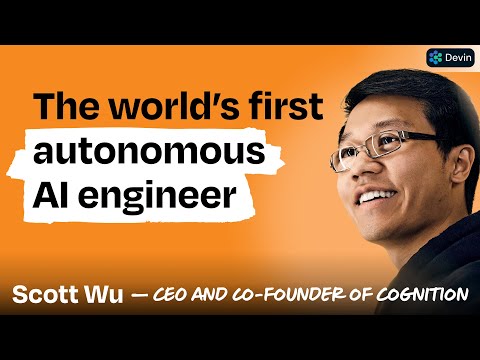
Inside Devin: The AI engineer that's set to write 50% of its company’s code this year | Scott Wu
Scott Wu (guest), Lenny Rachitsky (host), Narrator, Narrator
In this episode of Lenny's Podcast, featuring Scott Wu and Lenny Rachitsky, Inside Devin: The AI engineer that's set to write 50% of its company’s code this year | Scott Wu explores inside Devin: How AI Engineers Are Reshaping Software Teams and Workflows Cognition Labs CEO Scott Wu explains Devin, an autonomous AI software engineer that companies use like a junior remote developer via Slack, Linear, and GitHub.
Inside Devin: How AI Engineers Are Reshaping Software Teams and Workflows
Cognition Labs CEO Scott Wu explains Devin, an autonomous AI software engineer that companies use like a junior remote developer via Slack, Linear, and GitHub.
Within Cognition’s 15-person engineering team, each engineer typically runs around five Devins in parallel, and roughly a quarter of their monthly pull requests are authored by Devin—expected to exceed 50% by year-end.
Wu argues AI will shift engineers from “bricklayers” to “architects,” expanding, not shrinking, the total number of programmers by making software creation far more efficient and accessible.
The conversation also covers Devin’s origin story and pivots, its agentic product design, how it learns a codebase and supports onboarding, and broader implications of AI’s explosive, hardware‑unconstrained adoption curve.
Key Takeaways
Treat Devin like a junior engineer, not a smarter autocomplete.
Wu stresses that users get the most value when they give Devin well-scoped tasks (tickets, bugs, small features) and collaborate through reviews and clarifications, just as they would with a human junior teammate.
Run multiple agents asynchronously to massively increase throughput.
At Cognition, each engineer commonly runs up to five Devins in parallel, handing off different issues and features so they can focus on higher‑level design and review instead of serial implementation work.
Start with simple, verifiable tasks to onboard Devin into your codebase.
Successful teams first let Devin handle one‑pointers—small fixes, UI tweaks, tests, documentation—while teaching it how to run CI, linting, and local tests, then gradually scale to more complex projects.
Engineers will shift from ‘bricklayers’ to ‘architects,’ but coding literacy remains crucial.
Wu argues people should absolutely still learn to code: understanding abstractions, systems, and trade‑offs is what lets humans specify what to build, peel back layers when needed, and fully leverage AI capabilities.
AI will likely increase, not decrease, demand for software engineers.
Invoking Jevons paradox, Wu predicts that as the cost and friction of building software drop, society will find far more software to build, expanding the total amount of code and the number of people involved.
Agent UX and integration matter as much as raw model capability.
Half of Cognition’s effort has gone into product design—Slack/Linear/GitHub workflows, Devin Wiki, Devin Search, confidence estimates—not just model tuning, because teams must learn *how* to work with agents effectively.
Stickiness comes from accumulated codebase knowledge and team workflows, not hard moats.
Wu thinks defensibility is less about blocking competitors and more about making Devin increasingly valuable over time as it learns your stack, captures institutional knowledge, and becomes woven into team processes.
Notable Quotes
“Devin is a fully autonomous software engineer that is gonna work on tasks end-to-end.”
— Scott Wu
“Our whole team is only like 15 engineers. We use a ton of Devin when we're building Devin.”
— Scott Wu
“I really think that programming is only going to become more and more important as AI gets more powerful.”
— Scott Wu
“One of the ways that we've kind of thought about Devin is really allowing engineers to go from bricklayer to architect.”
— Scott Wu
“As it becomes easier and easier to program, I think we're gonna have a lot more programmers, not fewer.”
— Scott Wu
Questions Answered in This Episode
How should a mid-size engineering team decide which parts of their workflow to give to Devin first, and what setup steps are non‑negotiable?
Cognition Labs CEO Scott Wu explains Devin, an autonomous AI software engineer that companies use like a junior remote developer via Slack, Linear, and GitHub.
If Devin eventually writes the majority of a company’s code, how should teams rethink code ownership, accountability, and on‑call responsibilities?
Within Cognition’s 15-person engineering team, each engineer typically runs around five Devins in parallel, and roughly a quarter of their monthly pull requests are authored by Devin—expected to exceed 50% by year-end.
What new skills or career paths will emerge for engineers in a world where they primarily architect, orchestrate, and review work from fleets of AI agents?
Wu argues AI will shift engineers from “bricklayers” to “architects,” expanding, not shrinking, the total number of programmers by making software creation far more efficient and accessible.
How does Cognition evaluate and mitigate the risks of agent autonomy—such as bad architectural decisions, subtle bugs, or security misconfigurations—at scale?
The conversation also covers Devin’s origin story and pivots, its agentic product design, how it learns a codebase and supports onboarding, and broader implications of AI’s explosive, hardware‑unconstrained adoption curve.
In a landscape where many players can build coding agents on top of similar base models, what product decisions could truly differentiate Devin five years from now?
EVERY SPOKEN WORD
Install uListen for AI-powered chat & search across the full episode — Get Full Transcript
Get more out of YouTube videos.
High quality summaries for YouTube videos. Accurate transcripts to search & find moments. Powered by ChatGPT & Claude AI.
Add to Chrome