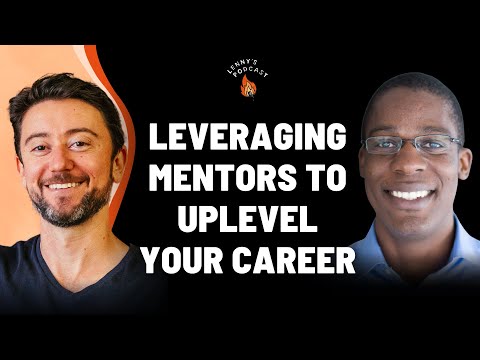
Leveraging mentors to uplevel your career | Jules Walter (YouTube, Slack)
Jules Walter (guest), Lenny Rachitsky (host), Narrator, Narrator
In this episode of Lenny's Podcast, featuring Jules Walter and Lenny Rachitsky, Leveraging mentors to uplevel your career | Jules Walter (YouTube, Slack) explores mentors, feedback, and focus: how PMs accelerate real career growth Product leader Jules Walter (YouTube, ex-Slack) shares the specific skills that matter most for product managers and how he systematically built them over his career. He splits PM skills into IQ (execution, product sense, strategy, interviewing) and EQ (communication, leadership, self-awareness, management), and explains why each becomes critical at different stages. A recurring theme is using clear outcomes, deliberate practice, and strong mentors to rapidly level up, including how he learned growth at Slack and later deeper leadership skills. Jules also details how to find mentors, earn their help, get honest feedback, and why doubling down on your strengths is often more powerful than “fixing” every weakness.
Mentors, feedback, and focus: how PMs accelerate real career growth
Product leader Jules Walter (YouTube, ex-Slack) shares the specific skills that matter most for product managers and how he systematically built them over his career. He splits PM skills into IQ (execution, product sense, strategy, interviewing) and EQ (communication, leadership, self-awareness, management), and explains why each becomes critical at different stages. A recurring theme is using clear outcomes, deliberate practice, and strong mentors to rapidly level up, including how he learned growth at Slack and later deeper leadership skills. Jules also details how to find mentors, earn their help, get honest feedback, and why doubling down on your strengths is often more powerful than “fixing” every weakness.
Key Takeaways
Treat interviewing as a core PM skill, not an afterthought.
Breaking into great companies unlocks better learning environments, but most candidates rarely do mock interviews. ...
Get the full analysis with uListen
Learn skills by setting a concrete outcome and working backwards.
When Jules joined Slack as the first growth PM, his goal was to materially increase activation within six months. ...
Get the full analysis with uListen
Build PM IQ first, then increasingly invest in EQ as scope grows.
Early in your career, execution, product sense, and strategy matter most. ...
Get the full analysis with uListen
Observe and reverse-engineer ‘great’ artifacts and behaviors around you.
Use access to strong companies to study real strategy docs, exec updates, and meetings. ...
Get the full analysis with uListen
Ask for feedback specifically, frequently, and enthusiastically.
Generic “How did that go? ...
Get the full analysis with uListen
Find mentors by starting tiny, specific, and reliable—not by asking ‘be my mentor?’
Identify people excellent at a very specific skill you’re working on, then make the smallest possible ask (a 2-minute email question, not a coffee chat). ...
Get the full analysis with uListen
Identify your true strengths by what feels ‘obvious’ to you—and understand their shadow side.
A strength is often something many people praise you for that you don’t think is a big deal (e. ...
Get the full analysis with uListen
Notable Quotes
“You want to basically practice so much that even at your worst you’re good enough.”
— Jules Walter
“It’s better sometimes to be wrong but clear than the other way around.”
— Jules Walter
“A lot of learning happens through the iterations, not by seeing the final product.”
— Jules Walter
“What is something that a lot of people say you’re good at, but you think is not a big deal? That’s how you know it’s a strength.”
— Jules Walter (paraphrasing advice from his mentor, Lawrence Ripsher)
“If you give me feedback, I’ll be like, ‘Hey, thank you so much. This is super helpful.’ Now inside, my heart might be melting… but externally I mean it. And that’s the key most people don’t focus on.”
— Jules Walter
Questions Answered in This Episode
How can I design a 3–6 month ‘learning plan’ with clear outcomes for the next PM skill I want to master?
Product leader Jules Walter (YouTube, ex-Slack) shares the specific skills that matter most for product managers and how he systematically built them over his career. ...
Get the full analysis with uListen AI
What are the biggest EQ blind spots that might be silently limiting my career progression, and how can I surface them safely?
Get the full analysis with uListen AI
If I don’t work at a big-name company, how can I still systematically get exposure to ‘great’ artifacts, strategies, and PM role models?
Get the full analysis with uListen AI
How do I balance investing in my natural strengths with addressing weaknesses that are true blockers for senior PM or leadership roles?
Get the full analysis with uListen AI
What is one very small, specific ask I could make of a potential mentor this week that would start a genuine, mutually valuable relationship?
Get the full analysis with uListen AI
Transcript Preview
If you give me feedback, I'll be like, "Hey, thank you so much. This is super helpful." Because people are like, "Oh, he actually likes the feedback." Now, in- inside, my heart might be melting, you know? And I'm like, "Oh, I thought I was dead at this." You know what I mean?
Yeah.
But externally I'm like, "Hey, thank you," and I mean it. And I think that's the key that most people don't focus on. And if you get more feedback, then you'll just get better at the things.
(Intro music) Welcome to Lenny's Podcast. I'm Lenny, and my goal here is to help you get better at the craft of building and growing products. Today my guest is Jules Walter. Jules is a product leader at YouTube. Before that, he spent four and a half years at Slack, where he was their first growth PM, and then went on to lead their monetization teams and also their mobile team. He's also the co-founder and a board member of the Black Product Managers Network and Code Path, both of which are nonprofits that aim to increase diversity within tech. Jules and I have collaborated on a number of projects over the years, including a killer guest post on building product sense that continues to be one of the most shared and beloved posts in my newsletter. In our conversation, we focused on what skills matter most in advancing a PM's career, and more importantly, all the ways Jules has found to build those skills. We also go deep on mentorship, how to find a mentor, what to look for in a mentor, how to get someone to agree to be a mentor, and a lot more. I super enjoyed this conversation, which I'm sure you can tell. And Jules is such a gem of a human. I can't wait for you to hear this episode. With that, I bring you Jules Walter after a short word from our sponsors. (Upbeat music) This episode is brought to you by Vanta, helping you streamline your security compliance to accelerate growth. If your business stores any data in the cloud, then you've likely been asked or you're gonna be asked about your SOC 2 compliance. SOC 2 is a way to prove your company is taking proper security measures to protect customer data, and builds trust with customers and partners, especially those with serious security requirements. Also, if you want to sell to the enterprise, proving security is essential. SOC 2 can either open the door for bigger and better deals, or it can put your business on hold. If you don't have a SOC 2, there's a good chance you won't even get a seat at the table. But getting a SOC 2 report can be a huge burden, especially for startups. It's time-consuming, tedious, and expensive. Enter Vanta. Over 3,000 fast-growing companies use Vanta to automate up to 90% of the work involved with SOC 2. Vanta can get you ready for security audits in weeks instead of months, less than a third of the time that it usually takes. For a limited time, Lenny's Podcast listeners get $1,000 off Vanta. Just go to vanta.com/lenny. That's V-A-N-T-A dot com slash Lenny to learn more and to claim your discount. Get started today. This episode is brought to you by Notion. If you haven't heard of Notion, where have you been? I use Notion to coordinate this very podcast, including my content calendar, my sponsors, and prepping guests for launch of each episode. Notion is an all-in-one team collaboration tool that combines notetaking, document sharing, wikis, project management, and much more into one space that's simple, powerful, and beautifully designed. And not only does it allow you to be more efficient in your work life, but you can easily transition to using it in your personal life, which is another feature that truly sets Notion apart. The other day, I started a home project and immediately opened up Notion to help me organize it all. Learn more and get started for free at notion.com/lennyspod. Take the first step towards an organized, happy team today, again, at notion.com/lennyspod. Jules, welcome to the podcast.
Install uListen to search the full transcript and get AI-powered insights
Get Full TranscriptGet more from every podcast
AI summaries, searchable transcripts, and fact-checking. Free forever.
Add to Chrome