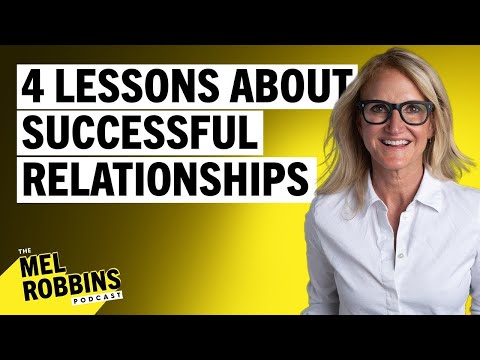
4 Surprising Secrets of Successful Relationships (What I Learned From a Fight with My Daughter)
Mel Robbins (host), Kendall Robbins (guest), Kendall Robbins (guest), Chris Robbins (guest), Oakley Robbins (guest), Chris Robbins (guest), Kendall Robbins (guest), Oakley Robbins (guest)
In this episode of The Mel Robbins Podcast, featuring Mel Robbins and Kendall Robbins, 4 Surprising Secrets of Successful Relationships (What I Learned From a Fight with My Daughter) explores messy Fights, Real Love: Mel Robbins’ Family Reveals Relationship Secrets Mel Robbins hosts a candid, funny, and emotional episode with her husband Chris and children Kendall and Oakley, using real family conflicts to unpack what makes relationships work. They answer listener questions about distant teens and lonely freshmen, while dissecting a fresh mother–daughter blowup that happened that very morning. Through their stories, they highlight the power of apologies, giving others emotional space, not weaponizing generosity, and normalizing that change and disconnection are part of family life. The episode closes by encouraging listeners to meet family members with grace, recognizing that everyone is struggling with something beneath the surface.
Messy Fights, Real Love: Mel Robbins’ Family Reveals Relationship Secrets
Mel Robbins hosts a candid, funny, and emotional episode with her husband Chris and children Kendall and Oakley, using real family conflicts to unpack what makes relationships work. They answer listener questions about distant teens and lonely freshmen, while dissecting a fresh mother–daughter blowup that happened that very morning. Through their stories, they highlight the power of apologies, giving others emotional space, not weaponizing generosity, and normalizing that change and disconnection are part of family life. The episode closes by encouraging listeners to meet family members with grace, recognizing that everyone is struggling with something beneath the surface.
Key Takeaways
Apologize clearly when you’ve overstepped or mishandled a situation.
Kendall explains that what she’d most want from a parent who interfered in her social life is a direct, human apology—admitting the mistake and acknowledging the hurt builds trust and softens resentment.
Get the full analysis with uListen
Recognize that a teen’s anger isn’t always actually about you.
Oakley notes that a 17-year-old who’s lost friends may be full of generalized negative emotion and is using parents as a safe outlet, which often looks like ‘hating’ them but is really displaced pain and frustration.
Get the full analysis with uListen
Give it time: big transitions often take about a year to feel normal.
For the teen who moved schools, the family emphasizes that feeling lonely and out of place is normal for many months, and expecting roughly a year for adjustment creates more self-compassion and persistence.
Get the full analysis with uListen
Take small, uncomfortable actions to build new connections.
They suggest joining clubs, sitting at new lunch tables, going to events without a date, and inviting people over—each step feels hard, but systematically expands your social circle and sense of belonging.
Get the full analysis with uListen
Don’t weaponize the nice things you do for loved ones.
Mel catches herself nearly saying, “After all I bought you…” in a fight and stops, stressing that gifts and favors shouldn’t become leverage; otherwise, love feels conditional and transactional.
Get the full analysis with uListen
Let people have their emotions instead of trying to fix them immediately.
Using the morning fight as an example, Mel describes the “let them” approach: allowing someone to be angry or grumpy without escalating, and staying regulated yourself—often diffusing conflict faster than pushing for a mood change.
Get the full analysis with uListen
Clarify what kind of support you need—listening vs. advice or space.
Kendall and Chris highlight the value (and awkwardness) of asking, “Do you want me to listen or advise? ...
Get the full analysis with uListen
Notable Quotes
“There were dozens of things that you did when I was in high school that I hated you for… and now I can see all of those things as just trying to keep me safe.”
— Kendall Robbins
“There’s a very strong chance that he doesn’t hate you, but he just has a lot of negative feelings, and you’re the only person that he can channel them into.”
— Oakley Robbins
“If you want to buy somebody something, buy them something, but do not hold that shit over their head as a reason they need to be obedient to you.”
— Mel Robbins
“Most of the time when you fight with people you care about, it is about either energy not matching or your routine getting interrupted.”
— Mel Robbins
“Everybody’s going through stuff. Everybody has something going on. So you are 100% not alone in this.”
— Oakley Robbins
Questions Answered in This Episode
How can parents distinguish between normal teen withdrawal and a relationship rupture that truly needs intervention?
Mel Robbins hosts a candid, funny, and emotional episode with her husband Chris and children Kendall and Oakley, using real family conflicts to unpack what makes relationships work. ...
Get the full analysis with uListen AI
What are practical ways for a teen to communicate, “I need space” or “I just need you to listen,” without feeling disrespectful or dramatic?
Get the full analysis with uListen AI
How can families adopt something like the “let them” theory without it feeling like emotional disengagement or indifference to the other person?
Get the full analysis with uListen AI
What specific boundaries can parents set around gifts and support to avoid creating a sense of conditional love or indebtedness?
Get the full analysis with uListen AI
For teens adjusting to a new school, what concrete weekly challenges (social, emotional, or logistical) could help them intentionally build a life where they feel they belong?
Get the full analysis with uListen AI
Transcript Preview
Hey, it's your friend Mel, and welcome to the Mel Robbins Podcast. (record scratch) (blowing raspberry) (laughing)
(laughing)
I just had an intrusive thought to interrupt you.
Of what?
You had an intrusive thought? What do you mean?
To just be like (blowing raspberry) welcome to Mel Ro- (horn)
Welcome to having kids on the show.
There were things that my parents did in high school that I was pissed at them for.
We're right here, you can tell us. (laughs)
Well, I was-
Oh, we had the worst fight you guys. It... okay, you're still being dramatic.
(laughs)
Like what you were doing this morning. (bell dinging) I'm grumpy because I'm hungover, and I'm like, "I'm gonna strangle you if you don't pick up every single thong that's on my ground right now."
(laughs)
I have so much sympathy for your life.
Yeah.
Anything else as a takeaway?
Pick up your (beep) .
Okay, thank you for that. Hug me next time (beep) . Okay. (laughs)
(laughs)
Your makeup in every crevice of my room started it, babe.
Did you wanna say anything, Oakley?
No.
Hey, it's your friend Mel, and welcome to the Mel Robbins Podcast. (record scratch) (blowing raspberry)
(laughing) I just had an intrusive thought to interrupt you.
Of what?
You had an intrusive thought? What do you mean?
To just be like (blowing raspberry) like halfway through the-
Be like-
... welcome to Mel Ro- (horn)
Welcome to having kids on the show.
All right. Well, as you can tell, I'm not alone. I have our 18-year-old son, Oakley, our 23-year-old daughter, Kendall, and my awesome husband, Christopher Robbins, all here at SiriusXM Studios in Los Angeles. And we have piles and piles and piles of questions from listeners that are directed at Kendall and Oakley. And so, we are just gonna rapid fire your questions and, uh, crowdsource answers as a family. But before we start, can we please talk about the fact that I met Reese Witherspoon?
Yeah.
(laughs) Okay, so I gotta tell you this story. So, a couple days ago, in New York, I'm there for work, I get up early, I go exercise with Christine, who, you know, is our chief operating officer and your aunt. And we are walking back to the hotel that we're staying in. It's probably, I don't know, maybe quarter of 8 o'clock in the morning? And you know how when you walk into some hotels, there's two sets of doors? There's that first door on the outside and then there's that little, like, hallway area and then the second set of doors? So, we open up the first set of doors to walk into the hotel, and just as we're stepping into that vestibule area, 7:45 in the morning, the second set of doors open up, and somebody walks through, and there is a woman behind him walking with another woman. And the woman who was shorter was incredibly striking, and she had dark sunglasses on, and I noticed her out of the corner of my eye, but I was busy talking to Christine about something, 'cause we, you know, had a busy day ahead of us. And as we pass by the two women, Reese Witherspoon was the one wearing the sunglasses. She walks past me and then stops. She lowers her sunglasses and reaches over and says, "Excuse me, I'm sorry to bother you, but I just wanna tell you I'm a huge fan of yours, and I really love your work. I'm Reese." And I nearly shat my pants. I-
Install uListen to search the full transcript and get AI-powered insights
Get Full TranscriptGet more from every podcast
AI summaries, searchable transcripts, and fact-checking. Free forever.
Add to Chrome