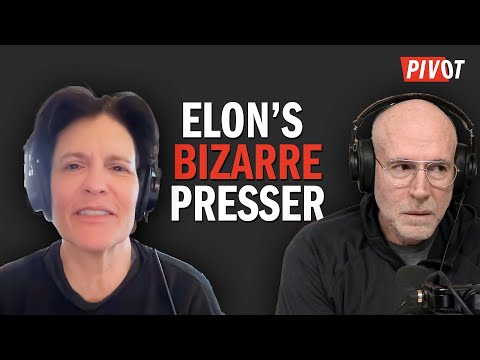
Elon Musk Takes His Son To Work in Weird Oval Office Presser | Pivot
Kara Swisher (host), Scott Galloway (host), Narrator, Narrator, Narrator, Narrator, Narrator, Narrator
In this episode of Pivot, featuring Kara Swisher and Scott Galloway, Elon Musk Takes His Son To Work in Weird Oval Office Presser | Pivot explores musk’s Oval Office Spectacle, Ukraine Talks, and Tesla’s China Trouble Kara Swisher and Scott Galloway unpack a chaotic week in politics, tech, and economics, centering heavily on Elon Musk and Donald Trump. They criticize Trump’s Ukraine peace overtures as effectively capitulating to Russia and debate Europe’s willingness to accept territorial losses and block NATO membership. Domestically, they examine sticky inflation driven by housing, argue Democrats need a bold housing agenda, and dissect Musk’s growing political power, from the “Doggy” cost‑cutting role in Washington to government Cybertruck contracts. They also explore Tesla’s weakening position against Chinese EV maker BYD and Musk’s legal and psychological warfare against OpenAI, while closing with broader worries about democratic norms, corruption, and US–China competition in AI and autos.
Musk’s Oval Office Spectacle, Ukraine Talks, and Tesla’s China Trouble
Kara Swisher and Scott Galloway unpack a chaotic week in politics, tech, and economics, centering heavily on Elon Musk and Donald Trump. They criticize Trump’s Ukraine peace overtures as effectively capitulating to Russia and debate Europe’s willingness to accept territorial losses and block NATO membership. Domestically, they examine sticky inflation driven by housing, argue Democrats need a bold housing agenda, and dissect Musk’s growing political power, from the “Doggy” cost‑cutting role in Washington to government Cybertruck contracts. They also explore Tesla’s weakening position against Chinese EV maker BYD and Musk’s legal and psychological warfare against OpenAI, while closing with broader worries about democratic norms, corruption, and US–China competition in AI and autos.
Key Takeaways
Trump’s Ukraine stance effectively locks in Russian gains and weakens negotiating leverage.
By declaring pre‑2014 borders and NATO membership for Ukraine “unrealistic” before talks, the administration is, in Galloway’s words, “negotiating against itself” and echoing Russian talking points.
Get the full analysis with uListen
Europe may be more willing than Washington to resist rewarding Russian aggression.
Both hosts note rising EU defense spending and historical memory of appeasement, arguing Europe may continue backing Ukraine even if the US signals it wants Kyiv to “bend the knee.”
Get the full analysis with uListen
Housing, not eggs, is the real inflation problem—and Democrats need a bold housing plan.
Galloway argues shelter costs are driving stubborn inflation and calls for a CHIPS‑style housing act: tax subsidies for large‑scale homebuilding and curbing NIMBY‑driven permit obstruction.
Get the full analysis with uListen
Musk’s new government role blurs lines between private gain and public policy.
Musk’s “Doggy” team embedded in agencies and a one‑for‑four hiring cap are framed as neutral cost‑cutting, but Swisher emphasizes how many of the cuts align with Musk’s business interests and political agenda.
Get the full analysis with uListen
Using a young child as a political prop is both ethically troubling and strategically odd.
Both hosts criticize Musk for bringing his son into the Oval Office presser—and even to Auschwitz—as a media prop, arguing it’s harmful for the child and disrespectful to the office and setting.
Get the full analysis with uListen
Musk’s legal and financial moves against OpenAI aim to slow a rival, not buy it.
They view his lawsuit and supposed bid for OpenAI as classic Musk tactics—“I’ll buy it or I’ll sue you”—intended to bog the company down and possibly spook investors like SoftBank rather than consummate a real deal.
Get the full analysis with uListen
Tesla faces a real existential threat from Chinese EV makers like BYD.
With Tesla sales down sharply in China and Europe and BYD selling sub‑$10,000 EVs with advanced driver assistance, Galloway predicts a major Tesla crisis and falling stock price, especially as Musk’s brand repels many potential buyers.
Get the full analysis with uListen
Notable Quotes
““This could have been written by the Russians.””
— Scott Galloway, on Pete Hegseth’s Ukraine peace framing
““He’s the most Churchillian character of this millennium so far.””
— Scott Galloway, on Volodymyr Zelenskyy
““Elon Musk has two moves: ‘I’ll buy it’ or ‘I’ll sue you.’””
— Kara Swisher, on Musk’s approach to OpenAI and rivals
““Arguably one of the biggest welfare queens in history is Elon Musk.””
— Scott Galloway, on Musk’s reliance on government largesse
““Musk does not make cars that are interesting anymore.””
— Kara Swisher, on Tesla’s stagnating product lineup compared to BYD
Questions Answered in This Episode
How should Western governments balance a pragmatic end to the Ukraine war with the long‑term risks of rewarding Russian territorial aggression?
Kara Swisher and Scott Galloway unpack a chaotic week in politics, tech, and economics, centering heavily on Elon Musk and Donald Trump. ...
Get the full analysis with uListen AI
What would a serious, CHIPS‑style national housing policy actually look like, and which political coalition could realistically pass it?
Get the full analysis with uListen AI
Where should the ethical line be drawn on involving children in highly charged political and media events like Musk’s Oval Office appearance?
Get the full analysis with uListen AI
To what extent is Elon Musk’s growing political influence compatible with fair competition and healthy democratic institutions?
Get the full analysis with uListen AI
How can US and EU policymakers engage with China on EVs and AI without either surrendering critical IP or escalating into a full‑blown economic cold war?
Get the full analysis with uListen AI
Transcript Preview
Turn off the electricity and let's dance.
(laughs)
(laughs)
Let's dance. Hi, everyone. This is Pivot from New York Magazine and the Vox Media Podcast Network. I'm Kara Swisher.
And I'm Scott Galloway.
How you doing, Scott? What's going on?
I'm doing okay. I, I just, um, hauled up five flights of stairs my 14-year-old's, uh, uh, beverage refrigerator, 'cause what is a 14-year-old without his own beverage refrigerator? Um-
I like a bevera... I just bought a beverage refrigerator.
Yeah, you and my son.
Do you know that?
Yeah, but you deserve one. (laughs)
I, I, I, we renovated our house. We're moving back in, and I thought, "I need a beverage refrigerator in my little pod room." I created a pod room, you know that? I have my own home pod studio like you. I'm trying to keep up with you. It's very nice. Yeah, but I got one of those old retro ones, and it's blue. What do you think?
Oh, really?
Yeah.
Uh, I- I'm in favor of retro blue frig... I'm just, I'm actually very much an evangelist for beverages, but also-
Uh, me too.
... also, uh, um, yeah. Was it one of those, like, cool, what do they call it, Smeg? Or...
S- It's not Smeg, actually. Frigidaire. They... Someone bought the Frigidaire name and it has Frigidaire across it in that script. I'm very pleased. I'm very pleased with my refrigerator. I love a refrigerator.
Mm-hmm.
I've always had beverage refrigerators and my kids have too. I think it's important. I have one in San Francisco. Uh, on my... I, I had to haul mine up the stairs too. Anyway, uh, we have a lot to get to today. My God, this, the news is insane, Scott. I have to tell you.
Won't stop. Yeah.
It's nuts.
Won't stop.
Um, besides that weird Elon Oval Office presser with the kid saying whatever he was saying, um, we have also have how DeepSeak is threatening, uh, Tesla's dominance. We've got a million of things. Of course, it's all about fucking Elon. I'm so tired of him, but he's right in the middle of everything, so what are we gonna do? Uh-
What are we gonna do?
What are we gonna do? But first-
Yeah.
Uh, Pr- President Trump said he and Russian President Vladimir Putin have agreed to start negotiating an end to the war in Ukraine. Trump and Putin had what was described as a lengthy and highly productive phone call on Wednesday. Trump later spoke with Ukraine's President, uh, Zelenskyy. Defense Secretary Pete Hegseth offered some insights on what Ukraine can expect from a peace deal. Way to go, Pete, you know, telling th- people what we're gonna do before we negotiate. But go ahead.
We will only end this devastating war and establish a durable peace by coupling allied strength with a realistic assessment of the battlefield. We want, like you, a sovereign and prosperous Ukraine, but we must start by recognizing that returning to Ukraine's pre-2014 borders is an unrealistic objective. Chasing this illusionary goal will only prolong the war and cause more suffering.
Install uListen to search the full transcript and get AI-powered insights
Get Full TranscriptGet more from every podcast
AI summaries, searchable transcripts, and fact-checking. Free forever.
Add to Chrome