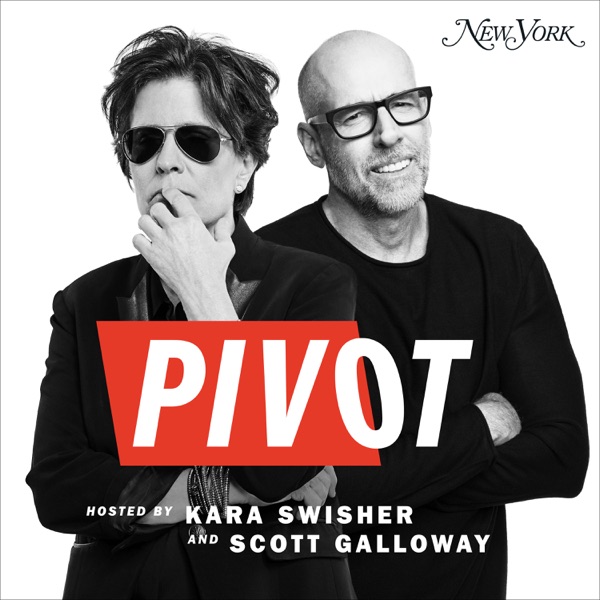
 Pivot
PivotScott Galloway: Elon Musk Defines Messiah Complex | Pivot
Kara Swisher on fCC targets Disney, AI spending surges, Musk implodes, Swift fights back.
In this episode of Pivot, featuring Kara Swisher and Scott Galloway, Scott Galloway: Elon Musk Defines Messiah Complex | Pivot explores fCC targets Disney, AI spending surges, Musk implodes, Swift fights back The hosts argue the FCC’s accelerated Disney/ABC license renewals—citing a DEI probe—functions as political intimidation tied to Trump-era culture-war pressure on media companies.
At a glance
WHAT IT’S REALLY ABOUT
FCC targets Disney, AI spending surges, Musk implodes, Swift fights back
- The hosts argue the FCC’s accelerated Disney/ABC license renewals—citing a DEI probe—functions as political intimidation tied to Trump-era culture-war pressure on media companies.
- They review blowout earnings from Alphabet, Microsoft, Amazon, and Meta, concluding AI demand is real but the infrastructure build-out is forcing enormous capex that spooks investors and concentrates market gains in a few mega-firms.
- They describe a broader “ketamine economy” dynamic in which wealthy elites and markets appear dissociated from everyday societal conditions, leaving rising public anger and a looming “reckoning.”
- They frame Elon Musk’s OpenAI lawsuit as historic “seller’s regret,” alleging he tried to convert OpenAI to a for-profit entity he controlled and now casts himself as an AI savior despite building lower-guardrail AI elsewhere.
- They highlight Taylor Swift’s strategy of trademarking voice/image elements as a test case for protecting “digital twins,” advocating opt-in licensing and royalties when AI systems use creators’ likeness or past work.
IDEAS WORTH REMEMBERING
5 ideasRegulatory levers can be used as soft censorship via compliance costs.
The Disney license-renewal acceleration is presented as less about spectrum policy and more about chilling speech: more lawyers, more review, more hesitation around edgy content—even if the government ultimately loses in court.
AI is boosting top lines while simultaneously depressing sentiment through capex shocks.
Across Alphabet, Microsoft, Meta, and Amazon, the pattern is strong revenue/earnings paired with higher infrastructure spend; investors reward growth but punish rising capex and collapsing free cash flow.
The economy is increasingly a concentrated bet on a handful of AI mega-firms.
They argue a large share of earnings growth is coming from the “Mag 10,” and VC funding is heavily skewed toward AI; non-AI startups face materially worse fundraising conditions.
A ‘reckoning’ risk emerges when gains accrue mainly to tech/oil elites.
Galloway’s “ketamine economy” metaphor suggests the richest are less dependent on public systems (schools, TSA, public safety, healthcare), weakening incentives to invest in broad-based societal health and amplifying backlash.
Musk’s OpenAI case is framed as control-seeking, not charity-protecting.
They allege Musk pushed for a for-profit structure with himself in control and an 80% stake, then left and later sued after OpenAI’s commercial success—undercutting his courtroom posture as a public-interest guardian.
WORDS WORTH SAVING
5 quotesThis is literally the biggest example of seller's regret in history.
— Scott Galloway
To me, this defines messiah complex, full stop.
— Scott Galloway
The most dangerous thing I think about the world we live in in America right now is that if you live in America and you're in the .1%, you are not invested in the well-being of America.
— Scott Galloway
America is a giant bet on AI.
— Scott Galloway
We have to figure out economic policies that give the wealthiest people in our nation a vested interest in the success of America again.
— Scott Galloway
QUESTIONS ANSWERED IN THIS EPISODE
5 questionsWhat specific FCC authority would allow early Disney/ABC renewals based on a DEI investigation, and what’s Disney’s strongest legal counterargument?
The hosts argue the FCC’s accelerated Disney/ABC license renewals—citing a DEI probe—functions as political intimidation tied to Trump-era culture-war pressure on media companies.
Galloway says the intimidation ‘chill’ is already working in TV writers’ rooms—what concrete examples (policy changes, legal review steps, self-censorship) have producers reported?
They review blowout earnings from Alphabet, Microsoft, Amazon, and Meta, concluding AI demand is real but the infrastructure build-out is forcing enormous capex that spooks investors and concentrates market gains in a few mega-firms.
If AI capex keeps rising, what metric would signal the turning point—slowing cloud backlog growth, margin compression, power constraints, or a major customer cutting spend?
They describe a broader “ketamine economy” dynamic in which wealthy elites and markets appear dissociated from everyday societal conditions, leaving rising public anger and a looming “reckoning.”
How much of each company’s earnings beat was ‘real operations’ versus one-time items (equity gains, tax benefits), and how should investors normalize that?
They frame Elon Musk’s OpenAI lawsuit as historic “seller’s regret,” alleging he tried to convert OpenAI to a for-profit entity he controlled and now casts himself as an AI savior despite building lower-guardrail AI elsewhere.
In the Musk v. OpenAI narrative, what are the most consequential documents/emails that support (or contradict) the claim he demanded control and 80% ownership?
They highlight Taylor Swift’s strategy of trademarking voice/image elements as a test case for protecting “digital twins,” advocating opt-in licensing and royalties when AI systems use creators’ likeness or past work.
Chapter Breakdown
Kara’s courtroom trolling idea sets the tone
Kara jokes about showing up in court to rattle Elon Musk, then pivots into the day’s political-media news. The banter frames a broader theme: powerful figures demanding attention and control, and how institutions respond.
FCC targets Disney/ABC over DEI investigation and political retaliation claims
The hosts argue the FCC’s demand that Disney file early license renewals is a politicized intimidation tactic tied to culture-war pressure. Kara predicts Disney will fight—and win—in court, calling the move harassment of a major American company.
Free-speech “warriors,” comedy, and the chilling effect on media
Scott and Kara discuss how Trump-aligned threats can chill speech even if lawsuits fail. Scott claims producers are already softening language due to legal risk, while Kara argues pushback is growing and mockery is the right response.
How to cover Trump without feeding the conflict machine
Scott proposes “ring-fencing” Trump coverage: a short, standardized daily recap instead of wall-to-wall programming. They argue Trump gains power from controversy and media saturation, so containment is both editorially and civically healthier.
Preventive health detour: Spotify founders’ Neko/Necco scans and behavior change
Scott describes a comprehensive preventive health screening experience—full-body scans, bloodwork, and immediate clinician review—at a surprisingly low cost. The conversation turns to exercise “zone 2” training and recurring medical advice to reduce alcohol.
Big Tech earnings blowout: AI demand vs runaway CapEx
Kara runs through Alphabet, Microsoft, Amazon, and Meta results; Scott argues AI is ‘eating the world’ while infrastructure spending siphons cash flow. The markets reward growth but punish ever-rising capital expenditure guidance.
‘Ketamine economy’ and the coming ‘reckoning’ for markets and society
Scott claims the economy is increasingly dissociated from everyday pain because wealth and markets are concentrated in AI winners and insulated elites. Kara adds that public anger is rising as tech/wealthy figures shift from ‘heroes to villains,’ hinting at political and economic consequences.
Elon Musk on the stand vs OpenAI: seller’s remorse and messiah complex
They dissect Musk’s testimony and motivations, portraying the suit as regret after leaving OpenAI and losing control. Scott predicts OpenAI won’t settle; Kara emphasizes the value of seeing powerful people under oath—and argues Musk’s self-image as savior contrasts with harmful actions and lax AI guardrails.
Taylor Swift’s AI counterstrike: trademarking voice and image
Swift’s trademark filings for voice clips and imagery are framed as a high-profile attempt to protect likeness from AI misuse. The hosts argue for stronger individual ownership of ‘digital twins’ and clearer licensing/royalty systems for training data and synthetic performances.
Scott’s Google ‘Portraits’ avatar: why he pulled it down
Scott explains he collaborated with Google on an AI avatar trained on his content to answer advice questions, but later worried it could deepen social isolation—especially for young men. After reassessing, he asked Google to remove it, raising questions about responsibility even with consent-based tools.
KaraTar and the broader unease: synthetic selves that persist
Kara describes creating a boxed 3D talking avatar of herself—both amusing and unsettling—and plans to gift it to Scott. They return to the idea that consent and compensation are essential, but psychological and cultural impacts remain unresolved.
Predictions: movies feel ‘human’ again; Intel set up for a fall
Kara predicts well-made, people-centered films will outperform expectations as audiences crave authenticity and shared experiences. Scott predicts Intel will underperform sharply, arguing it’s overvalued amid intensifying competition from Amazon and Google chips and shifting AI bottlenecks toward power and infrastructure.
Bonus win and wrap: King Charles’ rhetorical precision; listener callouts
They praise King Charles’ speech as a rare, elegant critique that lands even in a polarized environment. The episode closes with plugs, a listener-question prompt, and a clip about Trump’s waning alignment with his own supporters.
EVERY SPOKEN WORD
Install uListen for AI-powered chat & search across the full episode — Get Full Transcript
Get more out of YouTube videos.
High quality summaries for YouTube videos. Accurate transcripts to search & find moments. Powered by ChatGPT & Claude AI.
Add to Chrome