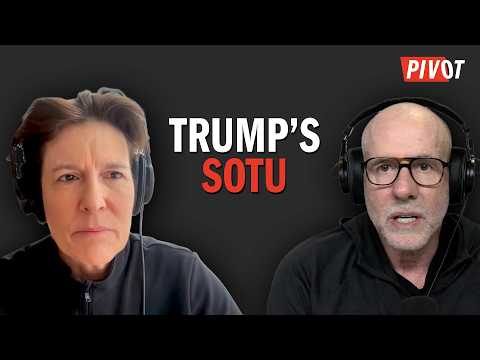
Trump’s State of the Union: “High Chance of Crazy” | Pivot
Kara Swisher (host), Scott Galloway (host), Scott Galloway (host)
In this episode of Pivot, featuring Kara Swisher and Scott Galloway, Trump’s State of the Union: “High Chance of Crazy” | Pivot explores pivot debates tariffs, tech boycotts, media deal politics, AI investing shifts The episode opens with Mexico’s cartel violence flare-up and the structural forces behind it, including fragmented cartels, diversified criminal revenue, and U.S. roles in gun flows and drug demand.
Pivot debates tariffs, tech boycotts, media deal politics, AI investing shifts
The episode opens with Mexico’s cartel violence flare-up and the structural forces behind it, including fragmented cartels, diversified criminal revenue, and U.S. roles in gun flows and drug demand.
They then assess the Supreme Court striking down most Trump tariffs, Trump’s workaround via a 1974 trade law, and how policy inconsistency harms businesses more than tariff levels themselves—plus the looming refund mess.
The hosts update the “Resist and Unsubscribe” movement, featuring recommendations for privacy- and user-controlled alternatives to Big Tech and debating how to focus and sustain momentum beyond February.
Finally, they cover Trump’s pressure campaign against Netflix board member Susan Rice amid Hollywood M&A drama, discuss “HALO” (AI-immune) stocks versus battered SaaS valuations, and close with wins/fails centered on women’s Olympic performance and political sexism—ending with Scott urging Democrats to retaliate more aggressively in corporate governance fights.
Key Takeaways
Mexico’s violence is increasingly about power vacuums and diversified rackets, not only drugs.
They frame cartel conflict as fragmentation after larger cartel breakups, with revenue streams like fuel theft, extortion, and human smuggling—making it a governance and economic-control problem that spills into tourism and local markets.
Get the full analysis with uListen
U.S. policy choices meaningfully contribute to Mexico’s cartel capacity.
Scott highlights firearms flowing south and U. ...
Get the full analysis with uListen
Consumer “unsubscribe” activism can create real signal, but incentives require boardroom pressure.
Scott argues the campaign succeeded in public awareness and measurable attention, yet hasn’t reliably reached board-level decision-making; the next step is focus, consolidation, and professional organizing capacity.
Get the full analysis with uListen
Tariff unpredictability is as damaging as tariffs themselves.
Even with a court check, Trump’s pivot to temporary tariffs extends uncertainty, making planning difficult for small businesses and prompting supply chains to reconfigure away from the U.S.
Get the full analysis with uListen
Tariff refunds are likely but administratively messy—and uncertainty keeps money discounted.
Scott notes tariff-claim markets pricing in delays (claims trading well below par) and rejects the idea refunds are inherently hard if collections were digital, implying bureaucratic friction is the real risk.
Get the full analysis with uListen
Presidential meddling in corporate boards is a direct threat to rules-based capitalism.
They argue investors can price stable regulation, not discretionary political targeting; pressuring companies to remove board members shifts governance from shareholder accountability to personality-driven political risk.
Get the full analysis with uListen
Markets may be over-rotating into “AI-immune” defensives while mispricing SaaS durability.
Scott contends HALO names look expensive for low growth, while Salesforce/Adobe/ServiceNow are punished on thin evidence that enterprises will rip out deeply embedded systems; he expects cost reductions and modest margin effects, not collapse.
Get the full analysis with uListen
Notable Quotes
““More than the tariffs themselves, the most damaging thing to American trade policy is inconsistency.””
— Scott Galloway
““Capitalism is supposed to be regulated competition… you shift from rules-based capitalism to personality-driven capitalism.””
— Scott Galloway
““He’s a victim, thinks he’s a victim.””
— Kara Swisher
““There is absolutely no evidence whatsoever that a large corporation is giving up Adobe or Salesforce and putting in new prompts into AI.””
— Scott Galloway
““Democrats do not… lack all creativity around how we’re gonna strike back.””
— Scott Galloway
Questions Answered in This Episode
Resist and Unsubscribe: What single target (or two) would maximize board-level pressure, and why—Meta, Alphabet, Amazon, or an AI lab like OpenAI?
The episode opens with Mexico’s cartel violence flare-up and the structural forces behind it, including fragmented cartels, diversified criminal revenue, and U. ...
Get the full analysis with uListen AI
If the goal is “incentives,” what specific actions would force boards to discuss political risk (e.g., shareholder proposals, advertiser boycotts, director campaigns)?
They then assess the Supreme Court striking down most Trump tariffs, Trump’s workaround via a 1974 trade law, and how policy inconsistency harms businesses more than tariff levels themselves—plus the looming refund mess.
Get the full analysis with uListen AI
On tariffs: How should Congress reassert authority without paralyzing legitimate emergency trade responses—what statutory changes would you propose?
The hosts update the “Resist and Unsubscribe” movement, featuring recommendations for privacy- and user-controlled alternatives to Big Tech and debating how to focus and sustain momentum beyond February.
Get the full analysis with uListen AI
Do you buy Scott’s claim that refunds should be easy because tariff collection is digital—what operational steps actually block fast repayment?
Finally, they cover Trump’s pressure campaign against Netflix board member Susan Rice amid Hollywood M&A drama, discuss “HALO” (AI-immune) stocks versus battered SaaS valuations, and close with wins/fails centered on women’s Olympic performance and political sexism—ending with Scott urging Democrats to retaliate more aggressively in corporate governance fights.
Get the full analysis with uListen AI
Netflix/WBD/Paramount: If the Ellisons close the deal and then cut costs 40%, what parts of the creative pipeline get hit first (development, production, marketing, news)?
Get the full analysis with uListen AI
Transcript Preview
The victimization that he has is so massive, you know, that he's always being victimized. Someone's always fucking him. That's his whole worldview. [upbeat music] Hi, everyone. This is Pivot from New York Magazine and the Vox Media Podcast Network. I'm Kara Swisher.
And I'm Scott Galloway.
Scott, you're missing the blizzard! It's outside. I should pull it back on-
Is it a bomb cyclone?
It's something else. Can you see that or not?
I see a city being snowed on by an old lady-
[laughing]
um, [chuckles] in athleisure.
It's really-- Today, it's nuts. It's, it is really quite a blizzard. It's a blizzard. It's what's happening here, so just so you know. As we tape, over forty million people in the US are under a blizzard warning, by the way, and snow dropping three inches an hour in some locations. It really is still going on here in New York, um, and it's crazy. It's, it's, it's-- There's a lot of snow happening. We all thought the snow was over. Maybe I'll go take a, a walk in New York and con- and wa- walk in the Central Park and contemplate my life.
Do what I would do. Go to Chez Margaux and get fucked up, and establish eye contact with a nice, young Russian lady.
I'm getting an award tonight in Brooklyn. I've got to go out to Brooklyn.
Of course, you are!
I am.
Of cou-
I'm getting the Governors Award.
I'm getting an award-
An Ambie
... tonight in Brooklyn.
[chuckles]
That is the most Kara Swisher thing ever said.
[chuckles]
"I'm getting an award in Brooklyn."
Yes, I have to go there.
Okay.
Yeah, it's the Ambies.
What do you... Okay.
I don't know.
All right, fine.
It's the, it's the-
I'll play along
... Oscars of podcasting.
What are you getting an award for?
For being old, from the Governors Award.
The Oscars of podcasting. I thought that was the Vibes. What, what are those, what is it called, the Webbys or the-
No, no, not those. No, that's the, oh, the-
The Signal Awards?
No, I don't know. Whatever.
The-
They're trying to make fetch happen-
Two Guys-
with awards
... Two Guys With a Mic? That's called... That's a podcast.
This is not the BAFTAs or the Oscars. This is the podcast version, and I'm getting the Great Contributions to Podcasting Award.
Really?
I guess. Here's something crazy going on. Mexican security forces killed the leader of the Jalisco New Generation cartel and eight other cartel members in a Mexican military operation aided by US intelligence support. And then they went crazy, these, these cartels, and they're like, they're in Puerto Vallarta, like Captain Stubing. That's how I know Puerto Vallarta from, from Love Boat, and they're, like, bombing the whole place. And all these Americans have been either diverted from going there or cannot leave there. Not just Americans, but lots of people, and they're, like, attacking neighborhoods, and this footage is really something. All these burnt cars, and i- it's really something. I don't know what you think about it.
Install uListen to search the full transcript and get AI-powered insights
Get Full TranscriptGet more out of YouTube videos.
High quality summaries for YouTube videos. Accurate transcripts to search & find moments. Powered by ChatGPT & Claude AI.
Add to Chrome