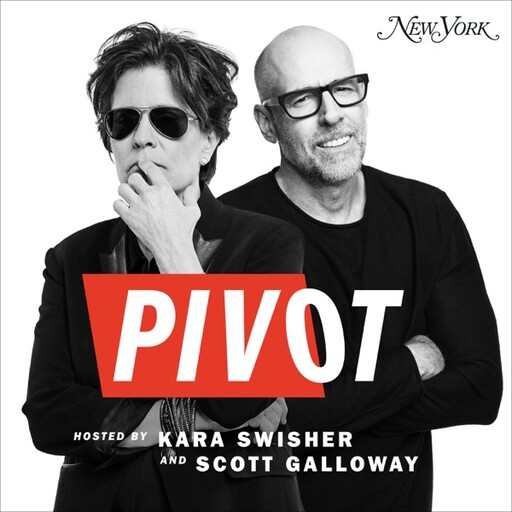
 Pivot
PivotKara Swisher Explains Why Airport Chaos is "Trump's Chaos"| Pivot
At a glance
WHAT IT’S REALLY ABOUT
Trump-era instability fuels airports, Iran, AI policy and media consolidation
- They argue the airport meltdown—unpaid TSA, staff quitting, and proposals to deploy ICE/National Guard—reflects deliberate political brinkmanship that disproportionately harms ordinary travelers while elites bypass the system.
- They characterize Trump’s Iran posture as erratic and destabilizing, warning that unclear objectives and rapid policy reversals raise recession risks through energy chokepoints like the Strait of Hormuz.
- They discuss how asymmetric warfare (cheap drones/boats vs expensive defenses) is changing conflict dynamics in Ukraine and the Middle East, increasing the advantage of lower-cost disruption.
- They interpret the Musk/Twitter investor verdict and Musk’s outsized role in Ukraine communications as evidence that individual tech leaders wield dangerous, quasi-sovereign power without democratic accountability.
- They critique the administration’s proposed national AI framework as likely industry-captured, noting massive AI lobbying spend and public trust collapse, while still agreeing federal (not patchwork state) rules are necessary.
IDEAS WORTH REMEMBERING
5 ideasInfrastructure failure is a direct middle-class tax.
They frame airport chaos as lost time, stress, and reduced mobility for working families—an immediate, visceral sign of declining public investment and governance capacity.
When leaders don’t feel the pain, problems don’t get fixed.
Galloway argues the wealthy operate on parallel infrastructure (private planes/security), so political incentives to resolve TSA/air-traffic crises weaken; he proposes targeting private aviation privileges to force action.
Erratic foreign policy magnifies global economic fragility.
They warn that whiplash statements on Iran create uncertainty that moves markets and can trigger broader downturns because energy routes like Hormuz are structural choke points.
Asymmetric warfare is rewriting defense economics.
Cheap drones/boats can overwhelm expensive systems (e.g., $25k–$40k drones vs $4M interceptors), making “power” less about platforms and more about scalable, low-cost disruption and adaptation.
Energy shocks can accelerate electrification and renewables.
They note rising oil prices are boosting EV interest and argue that long-run energy resilience comes from alternatives—citing Texas’s high real-time wind/solar share as an illustrative data point.
WORDS WORTH SAVING
5 quotesThis chaos is Trump's chaos.
— Kara Swisher
A fairly decent metric for the progress of a civilization... is its investments in infrastructure.
— Scott Galloway
A Shahed drone costs twenty-five to forty thousand dollars, but the Patriot missile to shoot it down costs four million.
— Scott Galloway
The wisdom of crowds. The ignorance of the individual is really frightening.
— Scott Galloway
We should not have any individual that accretes so much wealth and power and technical sophistication that they can change the course of civilization.
— Scott Galloway
High quality AI-generated summary created from speaker-labeled transcript.



