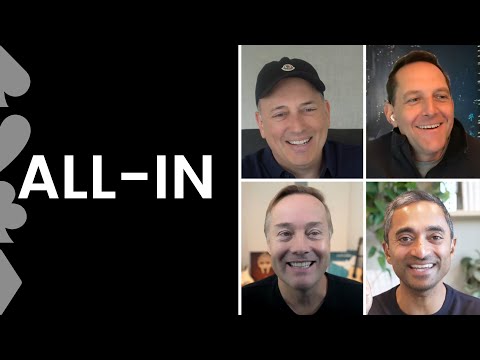
E99: Cheating scandals, Twitter updates, rapid AI advancements, Biden's pardon, Section 230 & more
David Sacks (host), Jason Calacanis (host), David Friedberg (host), Chamath Palihapitiya (host), Narrator, Jason Calacanis (host), Chamath Palihapitiya (host)
In this episode of All-In Podcast, featuring David Sacks and Jason Calacanis, E99: Cheating scandals, Twitter updates, rapid AI advancements, Biden's pardon, Section 230 & more explores cheating Scandals, AI Acceleration, Twitter Deal Drama, and Weed Reform The episode opens with an extended discussion of recent cheating scandals in chess, poker, fishing, and esports, using them to highlight a broader cultural decay in personal responsibility and integrity.
Cheating Scandals, AI Acceleration, Twitter Deal Drama, and Weed Reform
The episode opens with an extended discussion of recent cheating scandals in chess, poker, fishing, and esports, using them to highlight a broader cultural decay in personal responsibility and integrity.
The hosts then dissect Elon Musk’s on‑again Twitter acquisition, focusing on the legal specific-performance clause, the stressed financing syndicate, and the operational and cost-cutting opportunities at Twitter.
A long segment explores the rapid compounding of narrow AI capabilities—from Tesla’s Optimus robot and self‑driving to text‑to‑video models—framing AI as a continuation of a 60‑year arc in data, compute, and modeling.
They close with policy debates on Biden’s marijuana pardons and rescheduling, and on Section 230, common carrier rules, and algorithmic curation—arguing over how to preserve free speech while managing harmful content and platform power.
Key Takeaways
Statistical forensics now make cheating in complex games detectable at scale.
In chess, comparing a player’s moves to top engine choices reveals improbably high correlations; Hans Niemann showed near-perfect games and tournament-level stats far above legends like Fischer and Carlsen, making cheating strongly inferable even without being caught physically.
Get the full analysis with uListen AI
Cheating reflects a deeper erosion of personal responsibility and respect for the journey.
The hosts argue that winning without struggle empties the experience of meaning, and that a “quick-fix, no-consequences” mindset is spreading from online poker HUDs and esports aim-bots to real-world competitions like fishing tournaments.
Get the full analysis with uListen AI
Musk’s Twitter deal hinges on specific performance and stressed debt markets, not just drama.
Because the contract lets Twitter force a close at $54. ...
Get the full analysis with uListen AI
Substantial operating cuts could quickly make an overpaid Twitter deal financially viable.
Chamath estimates about $10 per share in OpEx reductions—from headcount, real estate, data center decisions, and cloud bidding—could make Twitter breakeven under Musk, creating a margin of safety and turning it into a template for running ad-driven tech companies leaner.
Get the full analysis with uListen AI
AI advances are less a sudden revolution and more a compounding of data and compute.
Friedberg frames AI as a 60‑year continuum: from hand-written algorithms to data science, to machine learning with dynamic parameters, to AI where models themselves are shaped by data—enabled by exponentially cheaper sensing, storage, and GPU-based supercomputing.
Get the full analysis with uListen AI
As AI handles more ‘creation,’ humans may shift from creators to narrators.
The hosts predict that instead of painstakingly designing buildings, films, or software, people will increasingly describe what they want and AI systems will generate blueprints, media, and code—turning human work into specifying and iterating rather than manual production.
Get the full analysis with uListen AI
Algorithmic curation is effectively editorial and should be treated as such in regulation.
They argue that recommendation algorithms are just codified versions of an editor’s mental weighting of variables; any serious reform of Section 230 and platform responsibility must acknowledge this, potentially enabling user choice of algorithms and even ‘algorithm marketplaces.’
Get the full analysis with uListen AI
Notable Quotes
“The people that cheat in any of these games don't understand this basic simple idea, which is that trying is a huge part of the human experience.”
— Chamath Palihapitiya
“The marginal cost of intelligence is gonna go to zero.”
— Chamath Palihapitiya
“As a lot of the knowledge work gets supplanted by AI... the role of the human, I think, transitions to being one of a narrator.”
— David Friedberg
“If you look at the Bill of Rights, the original rights are all about protecting the citizen against an intrusion on their liberty by a state or by the federal government... I think [free speech] actually needs to be a positive right.”
— David Sacks
“These computers are thinking actively for us. They're providing this, you know, computationally intensive decision-making and reasoning.”
— Chamath Palihapitiya
Questions Answered in This Episode
How far should statistical evidence alone be allowed to go in condemning someone for cheating when there’s no physical proof?
The episode opens with an extended discussion of recent cheating scandals in chess, poker, fishing, and esports, using them to highlight a broader cultural decay in personal responsibility and integrity.
Get the full analysis with uListen AI
If Twitter under Musk becomes a radically leaner, more profitable company, will that reset expectations for how bloated other ad-tech and social platforms can be?
The hosts then dissect Elon Musk’s on‑again Twitter acquisition, focusing on the legal specific-performance clause, the stressed financing syndicate, and the operational and cost-cutting opportunities at Twitter.
Get the full analysis with uListen AI
At what point do AI systems that can write their own models and optimize across modalities (vision, language, sound) require new ethical or legal frameworks?
A long segment explores the rapid compounding of narrow AI capabilities—from Tesla’s Optimus robot and self‑driving to text‑to‑video models—framing AI as a continuation of a 60‑year arc in data, compute, and modeling.
Get the full analysis with uListen AI
How can society balance decriminalizing or legalizing marijuana with the reality of far higher THC potencies and easier access for teenagers?
They close with policy debates on Biden’s marijuana pardons and rescheduling, and on Section 230, common carrier rules, and algorithmic curation—arguing over how to preserve free speech while managing harmful content and platform power.
Get the full analysis with uListen AI
Should large platforms be required by law to offer user-selectable recommendation algorithms, and would that meaningfully improve free speech and user safety?
Get the full analysis with uListen AI
Transcript Preview
We're seven minutes in and we've produced absolutely nothing that will go in the show.
(laughs)
(laughs)
Here comes Sax, waking up with his-
Oh, boy. Here he comes.
... with his commentary.
When Friedberg is criticizing you for being too negative, you're in a dark place, Sax. (laughs)
I'm actually angry at Sax for not publishing my AMA from the other night while he publishes-
It's coming, it's coming.
... while he publishes Neval's content.
His app crashed.
We had such a crowded room. We had over 2,000 people-
That was impressive.
... in the room for, like, four hours.
It was crazy. It was like the original days of Clubhouse.
Everyone I know that was trying to get in was texting saying they couldn't get in. So it definitely capped out, right?
I know. Well, we hit, we hit some scalability limits.
You may want to buy an extra server, Sax. Cheap (beep) . Weren't you the same guy who was responsible for scaling PayPal?
No, that was somebody else. That was eBay. They sold it before it scaled.
No, no, that's not true. We, we had huge scalability challenges at PayPal too.
(laughs)
It seems like a theme.
Yeah. The theme is when you have an app that's breaking out, you hit scalability challenges. It's called a high-class problem.
2,000 people is not a high-class problem. It's a trickle. It's 2022.
2,000 people participating in the conversation is a challenge.
I haven't written code in 20 years. Here's what you do. When you get to 1,000 people coming to the room-
That's a lie, that's a lie.
... everybody else is in passive ro- mode.
You've never written code ever.
Of course, I have. Of course, I have.
(laughs)
That's a lie. That's a lie. Come on, be honest.
Oh, yeah, it's actually been 25. The last time I wrote code was Lotus Notes. (laughs) It's true.
I'm going all in. Don't let your winner slide. Rain Man David Sacks. I'm going all in. And I said, we open source it to the fans and they've just gone crazy with it. Love you, SI. Queen of Kinwa. I'm going all in.
So there have been three (laughs) cheating scandals across poker, chess, and even competitive, uh, fishing. I don't know if you guys saw the fishing one, but they found weights and filets during a fish, uh, weigh-in. And then everybody wants us to check in on the chess and the poker scandals. Chess.com just released their report that this, uh, grandmaster has been suspended. They have evidence he cheated basically in a bunch of, uh, tournaments that were, in fact, uh, for money. He denied that he had done that, but he had previously cheated as a kid. Uh, they now have the statistical proof that he was playing essentially perfect chess. And, uh, they've outlined this in, like, hundreds of pages in a report. Sax, you, what, what are your thoughts on this, uh, scandal in chess?
Install uListen to search the full transcript and get AI-powered insights
Get Full TranscriptGet more from every podcast
AI summaries, searchable transcripts, and fact-checking. Free forever.
Add to Chrome