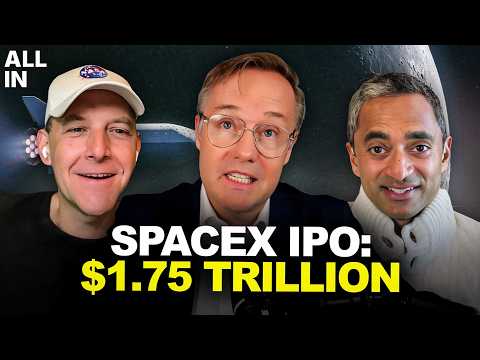
SpaceX IPO, Iran War Fallout, Quantum Bitcoin Hack, The Space Opportunity
Jason Calacanis (host), David Friedberg (host), David Sacks (host)
In this episode of All-In Podcast, featuring Jason Calacanis and David Friedberg, SpaceX IPO, Iran War Fallout, Quantum Bitcoin Hack, The Space Opportunity explores spaceX IPO talk meets Iran war risks and quantum threats The panel argues a SpaceX IPO would provide a crucial public-market valuation anchor and could pave the way for a future Tesla–SpaceX merger driven by shared AI, manufacturing, robotics, and infrastructure synergies.
SpaceX IPO talk meets Iran war risks and quantum threats
The panel argues a SpaceX IPO would provide a crucial public-market valuation anchor and could pave the way for a future Tesla–SpaceX merger driven by shared AI, manufacturing, robotics, and infrastructure synergies.
They frame space as a new industrial frontier—Moon-based mining/manufacturing, mass-driver logistics, and Starlink as a parallel “backup internet”—enabling a large ecosystem of downstream “space economy” companies.
They predict a potential 2026 IPO wave but warn investor appetite is finite, with significant risk that later IPOs price poorly due to liquidity needs, pent-up selling pressure, and uncertainty around whether AGI is real and durable.
They assess the Iran conflict as a major macro and political risk with knock-on effects, emphasizing energy independence and highlighting fertilizer and helium supply chokepoints that could trigger a global food-supply shock.
They warn that accelerating progress in quantum algorithms and hardware could make today’s cryptography—and thus Bitcoin/crypto wallets and infrastructure—vulnerable, urging coordinated migration to quantum-resistant standards within a 5–7 year window.
Key Takeaways
A public SpaceX price could de-risk governance and enable consolidation.
They argue daily mark-to-market pricing reduces disputes over “made-up” valuations and time-allocation criticism, making a Tesla–SpaceX combination far easier to justify and structure.
Get the full analysis with uListen AI
Space is shifting from “rockets” to a full-stack logistics-and-industry economy.
Beyond launch, they anticipate “last-mile in orbit,” debris/garbage collection, space power generation, manufacturing, and eventually lunar resource processing—analogous to ports, FedEx, utilities, and mining on Earth.
Get the full analysis with uListen AI
The Moon may be a nearer-term industrial target than asteroid mining.
Friedberg contends the Moon has broad mineral abundance and favorable physics (low gravity/no atmosphere) enabling low-energy export via mass drivers, while asteroid mining may be less practical early on.
Get the full analysis with uListen AI
A 2026 IPO boom is plausible, but the marginal IPO may disappoint.
They warn of limited buy-side capacity and large sell pressure from long-held private shares; many post-IPO stocks could trade down as markets “find a price.”
Get the full analysis with uListen AI
AI creates a valuation paradox that could compress tech multiples.
Chamath argues: if AGI is real, moats erode and long-duration software profits are less defensible; if AGI isn’t real, mega-capital raises for frontier labs become harder to justify—both can’t be true simultaneously.
Get the full analysis with uListen AI
Middle East capital flows are a hidden constraint on capital-intensive tech.
Friedberg suggests conflict could reduce sovereign/family-office funding that indirectly supports big AI financings, tightening liquidity and potentially shifting advantage to China if US-linked capital wanes.
Get the full analysis with uListen AI
Hormuz disruption threatens food and medical/industrial inputs, not just oil.
They highlight nitrogen fertilizer (urea/ammonia) supply exposure to Gulf nat gas and shipping lanes, plus helium dependence; shocks can raise crop costs, reduce yields, and ripple into malnourishment risks.
Get the full analysis with uListen AI
Bitcoin and crypto should treat quantum risk as a near-term migration problem.
They cite faster quantum factoring algorithms and improving hardware timelines; without a coordinated move to quantum-resistant cryptography, crypto becomes an obvious early “honeypot” target for attackers.
Get the full analysis with uListen AI
Notable Quotes
“Ninety-nine point nine nine nine percent... these things are going to merge.”
— Chamath Palihapitiya
“SpaceX will be to the Moon and ultimately to Mars what the railroads were to the West.”
— David Friedberg
“The opportunity is really limited only by our imagination.”
— David Friedberg
“If AGI is real, the durability of most companies is slim to none. If AGI is not real... both cannot be right.”
— Chamath Palihapitiya
“You have five to seven years to get your [crypto] in order.”
— Chamath Palihapitiya
Questions Answered in This Episode
On what concrete operational synergies (chips, factories, robotics, satellite comms) would a Tesla–SpaceX merger actually be structured, and what would be the biggest antitrust or governance hurdles?
The panel argues a SpaceX IPO would provide a crucial public-market valuation anchor and could pave the way for a future Tesla–SpaceX merger driven by shared AI, manufacturing, robotics, and infrastructure synergies.
Get the full analysis with uListen AI
How realistic is the “mass driver from the Moon” concept—what are the engineering constraints (targeting accuracy, heat shielding, payload fragility, safety) and what would the first commercial payloads be?
They frame space as a new industrial frontier—Moon-based mining/manufacturing, mass-driver logistics, and Starlink as a parallel “backup internet”—enabling a large ecosystem of downstream “space economy” companies.
Get the full analysis with uListen AI
If Starlink is a “backup internet,” what are the failure modes (jamming, anti-satellite threats, ground terminal dependence) and how should investors price those risks into SpaceX?
They predict a potential 2026 IPO wave but warn investor appetite is finite, with significant risk that later IPOs price poorly due to liquidity needs, pent-up selling pressure, and uncertainty around whether AGI is real and durable.
Get the full analysis with uListen AI
Which specific “space last-mile” businesses are most investable now (orbital tugs, debris removal, in-space power, on-orbit servicing), and what milestones would de-risk each?
They assess the Iran conflict as a major macro and political risk with knock-on effects, emphasizing energy independence and highlighting fertilizer and helium supply chokepoints that could trigger a global food-supply shock.
Get the full analysis with uListen AI
For the 2026 IPO pipeline, which companies have the greatest risk of post-IPO repricing due to secondary-market signals and liquidity needs, and why?
They warn that accelerating progress in quantum algorithms and hardware could make today’s cryptography—and thus Bitcoin/crypto wallets and infrastructure—vulnerable, urging coordinated migration to quantum-resistant standards within a 5–7 year window.
Get the full analysis with uListen AI
Transcript Preview
All right, everybody. Welcome back to the number one podcast in the world, the All-In Podcast. David Sacks couldn't make it this week, but we have the trio. David Friedberg is here, your sultan of science, Chamath Palihapitiya. SpaceX filed confidentially to go public on April first, targeting a one point seven five trillion, with a T, valuation. When SpaceX goes public, if it's at that one point seven five, uh, trillion-dollar valuation [chuckles] so weird to say trillion-dollar valuation for an IPO, uh, they would be the eighth largest company in the world right behind TSMC and Saudi Aramco. They're both worth one point seven X, uh, at the taping of this podcast. Tesla is number ten with a one point three seven trillion-dollar valuation. Hey, if you were to combine those two, as many people are speculating will happen at some point, and you can buy the stock ticker E-L-O-N, that would be a three point one trillion-dollar company, and that would make them the fourth largest company, ahead of Microsoft. They're aiming to raise, Chamath, seventy-five billion, which would be the, by far, the biggest raise ever in an IPO. Uh, expected to go out in June. I think they were trying to hit the four twenty date 'cause that would've been even more hilarious, but, uh, they're not gonna be able to do that. SpaceX, uh, recently acquired X.AI for two hundred fifty billion. That includes X and Twitter and the X AI large language model AI company. Starlink generating between fifty and eighty percent of SpaceX's revenue. We'll have all those details shortly. Um, it'll be close to twenty billion dollars a year according to reports. Launch of rockets is the other forty percent of the business, five billion in twenty twenty-four according to reports. Total revenue, twenty twenty-five, fifteen to sixteen billion, with eight billion in profit according to Reuters. So let's stop there, uh, and we're gonna talk about all the other IPOs that could be coming. Uh, Chamath, I think people really wanna know, and you may have mentioned this on an earlier episode, what are the chances that Tesla, after-- if this IPO goes well, that Tesla and SpaceX could wind up being the same company? We saw they're collaborating-
Hundred percent
... on a fab. A hundred percent is what you're putting it on? Okay.
Okay, sorry. Let me, let me be clear. Ninety-nine point nine nine nine percent.
Okay. [laughs]
What will that mean when th- if those two companies or when those two companies merge? One of the great things that happened in my career was there was a point where you know how, like, you grind at a level, and then, you know, you just get exposed to things at a different level.
Mm-hmm.
And then you grind for years, and you get exposed to things at a yet another level. In one of those steps, I was very fortunate to be introduced, by Thomas Lafont actually, to the head of Wachtell Lipton.
Install uListen to search the full transcript and get AI-powered insights
Get Full TranscriptGet more from every podcast
AI summaries, searchable transcripts, and fact-checking. Free forever.
Add to Chrome