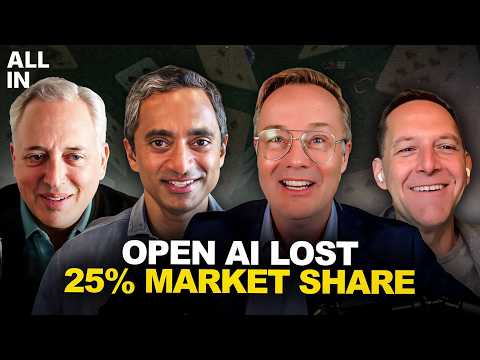
Anthropic's Generational Run, OpenAI Panics, AI Moats, Meta Loses Major Lawsuits
Jason Calacanis (host), David Sacks (host), David Friedberg (host), Chamath Palihapitiya (host), Jason Calacanis (host)
In this episode of All-In Podcast, featuring Jason Calacanis and David Sacks, Anthropic's Generational Run, OpenAI Panics, AI Moats, Meta Loses Major Lawsuits explores anthropic surges, OpenAI refocuses, AI moats shift, Meta verdicts loom Anthropic is portrayed as executing a standout product-and-distribution run by betting early on coding, which is pulling it deeper into enterprise budgets and adjacent agent workflows.
Anthropic surges, OpenAI refocuses, AI moats shift, Meta verdicts loom
Anthropic is portrayed as executing a standout product-and-distribution run by betting early on coding, which is pulling it deeper into enterprise budgets and adjacent agent workflows.
OpenAI is discussed as potentially “panicking” or sensibly refocusing, trimming side projects like Sora while considering enterprise moves and novel PE-style deployment/financing structures.
The group debates whether AI implies superintelligence-driven fragility that compresses valuation multiples, or merely a new software cycle—driving a re-rating of SaaS relative to cash-flow-rich mega-caps.
They argue about what constitutes a defensible moat in an AI world, including whether brands retain pricing power or get eroded by abundance and cheaper/faster/better products.
Two large verdicts against Meta ignite a broader discussion on child safety, addictive design, Section 230 workarounds via product liability, and the balance between corporate accountability and parental responsibility.
Key Takeaways
Anthropic’s coding focus is both a product wedge and an enterprise GTM hack.
The hosts argue coding is the breakout use case that opens enterprise IT budgets and enables adjacent outputs (slides, spreadsheets) by “generating the code” that creates them, then extending naturally into agents and computer control.
Get the full analysis with uListen AI
OpenAI’s biggest strategic risk is losing focus while competitors specialize.
They frame OpenAI’s cancellations and pivots (e. ...
Get the full analysis with uListen AI
Consumer AI may support both subscriptions and advertising—likely as in-chat ads.
Friedberg/Chamath expect high willingness to pay for an “AI meta-service,” while Sacks predicts most users will choose free ad-supported tiers; all agree the ad model can become more compelling than “ten blue links.”
Get the full analysis with uListen AI
Agents threaten traditional UI/app ecosystems, creating ‘strangulation as a service.’
They describe customers wanting a shim that hides complex software behind natural language, implying value shifts from interfaces to orchestration, trust, data access, and distribution (e. ...
Get the full analysis with uListen AI
Public markets are implicitly pricing ‘AI fragility’ into SaaS valuations.
Chamath’s framing is that if superintelligence accelerates disruption cycles, terminal values become uncertain and discount rates rise—pushing investors to demand nearer-term free cash flow, especially outside mega-cap incumbents.
Get the full analysis with uListen AI
Moats may migrate from brand to abundance, cost curves, and embedded distribution.
Chamath argues brands can go to zero when cheaper/faster/better options appear; others counter that ecosystems, networks, hardware integration, and subtle operational moats can still protect incumbents even as agents change workflows.
Get the full analysis with uListen AI
Meta verdicts signal a new litigation playbook around Section 230 via product liability.
Chamath suggests plaintiffs found a route around traditional platform protections, potentially unleashing ‘death by a thousand cuts’ suits; the group splits on remedies, emphasizing parental controls/age assurance versus corporate duty to mitigate known harms.
Get the full analysis with uListen AI
Notable Quotes
“Anthropic is sort of the most AGI-pilled of all the frontier labs, and I think they made this bet on coding as their way to get to recursive self-improvement.”
— David Sacks
“From an enterprise lens… it’s all Anthropic all the time… head and shoulders above anything else.”
— Chamath Palihapitiya
“AI… is likely gonna be the most valuable… meta service that consumers have ever seen.”
— David Friedberg
“If superintelligence is coming… what is anything worth?”
— Chamath Palihapitiya
“The door has been opened and a map has been drawn… this is how you navigate around Section 230.”
— Chamath Palihapitiya
Questions Answered in This Episode
What specific Anthropic product decisions (MCP, Claude Code, agents, ‘computer use’) created the biggest enterprise pull, and which were most defensible versus copyable?
Anthropic is portrayed as executing a standout product-and-distribution run by betting early on coding, which is pulling it deeper into enterprise budgets and adjacent agent workflows.
Get the full analysis with uListen AI
Chamath says OpenAI should ‘pick consumer’ if forced—what enterprise moves could OpenAI make that don’t dilute focus but still defend against Anthropic in B2B?
OpenAI is discussed as potentially “panicking” or sensibly refocusing, trimming side projects like Sora while considering enterprise moves and novel PE-style deployment/financing structures.
Get the full analysis with uListen AI
How should investors normalize OpenAI vs Anthropic revenue given different mixes (consumer subscriptions vs API) and different revenue recognition—what’s the fairest apples-to-apples metric?
The group debates whether AI implies superintelligence-driven fragility that compresses valuation multiples, or merely a new software cycle—driving a re-rating of SaaS relative to cash-flow-rich mega-caps.
Get the full analysis with uListen AI
If agents ‘strangle’ traditional UIs, which layers become the enduring moats: identity, data permissions, distribution (OS/browser), workflow integrations, or model quality?
They argue about what constitutes a defensible moat in an AI world, including whether brands retain pricing power or get eroded by abundance and cheaper/faster/better products.
Get the full analysis with uListen AI
Jason predicts consumer AI becomes mostly free via Apple/Google/Meta; Friedberg predicts massive paid subscriptions—what evidence would falsify either view over the next 12 months?
Two large verdicts against Meta ignite a broader discussion on child safety, addictive design, Section 230 workarounds via product liability, and the balance between corporate accountability and parental responsibility.
Get the full analysis with uListen AI
Transcript Preview
All right, everybody. Welcome back to the number one podcast in the world, Fantastic Four, the original.
Oh, the cast is back.
The cast is back.
Our brothers in arms.
Brothers in arms. Here we go, good boys. We've got a big news week. David Sacks is back, and he's in the great state of Texas. How's it been, Sacks? How's Texas been for you so far?
It's been great, although I just got back from D.C. I got like three hours sleep last night, so-
Christ
... but we had a lot of news this past week.
Hmm, yes, and we'll be talking about PCAST and your role-
Yay
... in the, in da, da, da, da-da, and your role going forward in the Trump administration. Big news that we'll be talking about today also relates to you, oh, sultan of science, David Friedberg, with your background from the iconic film, for those not watching, looks like the iconic Thelma & Louise. I wonder if that has something to do with the budget of California, which you've been outspoken about recently.
Great, great rant, which I retweeted.
You were on a mega rant-
Great rant
... with models.
Thank you, boys
... I, I retweeted it too. If only-
Thank you, boys
... if only you could be allowed the time and space to do those kinds of rants on this pod.
[laughs] Thank you very much.
Yeah. If you, if you kept-
Thank you very much
... interrupting him, Sacks-
Right as I say thank you, JCal starts talking over me
... and just let him go.
Here he is. He's going again. He's going again.
There it is, Dr. Doom.
There it is.
Dr. Doom, your mayor, your new governor. Are you-- Would you consider it, Friedberg, after Oholo, running for governor?
There is no after Oholo.
Oh, please do it.
There is no after Oholo. God.
Oh, please do it.
Wow, that'd be so great.
I'm tempted to buy Oholo for, like, five or six billion so he just does it.
[laughs] It's a dirty game, Paul. It's-- California politics is dirty, man.
I don't even know what it does. I'll just have somebody else deal with it. [laughs]
Could you imagine the oppo research-
But the amount, the amount-
... you run on Friedberg? [laughs]
No, no, no, no. We get him elected. He would do an incredible job. He would save the fourth-largest economy in the world. It would be incredible.
It'd be amazing. I would love the, the role- Here's the oppo research, Sacks. [laughs] David Friedberg went to a rave in 1999 [laughs] and stayed up until 10:00 AM. [laughs] We have witnesses.
Once he, he got tilted at the poker game, stole a bunch of pistachios and Lactaid and ran home.
He did. [laughs]
[laughs]
You gotta let your winners ride.
Rainman David Sacks. And instead-
We open-sourced it to the fans, and they've just gone crazy with it.
Love you guys.
Install uListen to search the full transcript and get AI-powered insights
Get Full TranscriptGet more from every podcast
AI summaries, searchable transcripts, and fact-checking. Free forever.
Add to Chrome