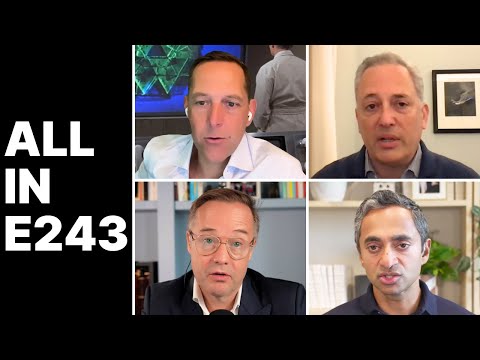
Charlie Kirk Murder, Assassination Culture in America, Jimmy Kimmel Suspended, Ellison Media Empire
Jason Calacanis (host), David Sacks (host), David Friedberg (host), Chamath Palihapitiya (host), Narrator, Narrator
In this episode of All-In Podcast, featuring Jason Calacanis and David Sacks, Charlie Kirk Murder, Assassination Culture in America, Jimmy Kimmel Suspended, Ellison Media Empire explores assassination Culture, Free Speech, and Ellison’s Emerging Media Empire The All-In hosts grapple with the assassination of Charlie Kirk, framing it as a watershed moment in America’s drift toward ‘assassination culture’ and the erosion of free speech norms. They argue the killer reflects a broader, ideologically incoherent, post-COVID generation of isolated young men radicalized by schools, media, algorithms, and subcultures. The episode then pivots to the fallout from Jimmy Kimmel’s suspension over comments about Kirk’s murder, debating free speech, cancel culture, and whether government pressure played a role. Finally, they analyze Larry and David Ellison’s rapidly expanding media footprint—Paramount, potential Warner Bros Discovery, TikTok US, and The Free Press—as a possible reconfiguration of global media power and distribution.
Assassination Culture, Free Speech, and Ellison’s Emerging Media Empire
The All-In hosts grapple with the assassination of Charlie Kirk, framing it as a watershed moment in America’s drift toward ‘assassination culture’ and the erosion of free speech norms. They argue the killer reflects a broader, ideologically incoherent, post-COVID generation of isolated young men radicalized by schools, media, algorithms, and subcultures. The episode then pivots to the fallout from Jimmy Kimmel’s suspension over comments about Kirk’s murder, debating free speech, cancel culture, and whether government pressure played a role. Finally, they analyze Larry and David Ellison’s rapidly expanding media footprint—Paramount, potential Warner Bros Discovery, TikTok US, and The Free Press—as a possible reconfiguration of global media power and distribution.
Key Takeaways
Political Violence Is Normalizing Among Young People, Especially on the Left
The hosts cite polling (e. ...
Get the full analysis with uListen AI
A ‘Lost Generation’ of Young Men Is Being Shaped by Isolation and Fragmented Ideologies
Chamath describes the killer, Tyler Robinson, as emblematic of a post-COVID cohort: years of isolation, heavy screen time, and immersion in niche online subcultures, often combined with overprescribed SSRIs/stimulants. ...
Get the full analysis with uListen AI
Charlie Kirk Was Targeted for His Effectiveness, Not Just His Views
Multiple hosts argue Kirk’s real ‘threat’ was his skill in live debate and persuasion, especially with young audiences on college campuses and online. ...
Get the full analysis with uListen AI
Free Speech Requires a Hard Line Against Political Violence—From All Sides
The panel insists that a functioning democracy demands one non-negotiable norm: you may never use or celebrate violence to resolve political disagreements. ...
Get the full analysis with uListen AI
Cancel Culture vs. Consequences: The Kimmel Suspension Illustrates a New Phase
They draw a distinction between orchestrated cancel campaigns (digging up decade-old tweets) and real-time backlash to offensive statements. ...
Get the full analysis with uListen AI
Opaque Algorithms Are Quietly Shaping Public Discourse—and Possibly Radicalization
The hosts discover mid-episode that several of their most contentious All-In Summit talks (Tulsi Gabbard, Tucker vs. ...
Get the full analysis with uListen AI
The Ellison Media Play: Converging Legacy Studios With Social Distribution
Freeberg frames Larry and David Ellison’s moves—Paramount/Skydance, possible Warner Bros Discovery acquisition, interest in The Free Press, and Oracle as frontrunner for TikTok US—as a coordinated bid to build the most influential media company in history. ...
Get the full analysis with uListen AI
Notable Quotes
“When you express an idea, it cannot be that then you risk becoming a target. Because the ultimate outcome of that is fewer people will then enter the public debate.”
— Chamath Palihapitiya
“He wasn’t targeted for his controversy. He was targeted for his effectiveness.”
— David Friedberg
“In his twisted mindset, it was somehow an act of love. And the question is, how did we get to this place?”
— David Sacks
“If you believe political opponents should be punished with violence or death, you’re a terrorist.”
— David Sacks (quoting J.K. Rowling, endorsing)
“Free speech does not mean you have a right to an ABC show. Sorry. You actually have to be able to get ratings.”
— David Sacks
Questions Answered in This Episode
You argue that a ‘lost generation’ of young men is emerging from COVID isolation, medication, and online subcultures—what concrete policy or institutional reforms would you prioritize first to reverse that trend?
The All-In hosts grapple with the assassination of Charlie Kirk, framing it as a watershed moment in America’s drift toward ‘assassination culture’ and the erosion of free speech norms. ...
Get the full analysis with uListen AI
If Randi Weingarten–style ‘oppressor vs. oppressed’ framing in schools is a root driver of radicalization, how would you redesign K–12 curricula to encourage critical thinking without simply imposing a different ideology?
Get the full analysis with uListen AI
You suggest algorithm transparency and ‘bring your own algorithm’ as solutions—how would you implement that technically and legally without crippling the business models of platforms like YouTube and TikTok?
Get the full analysis with uListen AI
In Kimmel’s case, you distinguish between cancel culture and legitimate consequences; where exactly would you draw the red line—for example, should calls to ‘dance on the grave’ of a political opponent always be grounds for losing a broadcast platform?
Get the full analysis with uListen AI
The Ellison media empire you describe could centralize enormous influence over both legacy news (CBS, CNN) and social distribution (TikTok US); what specific safeguards would you want in place to prevent that concentration from becoming its own form of speech control or narrative manipulation?
Get the full analysis with uListen AI
Transcript Preview
Okay, everybody. There's no easy way to start today's show. Eight days ago, Charlie Kirk was savagely murdered while doing what Americans love to do, debate. And when someone is senselessly killed like this, especially at a young age and at the hands of another human, try to make sense of it. That's only natural. And, uh, it's hard to imagine anything worse than a young father of two, just 31 years old and entering the best and most productive years of his life, being killed by a 22-year-old who's barely out of adolescence. Our hearts go out to the Kirk family, his friends, his fans, and every American who understands that no one should be killed for expressing their beliefs. That's the core of the great American experiment. So, let's keep that experiment alive today and the memory of Charlie Kirk by continuing the great debate. Besties, there's a lot to process here as a community, a country, a society, and, uh, I just wanna check everybody's temperature at the top of the program. We're obviously not gonna do a cold open here because that would be inappropriate. But Chamath, how are you processing the last eight days?
I actually wrote down something as well, which I normally don't do. I just like to kind of react, but let me just read that and then maybe we can just talk from there. So, to me, what Tyler Robinson illustrates is the emergence of a lost generation that was shaped by COVID. I see years of isolation, a reliance on screens, and an immersion in online subcultures that have created a vacuum where some young men are drifting in without any grounding. No institutions, no friends, no communities, no family. And out of that void, I think what comes out can, at best, only be called ideological incoherence. Somebody used the word salad bar extremism. These individuals are not clearly aligned with any one ideology completely, but they seem to be assembling fragments of memes, of conspiracies, of cultural signals into an unstable identity and in some cases now, it's exploding into violence. I think the most troubling consequence isn't just the facts themselves, which is abhorrent and I, and I feel incredibly bad for all of Charlie's friends and his family and his children, obviously himself. But beyond the act itself, there's an enormously chilling effect, I think, on public discourse. When you express an idea, it cannot be that then you risk becoming a target. Because the ultimate outcome of that is fewer people will then enter the public debate. And then what happens is the range of acceptable dialogue really narrows, and it only leaves space then for the most benign voices in the public square. And if you have that kind of anodyne discussion, I just think you have very bad outcomes for society. I've watched a lot of his content since he was murdered, and I'm still trying to grapple with why people could not shout the man down if they disagreed with him and instead shot the man down. And I think that that is a completely unacceptable response for what he thought. That's what I think.
Install uListen to search the full transcript and get AI-powered insights
Get Full TranscriptGet more from every podcast
AI summaries, searchable transcripts, and fact-checking. Free forever.
Add to Chrome