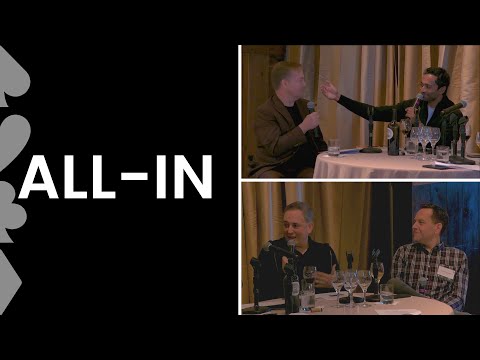
E46: False Ivermectin narratives, regulatory grift, wartime mentality in solving issues & more
David Sacks (host), Jason Calacanis (host), Narrator, Chamath Palihapitiya (host), David Friedberg (host), Jason Calacanis (host), Audience member (guest), Audience member (guest), Audience member (guest), Alex Filippenko (guest), Audience member (guest), Audience member (guest), Audience member (guest), Audience member (guest)
In this episode of All-In Podcast, featuring David Sacks and Jason Calacanis, E46: False Ivermectin narratives, regulatory grift, wartime mentality in solving issues & more explores media bias, pandemic policy, and wartime innovation in broken systems This live All-In Podcast episode, recorded at The Production Board Symposium, critiques mainstream media’s handling of the ivermectin story and broader COVID communication failures, arguing that bias and double standards erode trust. The hosts debate vaccine mandates, rapid testing, and how regulatory capture and corruption undermine effective pandemic and climate responses, contrasting government waste with the efficiency of entrepreneurial innovation. They explore wartime-style coordination for tests, climate tech, and nuclear/fusion, while warning about political bias in tech platforms and the geopolitical implications of China’s tightening control over its tech sector. The conversation closes on whether decentralized technologies (crypto/DeFi) and startup-driven innovation can offset government dysfunction, and whether the hosts themselves should use their platform to shape concrete political and policy agendas.
Media bias, pandemic policy, and wartime innovation in broken systems
This live All-In Podcast episode, recorded at The Production Board Symposium, critiques mainstream media’s handling of the ivermectin story and broader COVID communication failures, arguing that bias and double standards erode trust. The hosts debate vaccine mandates, rapid testing, and how regulatory capture and corruption undermine effective pandemic and climate responses, contrasting government waste with the efficiency of entrepreneurial innovation. They explore wartime-style coordination for tests, climate tech, and nuclear/fusion, while warning about political bias in tech platforms and the geopolitical implications of China’s tightening control over its tech sector. The conversation closes on whether decentralized technologies (crypto/DeFi) and startup-driven innovation can offset government dysfunction, and whether the hosts themselves should use their platform to shape concrete political and policy agendas.
Key Takeaways
Media bias and confirmation bias can rapidly turn weak anecdotes into viral ‘facts.’
The Rolling Stone ivermectin overdose story relied on a single questionable source and misleading imagery, but was widely amplified because it fit commentators’ preexisting narratives about ‘MAGA idiots’ and anti-vaxxers; once debunked, there were no real consequences for major amplifiers on the political left.
Get the full analysis with uListen AI
Content moderation on major platforms operates with two sets of rules.
The hosts argue that figures aligned with prevailing cultural and political views (e. ...
Get the full analysis with uListen AI
The U.S. squandered its chance to adopt a true wartime pandemic footing.
Instead of using emergency powers to mass-produce ultra-cheap rapid tests, the government leaned on incumbent vendors, overpaid for limited kits, and allowed regulatory structures (FDA rules, healthcare admin bloat) to block simple, scalable solutions that countries like Germany deployed.
Get the full analysis with uListen AI
Regulatory capture distorts climate and healthcare policy toward incumbents, not outcomes.
Tax credits and subsidies disproportionately favor large, well-lobbied players (e. ...
Get the full analysis with uListen AI
Entrepreneurial innovation delivers far more per dollar than government mega-spending.
Roughly the same $2 trillion that funded two decades of largely failed U. ...
Get the full analysis with uListen AI
Decentralized technologies (crypto/DeFi) are both a response to and a threat for states.
Crypto reflects broad distrust of fiat and institutions, but its scale, capital-light structure, and DAO-based governance may undermine traditional capitalism and invite aggressive state pushback, including attacks on the ‘open internet’ and stricter controls like China’s outright ban.
Get the full analysis with uListen AI
Solving systemic problems requires both entrepreneurial drive and smarter state action.
The hosts contend that startups alone can’t overcome entrenched IP, regulatory regimes, and geopolitical dependencies (e. ...
Get the full analysis with uListen AI
Notable Quotes
““This was basically a doctored up conjured article by some person trying to incite a moral mania at Rolling Stone.””
— Chamath Palihapitiya
““Twitter and Facebook do not punish people on the left for misinformation. That is a penalty they only meter out for people who disagree with their cultural and political biases.””
— David Sacks
““We don't have a wartime mentality right now. We haven't had a wartime mentality since COVID hit.””
— David Friedberg
““It’s straight up corruption. It’s graft… We could have taken over a friggin’ factory and on a piece of paper printed eight billion tests and distributed them for 50 cents.””
— David Friedberg
““I think it will destroy wealth. I frankly couldn't give a fuck, and I think it's better for the world.””
— Chamath Palihapitiya, on crypto/DeFi’s impact on traditional capitalism
Questions Answered in This Episode
How should platforms design content moderation systems that minimize political bias without abandoning responsibility for misinformation?
This live All-In Podcast episode, recorded at The Production Board Symposium, critiques mainstream media’s handling of the ivermectin story and broader COVID communication failures, arguing that bias and double standards erode trust. ...
Get the full analysis with uListen AI
What concrete steps would a genuine ‘wartime’ pandemic strategy have taken in 2020–2021, and which are still feasible now?
Get the full analysis with uListen AI
How can policymakers restructure incentives to reduce regulatory capture in healthcare and climate while still leveraging private industry?
Get the full analysis with uListen AI
Where should governments draw the line between embracing decentralized finance for innovation and restricting it to preserve monetary and national security?
Get the full analysis with uListen AI
What would a serious, founder-driven ‘strategic plan’ for a state like California or for the U.S. actually look like in practice, and who should own it?
Get the full analysis with uListen AI
Transcript Preview
Jake Hal looks like he's going to a Night at the Roxbury. I mean-
Absolutely. (laughs)
(laughs)
What?
He looks like Joe Pesci. Here we go. (laughs)
He looks like Joe Pesci-
Shut the fuck up.
Is it a joke right now or is it, uh-
What, like I'm a joke? (laughs)
... the Saturday Night Live skit? You know?
(laughs)
I mean, you look horrible.
Thank you. (laughs) Thank you, Chamath.
Absolutely fucking horrible.
Okay, appreciate it. (laughs) Wow.
Is that your MC outfit or what?
Here we go. (laughs)
(laughs)
(upbeat music) We're going all in. Don't let your winners ride. Rain man, David Sacks. We're going all in. And I said we open source it to the fans, and they've just gone crazy with it. Love you guys. Queen of quinoa. Going all in.
Thanks for coming. This is the Production Board Symposium 2021. Tell us just a little bit about why we're here, David, and, and what this is and what it represents for the Production Board.
Uh, the Production Board Symposium, second ever. Thank you all for being here. We're excited. We have, uh-
(clapping) Woo!
... an amazing group of, um, science, uh, scientists, engineers, folks from academia, from business, from the investing community, some of our investors. So we're excited to share thoughts and ideas over the next couple of days, um, and thought we would, uh, chase half of you away by hosting the All-In Pod tonight. So, um, here we go.
Great. Uh, okay, so first up in the news, Rolling Stone, uh, amplifies false ivermectin story. You were following this. Chamath, what do you think this, uh, ivermectin controversy and-
You wanna little, give a little summary of what the issue is before we talk about the hypocrisy of it?
Well, on September 1st, Oklahoma News, uh, Station KFOR ran a story and published an article on ivermectin overdoses, uh, backing up rural hospitals. The article was titled Patients, uh, Overdosing on Ivermectin Backing Up Rural Oklahoma Hospital- Hospitals and Ambulances. Uh, first line of the article, quote, "A rural Oklahoma doctor said patients who are taking the home dewormer medication ivermectin to fight COVID-19-"
Jesus.
"... are causing emergency rooms and ambulances to, uh, back up." On September 3rd, Rolling Stone amplified the story in its own article. Uh, the only problem was, uh, they treed- they tweeted it with a picture that featured people lined up in the cold. It turns out the picture was people waiting for vaccine shots back in January-
(laughs)
... not gunshot victims waiting to get into the hospital.
Yeah, the story is totally false. You understand that, right?
Well, I didn't wanna say fake news, but I know-
No, it was beyond fa- it, it, it was beyond f- fake news. This was basically a doctored up conjured article by some person trying to incite a moral mania at Rolling Stone. Look, there, you tell me if the, the science of this is wrong. The whole, the whole premise is r- ridiculous. So ivermectin basically, as far as we know, 'cause we don't know that much, acts on a handful of, uh, specific characteristics. One we know to be glutamate, which we don't really express in the same way as, like, fucking worms. And so, yes, technically it can be used as a dewormer, but there are four or five other ways in which it acts which we don't know anything about because we haven't taken the time to do a broad-based double blind study. So I think the fairest thing to say about ivermectin is we don't know what it is. And so neither the people that propose to use it as a solution for, for COVID nor the people that rail against it aren't really starting from a basis of fact. But then what happens is you have these folks who basically are so turned off by the idea that, you know, people aren't getting vaccines, they're going to use this other thing, they basically doctored up an article. That wouldn't be so bad 'cause nobody reads Rolling Stone, right? It's kind of a, it's, like, it's kind of-
Install uListen to search the full transcript and get AI-powered insights
Get Full TranscriptGet more from every podcast
AI summaries, searchable transcripts, and fact-checking. Free forever.
Add to Chrome