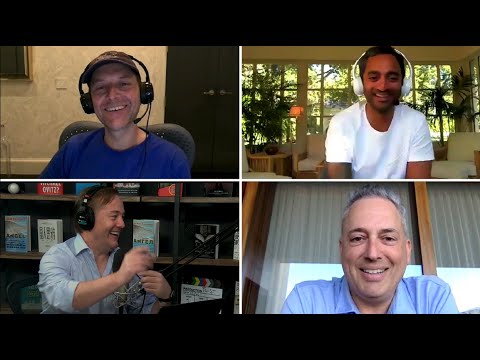
E3: Modern Cold War, politicizing the pandemic & more with David Sacks & David Friedberg
Jason Calacanis (host), Chamath Palihapitiya (host), David Sacks (host), David Friedberg (host)
In this episode of All-In Podcast, featuring Jason Calacanis and Chamath Palihapitiya, E3: Modern Cold War, politicizing the pandemic & more with David Sacks & David Friedberg explores pandemic Politics, Economic Turmoil, and a New U.S.–China Cold War The hosts and guests discuss how COVID-19 has evolved from a health crisis into a deeply politicized battle over lockdowns, masks, and economic policy. They argue that lockdowns were misdesigned and poorly enforced, and that widespread mask usage plus targeted protections could have replaced broad shutdowns. The conversation shifts to the distorted stock market recovery, long-term unemployment, remote work, and the likely reshaping of cities like San Francisco and New York. They close by framing rising U.S.–China tensions as the start of a modern Cold War and debate how America should decouple from Chinese supply chains while leapfrogging in manufacturing technology.
Pandemic Politics, Economic Turmoil, and a New U.S.–China Cold War
The hosts and guests discuss how COVID-19 has evolved from a health crisis into a deeply politicized battle over lockdowns, masks, and economic policy. They argue that lockdowns were misdesigned and poorly enforced, and that widespread mask usage plus targeted protections could have replaced broad shutdowns. The conversation shifts to the distorted stock market recovery, long-term unemployment, remote work, and the likely reshaping of cities like San Francisco and New York. They close by framing rising U.S.–China tensions as the start of a modern Cold War and debate how America should decouple from Chinese supply chains while leapfrogging in manufacturing technology.
Key Takeaways
Lockdowns were blunt, politically polarized, and often ineffective.
The guests argue that U. ...
Get the full analysis with uListen AI
Masks plus targeted protections could enable reopening with lower risk.
They emphasize that universal mask-wearing and focused protection for high‑risk groups (elderly, those with comorbidities, nursing homes) can meaningfully reduce transmission without broad economic shutdowns, but politics has blocked this compromise.
Get the full analysis with uListen AI
COVID-19’s true fatality rate is likely far below early official figures.
Based on serology and infection data, they estimate the infection fatality rate around ~0. ...
Get the full analysis with uListen AI
The stock market rebound is decoupled from the real economy.
Massive monetary stimulus has buoyed asset prices, especially large tech and SaaS companies, while tens of millions remain unemployed and asset-light, physical-economy businesses are 'decimated', masking true economic damage.
Get the full analysis with uListen AI
Remote work will reshape labor markets, cities, and tech’s geography.
Widespread comfort with managing remote teams enables companies to cut office costs, hire from anywhere, and potentially abandon expensive, problematic hubs like San Francisco, weakening Silicon Valley’s traditional network effects.
Get the full analysis with uListen AI
U.S.–China tension is entering a “modern Cold War” phase.
They foresee bipartisan support for decoupling from China in strategic areas (drugs, PPE, 5G, critical supply chains), favoring reciprocal trade and reducing dependence on an authoritarian rival that mishandled early outbreak information.
Get the full analysis with uListen AI
The crisis exposes overregulation and creates a window to leapfrog in tech.
Friedberg argues that slow, risk‑averse regulation has long impeded genetic therapies and advanced manufacturing; COVID-19 could catalyze deregulation and investment in 3D printing, automation, and biomanufacturing to rebuild production domestically.
Get the full analysis with uListen AI
Notable Quotes
“The pandemic underreaction caused the pandemic, and overreaction will cause the depression.”
— David Sacks
“Wear a goddamn mask and shut the fuck up and go back to work.”
— Chamath Palihapitiya
“We have 30 million American men and women out of work. That is every fifth person you see walking down the street.”
— Chamath Palihapitiya
“This is the beginning of the modern Cold War. And so it's America versus China.”
— Chamath Palihapitiya
“If we create new methods of production, which we're uniquely positioned to do, we can completely reinvent the wheel in a lot of industries and actually produce for the world.”
— David Friedberg
Questions Answered in This Episode
If masks and targeted protections are so effective, what specific political or cultural barriers are preventing broad adoption of this middle-ground strategy?
The hosts and guests discuss how COVID-19 has evolved from a health crisis into a deeply politicized battle over lockdowns, masks, and economic policy. ...
Get the full analysis with uListen AI
How should policymakers balance economic damage against incremental lives saved when deciding on future lockdowns or restrictions?
Get the full analysis with uListen AI
To what extent will remote work permanently weaken the economic and cultural centrality of cities like San Francisco and New York?
Get the full analysis with uListen AI
What is the right level of regulatory risk tolerance for fast-tracking promising therapies and technologies without repeating past safety failures?
Get the full analysis with uListen AI
How can the U.S. realistically decouple from Chinese manufacturing while avoiding runaway inflation or shortages for consumers?
Get the full analysis with uListen AI
Transcript Preview
Hey, everybody. Welcome to the All-In Podcast with Jason Calacanis and Chamath Palihapitiya. We record this podcast, well, on a, on a really unique schedule, Chamath. What's our schedule right now? Whenever we feel like it?
Uh, basically, it is whenever our significant others get so sick of us-
(laughs)
... that they kick us out (laughs) and say, "Don't come back."
Yeah, we get thrown to the pool house-
We get thrown to the pool house.
... we decide to pop up the podcast. Uh-
Exactly.
... you're in, uh, Atherton. Uh, I am in the city in San Francisco. And-
Thank you, Duke of Discretion. W- Is there anything else you'd like to do to help them?
Uh, put a beep!
My address, my gate code.
(laughs) Gate code-
(laughs)
... uh, off the fence. Um, w- you know, we had two guests on that people just went absolutely crazy for. Uh, the two David-
But they weren't available, so... (laughs)
So (laughs) we're just gonna talk shit about them.
(laughs)
No, we have two amazing Davids in our lives, David Friedberg and David Sacks. And they are super smart, super effective at their work, uh, everything we're not, Chamath. And so we thought we'd bring them back on the podcast and we'll do a little roundtable here and talk about life in the age of corona. So welcome back to the podcast, David Sacks.
Yeah. Good to, good to be back with you.
And also David Friedberg.
Thank you, guys. Happy to be here.
All right. Fantastic. So I just want to start off with our quar check. How is everybody doing in this quarantine? How's everybody's mental health? Let's start with you, Sacks.
Um, well, as you might be able to see, um, we've moved our, our bunker to a undisclosed Mexican location.
(laughs)
Uh, uh, you know, and it's been great. Um, you know, uh, we, you know, I think... I- it's really kind of sad because where we're at is, is a tourist city that would normally be, um, at peak season, and it's just deserted right now. All the construction has stopped. Um, normally you see lots of, you know, hotels and houses, um, being built, and that's all stopped. Um, and, uh, there's no tourists, so it's all just kind of cleared out. But, um, I think it's quite safe. You know, uh, every, uh, worker that I've seen here since we landed at the airport to, you know, got transported to, to this community we're at, I mean, has been wearing a mask. Um, much more consistent than I think in the US. And, um, you know, I think it's been, it's been fine.
Now, of course, you founded, uh, the, uh, Craft Venture capital firm, and people know before that, uh, you obviously did Yammer and sold that to Microsoft for a billion dollars plus. And before that, you were, uh, the COO of PayPal. What's going on with your business? Are you actively investing? Uh, and how is your firm running remote?
Install uListen to search the full transcript and get AI-powered insights
Get Full TranscriptGet more from every podcast
AI summaries, searchable transcripts, and fact-checking. Free forever.
Add to Chrome