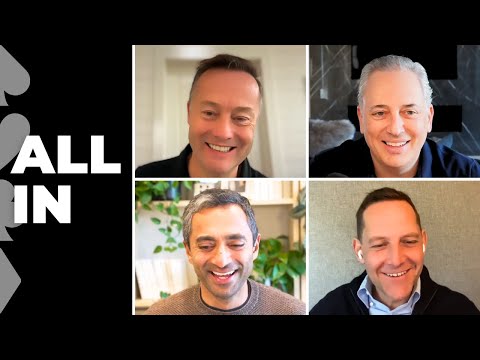
E171: DOJ sues Apple, AI arms race, Reddit IPO, Realtor settlement & more
Jason Calacanis (host), David Friedberg (host), Chamath Palihapitiya (host), David Sacks (host), Narrator, Narrator, Narrator
In this episode of All-In Podcast, featuring Jason Calacanis and David Friedberg, E171: DOJ sues Apple, AI arms race, Reddit IPO, Realtor settlement & more explores apple antitrust showdown, AI power plays, and disrupted commissions collide The hosts dissect the DOJ’s new antitrust lawsuit against Apple, debating whether Apple’s tightly integrated ecosystem is consumer choice or abusive lock‑in, and what role government should play in enforcing interoperability and App Store competition.
Apple antitrust showdown, AI power plays, and disrupted commissions collide
The hosts dissect the DOJ’s new antitrust lawsuit against Apple, debating whether Apple’s tightly integrated ecosystem is consumer choice or abusive lock‑in, and what role government should play in enforcing interoperability and App Store competition.
They then explore Apple’s rumored AI deal with Google Gemini as a potential sign of Apple ceding core innovation, while contrasting it with Microsoft’s aggressive AI strategy, including its quasi‑acquihire of Inflection AI and the broader AI investment landscape, such as Saudi Arabia’s proposed $40B AI fund.
A major settlement against the National Association of Realtors is framed as a turning point likely to compress commissions, eliminate many agents, and accelerate AI‑powered, a la carte and flat‑fee real estate services.
The conversation rounds out with market speculation (Reddit IPO, rate cuts, commercial real estate stress), plus science and tech breakthroughs, including cosmology findings, gene‑edited pig organ transplants, and Neuralink’s first successful human trial.
Key Takeaways
Apple’s closed ecosystem is under serious antitrust scrutiny, especially around interoperability and App Store control.
The DOJ’s case centers on whether Apple’s restrictions on super apps, messaging, wearables, cloud gaming, and wallets are legitimate product design or anti‑competitive tactics that unfairly lock users and developers in; the hosts expect at least some forced concessions, particularly on messaging and device interoperability.
Get the full analysis with uListen AI
Interoperability pressure may ultimately benefit Apple if it leans into openness instead of lock‑in.
Allowing iMessage on Android, opening the Watch to non‑iOS devices, and relaxing App Store rules could expand Apple’s addressable market rather than just preserving short‑term rent extraction, but Apple’s instinct has consistently been to push lock‑in until regulators or lawsuits push back.
Get the full analysis with uListen AI
Apple’s rumored reliance on Google Gemini signals strategic weakness in AI, especially versus Microsoft.
The panel views licensing Gemini as akin to IBM outsourcing its OS to Microsoft or Yahoo bundling Google Search—outsourcing a core future capability to a competitor; with $30B in R&D, Apple is criticized for not clearly owning a first‑class, in‑house LLM strategy.
Get the full analysis with uListen AI
Microsoft is aggressively consolidating AI talent via structures that sidestep full acquisitions and antitrust.
The Inflection AI deal—hiring most staff and licensing tech while leaving the corporate shell—looks to the hosts like a bailout of investors and a way for Microsoft to absorb top talent and IP without a headline acquisition, reinforcing its pattern with OpenAI and others.
Get the full analysis with uListen AI
The NAR settlement will likely compress commissions, kill the long tail of agents, and shift to flat or a la carte pricing.
By forcing buyers to pay their own agents instead of hiding buy‑side commissions inside the seller’s fee, the economics become explicit and unattractive for many buyers, driving fee reductions, fewer full‑time agents, more dual‑sided representation constraints, and a bigger role for AI tools, fixed‑fee and menu‑based services.
Get the full analysis with uListen AI
The real AI upside may accrue to application‑layer businesses and traditional industries, not just model and chip providers.
While chips and foundation models are crowded and capital‑intensive, the hosts expect significant value capture in vertical applications—especially robotics, manufacturing, medicine, and productivity tools—where AI can plug into existing revenue streams and deliver clear ROI.
Get the full analysis with uListen AI
Despite risk‑on sentiment (Reddit IPO, crypto, rate‑cut optimism), structural risks like CRE and inflation remain unresolved.
Markets are pricing in multiple rate cuts and fueling speculative activity, but data like office loans failing to pay off and stubborn 3% inflation suggest underlying fragility; the hosts see a ‘pretend and extend’ posture in commercial real estate and banking.
Get the full analysis with uListen AI
Notable Quotes
“What this lawsuit is really about is your view of interoperability.”
— David Sacks
“If Apple is gonna use Gemini, I think it’s them giving up.”
— Chamath Palihapitiya
“It’s always been crazy to me that anyone would pay a percent of absolute value… I just gave up 60% of my profit on my home.”
— David Friedberg
“The most important thing fund managers get wrong is not having appropriate reserves for your winners.”
— Chamath Palihapitiya
“Our universe is expanding at different rates in different parts of the universe, which totally doesn’t make sense, and there’s no really clear answer as to the physics of why.”
— David Friedberg
Questions Answered in This Episode
If regulators force Apple to open up iMessage and device interoperability, how might that reshape competitive dynamics between Apple and Android over the next decade?
The hosts dissect the DOJ’s new antitrust lawsuit against Apple, debating whether Apple’s tightly integrated ecosystem is consumer choice or abusive lock‑in, and what role government should play in enforcing interoperability and App Store competition.
Get the full analysis with uListen AI
Should foundational AI capabilities (like LLMs) be considered strategic national or corporate infrastructure that must be built in‑house, or is partnering with competitors a rational choice?
They then explore Apple’s rumored AI deal with Google Gemini as a potential sign of Apple ceding core innovation, while contrasting it with Microsoft’s aggressive AI strategy, including its quasi‑acquihire of Inflection AI and the broader AI investment landscape, such as Saudi Arabia’s proposed $40B AI fund.
Get the full analysis with uListen AI
How will making buyer’s agent fees explicit change consumer behavior in housing markets—will more buyers truly go agent‑free, or just push for radically different fee structures?
A major settlement against the National Association of Realtors is framed as a turning point likely to compress commissions, eliminate many agents, and accelerate AI‑powered, a la carte and flat‑fee real estate services.
Get the full analysis with uListen AI
Where in the AI stack do you personally believe the most sustainable competitive advantage lies: chips, models, infrastructure, or vertically focused applications, and why?
The conversation rounds out with market speculation (Reddit IPO, rate cuts, commercial real estate stress), plus science and tech breakthroughs, including cosmology findings, gene‑edited pig organ transplants, and Neuralink’s first successful human trial.
Get the full analysis with uListen AI
Given evidence of uneven cosmic expansion and breakthroughs like xenotransplants and brain–computer interfaces, how should policymakers and investors balance radical scientific uncertainty with long‑term planning?
Get the full analysis with uListen AI
Transcript Preview
Has anybody else seen Dune 2 in IMAX?
No, don't say anything.
Ugh, don't say anything about Dune. I wanna see it.
All I wanna say about Dune-
No, don't say it. Okay, stop, stop. Just stop.
... is it, it is fantastic and I want to see it again in IMAX.
Stop. Just stop.
That's it. That's all I'm saying, is that it's worth seeing twice.
I don't even want to know that you think it's good.
It's overrated.
It makes me... Ugh!
(laughs)
Stop, both of you. See, the exact-
He didn't see it. He didn't... Sacks didn't see it.
No, I saw Dune.
Dune 2.
Yeah, I saw it. It's overrated.
Okay, stop. Stop. Okay, stop. Everybody, you... Both of the two of you-
It's not overrated.
It... There's, like, five great scenes. Stop.
Sacks, the scene where-
Stop.
(laughs)
Stop. Stop. You guys are so annoying.
What your winners ride.
Rain Man David Sacks.
I'm going all in.
And I said, "We open sourced it to the fans and they've just gone crazy with it."
Love you guys.
Queen of quinoa. I'm going all in.
All right, everybody. Welcome to the All-In Podcast. With me again, The Chairman Dictator, Chamath Palihapitiya, David Sacks, The Rain Man, yeah, and The Sultan of Science, David Freiberg. It's your boy J Cal here and we have so much to go through. The DOJ dropped a Sherman Act suit on Apple today, right as we were about to tape the program. It seems like Thursdays is the big news drop day now. So this DOJ suit outlines five alleged abuses and they claim, obviously, that those abuses reduce competition while limiting consumer choice and raising the prices that consumers pay for their iPhone. We talked about this actually just a couple of weeks ago when we talked about peak Apple. The five categories are, very quickly, super apps, cloud gaming apps, messaging apps, smartwatches, and digital wallets. If you don't know about super apps, that's the one that's... Maybe you haven't heard of if you're listening to this. In Asia, they mentioned how Alipay, WeChat, and Paytm are, uh, super apps. What does that mean? You get, like, five or six different functions in one app. Social media, images, purchasing, getting rides, you know, all that stuff. And when you have that, you can move from one platform to another super easily. And when it comes to messaging apps, we've all experienced the green bubble friend. So, the main argument of the lawsuit, pretty interesting, they explain, and it's a really well-written document, I read it this morning, that when Apple faces new competition, instead of lowering prices for consumers or offering a better deal to developers they would, quote, "meet competitive threats by imposing a series of shape-shifting rules and restrictions in its app store guidelines and developer agreements." I've faced this every time I've invested in an app startup. They complain about the goalpost moving by Apple, and Apple shares down about 3% on the news today. I'm sure everybody's got some interesting thoughts on it. Chamath, you were talking about peak Apple just last week or the week before, I think. What are your thoughts on the lawsuit that dropped today?
Install uListen to search the full transcript and get AI-powered insights
Get Full TranscriptGet more from every podcast
AI summaries, searchable transcripts, and fact-checking. Free forever.
Add to Chrome