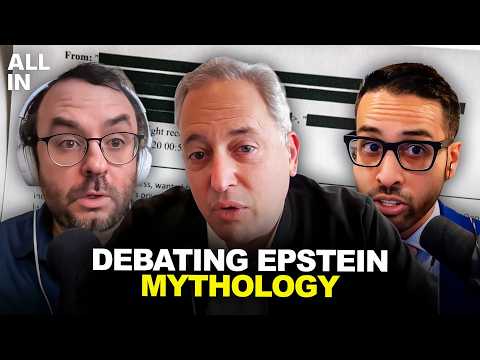
Epstein Files Special: Prince Andrew Arrested, Global Network, Mythology, Reid Hoffman Files
David Sacks (host), Saagar Enjeti (guest), Michael Tracey (guest), David Sacks (host), Kevin Bass (guest), Jason Calacanis (cameo)
In this episode of All-In Podcast, featuring David Sacks and Saagar Enjeti, Epstein Files Special: Prince Andrew Arrested, Global Network, Mythology, Reid Hoffman Files explores epstein Files spark debate: elite impunity claims versus mythology critique David Sacks hosts a guest-driven, all-Epstein episode featuring Saagar Enjeti, Michael Tracey, and Kevin Bass, aiming to surface competing interpretations of the Epstein story and the latest “files” discourse.
Epstein Files spark debate: elite impunity claims versus mythology critique
David Sacks hosts a guest-driven, all-Epstein episode featuring Saagar Enjeti, Michael Tracey, and Kevin Bass, aiming to surface competing interpretations of the Epstein story and the latest “files” discourse.
Saagar frames Epstein as a power-and-money-laundering nexus tied to elites and possible intelligence adjacency, citing Prince Andrew-related allegations and unresolved questions around figures like Leslie Wexner.
Tracey argues the dominant public narrative has become “Epstein Mythology”: a moral panic fueled by bad journalism, loose definitions of “trafficking,” and massive legal/financial incentives that reward unverified or exaggerated claims.
Bass presents a document-driven critique of Reid Hoffman’s public statements, claiming the released materials contradict Hoffman’s minimization of his Epstein relationship and show extensive direct contact beyond MIT Media Lab fundraising.
Key Takeaways
The episode’s central tension is ‘elite impunity’ vs ‘mass mythology.’
Saagar treats Epstein as evidence of a protected ruling class operating above accountability, while Tracey contends the most viral claims reflect a self-reinforcing panic divorced from verifiable facts.
Get the full analysis with uListen AI
Prince Andrew’s legal jeopardy is framed as official-duty misconduct, not only sex scandal.
Saagar emphasizes allegations that Andrew shared non-public UK trade information with Epstein and that additional material may exist beyond what’s in the recently circulated files.
Get the full analysis with uListen AI
What people ‘could have known’ about Epstein pre-2018 is contested but not zero.
Saagar and Tracey note there was mainstream coverage in 2008 after Epstein’s plea, even if the broader cultural fixation didn’t surge until the 2018 Miami Herald-driven revival.
Get the full analysis with uListen AI
Tracey claims key pillars of the popular narrative rely on unreliable or recanted accounts.
He highlights Virginia Giuffre’s recantations (notably against Dershowitz) and argues certain marquee allegations (e. ...
Get the full analysis with uListen AI
Financial/legal incentives may inflate victim counts and shape public understanding.
Tracey details settlement structures involving the Epstein estate and banks (JP Morgan, Deutsche Bank), emphasizing non-adversarial claim processes and large attorney-fee allocations that can encourage expansive, late-breaking claims.
Get the full analysis with uListen AI
Government messaging is criticized for propagandistic or imprecise statistics.
Tracey attacks the repeated ‘1,000+ victims’ figure as misleading, arguing internal memos suggest broad counting methods (including family members) and that politicians/media repeat it uncritically.
Get the full analysis with uListen AI
Reid Hoffman is portrayed as minimizing an extensive relationship with Epstein.
Bass argues Hoffman’s public claims—limited, MIT-mediated interactions ending in 2015—conflict with purported records showing frequent direct initiations, many meetings, and at least one multi-night island stay.
Get the full analysis with uListen AI
Guilt-by-association is acknowledged as pervasive and politically weaponizable.
Tracey argues mere contact with Epstein is treated as moral contamination; Sacks agrees this fuels partisan attacks and incentivizes misleading denials, while still insisting lies and selective media coverage warrant scrutiny.
Get the full analysis with uListen AI
Notable Quotes
““By popular demand, we're doing an all-Epstein show today.””
— David Sacks
““Jeffrey Epstein, a master money launderer… be at the forefront of the Bitcoin technology… in 2011.””
— Saagar Enjeti
““Why are we talking about Jeffrey Epstein right now…? Because [he] is believed to have been the most prolific child sex trafficker…””
— Michael Tracey
““The Epstein industry is now something like… a billion dollars… [with] payouts… to purported victims.””
— Michael Tracey
““It almost looks like best friends… [the record] appears to be contradicted relentlessly.””
— Kevin Bass
Questions Answered in This Episode
On Prince Andrew: What specific documents or disclosures allegedly went to Epstein, and what’s the clearest evidentiary chain for official-duty violations versus tabloid timing narratives?
David Sacks hosts a guest-driven, all-Epstein episode featuring Saagar Enjeti, Michael Tracey, and Kevin Bass, aiming to surface competing interpretations of the Epstein story and the latest “files” discourse.
Get the full analysis with uListen AI
On early knowledge: In 2008, what would a reasonable due-diligence search have shown about Epstein, and how should that affect judgments of people who interacted with him afterward?
Saagar frames Epstein as a power-and-money-laundering nexus tied to elites and possible intelligence adjacency, citing Prince Andrew-related allegations and unresolved questions around figures like Leslie Wexner.
Get the full analysis with uListen AI
On ‘Epstein class’ theory: What falsifiable predictions would Saagar’s ‘elite impunity’ framework make—what evidence would confirm or disconfirm it?
Tracey argues the dominant public narrative has become “Epstein Mythology”: a moral panic fueled by bad journalism, loose definitions of “trafficking,” and massive legal/financial incentives that reward unverified or exaggerated claims.
Get the full analysis with uListen AI
On media critique: Which concrete errors in Julie K. Brown’s reporting (and related books/docs) most materially changed public perception, and what primary sources contradict them?
Bass presents a document-driven critique of Reid Hoffman’s public statements, claiming the released materials contradict Hoffman’s minimization of his Epstein relationship and show extensive direct contact beyond MIT Media Lab fundraising.
Get the full analysis with uListen AI
On the ‘1,000+ victims’ figure: What is the government’s exact counting methodology, and what would be a responsible public-facing metric for alleged victims vs contacts vs claimants?
Get the full analysis with uListen AI
Transcript Preview
Okay, everyone, by popular demand, we're doing an all-Epstein show today. My besties are all on vacation for ski week, so I'm taking this on solo. We have three different guests on, who all have very different interpretations and opinions of the Epstein story. Saagar Enjeti from Breaking Points believes that the Epstein story shows that there is a, quote-unquote, "Epstein class" that operates above law and accountability. He views this story as an indictment of our ruling elites. Michael Tracey is skeptical about many of the most malicious claims about Epstein, and questions whether they meet any kind of evidentiary standard. He has criticized the media feeding frenzy over what he has called Epstein Mythology. And finally, Kevin Bass, a citizen journalist, who's been tracking the released files and posting his findings on X, specifically in regards to Reid Hoffman, perhaps the figure in tech most closely associated with Jeffrey Epstein. Some of it gets heated, but hopefully you'll come away with new perspectives and great information. I felt like it was important to showcase a range of viewpoints on this issue. I'm trying to keep an open mind, and I'll describe my own point of view at the end of the show. And with that, here we go. Saagar, let me start with you. What is the import of the arrest of Prince Andrew in the UK this morning? I mean, is this a case of show us the man and we'll tell you the crime? I mean, it- obviously, it seems kind of coincidental that he's not being arrested for misconduct in the Epstein affair. He's being arrested on mishandling, I guess, trade secrets or-
Mm-hmm
... public documents. So obviously, the timing of this is not coincidental.
No, it's certainly not coincidental, but I do believe that the facts do matter in this case, and, uh, unfortunately, you know, for Prince Andrew, for Lord Mandelson, the former ambassador, uh, to the United States from the UK as well, it is pretty clear-cut that they did violate their official duties. We should remember that the crux of this case involving Andrew is not just about some of the accusations that were made, although that is the genesis, let's say, of the investigation and of the interest. This is about Prince Andrew serving as a UK trade advisor and forwarding non-public information to Jeffrey Epstein that's been released, that's currently in the file. Some of it is involving scheduling. However, uh, Gordon Brown, this morning, said that he had actually shared some new information with Scotland Yard and the police. So none... It's not exactly just what's in the file, but it could potentially be other, uh, material that Gordon Brown and the Chancellery were able to investigate as to what Prince Andrew was sharing as part of a broader probe into Lord Mandelson, and the tip-off that he gave to Jeffrey Epstein about an upcoming bailout. And I do think that this does reveal a- quite a lot about Jeffrey Epstein, that next is the genesis of his rise to power, his wealth, and his influence. Something that involved, let's say, s- even some of the co-hosts, uh, let's say, on this very podcast, which is a deep financial knowledge of money laundering networks, of trying to be at the very forefront of moving money across the globe, which I believe is his real power and his influence, which is what enabled much of the behavior that much of the public is now horrified by.
Install uListen to search the full transcript and get AI-powered insights
Get Full TranscriptGet more from every podcast
AI summaries, searchable transcripts, and fact-checking. Free forever.
Add to Chrome