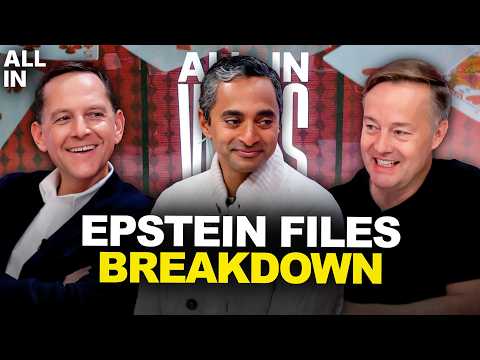
Epstein Files Fallout, Nvidia Risks, Burry's Bad Bet, Google's Breakthrough, Tether's Boom
Jason Calacanis (host), David Sacks (host), Chamath Palihapitiya (host), David Friedberg (host), David Friedberg (host), Alan Keating (guest), Narrator
In this episode of All-In Podcast, featuring Jason Calacanis and David Sacks, Epstein Files Fallout, Nvidia Risks, Burry's Bad Bet, Google's Breakthrough, Tether's Boom explores epstein Files, Stablecoin Power, Nvidia Doubts, Google’s AI Counterattack The episode opens with the All-In hosts in Las Vegas, quickly diving into the political, legal, and intelligence-community implications of the newly mandated release of the Epstein files. They debate whether the disclosures will disproportionately harm Democratic elites, how Epstein operated, and whether intelligence agencies may have been involved in his network and protection.
Epstein Files, Stablecoin Power, Nvidia Doubts, Google’s AI Counterattack
The episode opens with the All-In hosts in Las Vegas, quickly diving into the political, legal, and intelligence-community implications of the newly mandated release of the Epstein files. They debate whether the disclosures will disproportionately harm Democratic elites, how Epstein operated, and whether intelligence agencies may have been involved in his network and protection.
They then pivot to an in‑depth discussion of Tether and stablecoins as a massive, high‑margin, global financial-inclusion business tightly coupled to U.S. Treasury markets and banking regulation. From there, they dissect Michael Burry’s criticism of big tech’s GPU depreciation practices, arguing that his accounting thesis misunderstands GAAP and AI economics.
The conversation moves to Google’s Gemini 3, TPUs, and the fragmenting AI hardware and model landscape, with particular focus on competitive risk to Nvidia from hyperscaler chips and a possible Huawei-driven ‘black swan’ in 2026. The besties also get personal about venture investing vs. operating, with Friedberg explaining why Oppenheimer pushed him back into a CEO role.
The show closes in Vegas style with high-stakes poker talk: they analyze Alan Keating’s famous soul‑read hand versus Doug Polk, explore fear management and risk appetite at the table, and tee up bonus poker content featuring pros like Keating and Phil Hellmuth.
Key Takeaways
Epstein file release is about public trust more than partisan gain
Chamath frames the bipartisan Epstein Files Transparency Act as a symbolic ‘compact’ between citizens and government: when an issue animates millions, releasing long‑sealed files—carefully redacted to protect victims and open investigations—signals responsiveness, akin to declassifying JFK, MLK, Amelia Earhart, or UFO files. ...
Get the full analysis with uListen AI
Epstein likely operated as some form of intelligence asset
Jason describes meeting Epstein multiple times at TED ‘billionaires’ dinners’, noting how Epstein embedded himself with top scientists, tech founders, and billionaires through donations and tax advice. ...
Get the full analysis with uListen AI
Stablecoins like Tether are gigantic, ultra-high-margin financial rails
Chamath explains Tether’s core model: users in unstable currencies convert local cash into dollar‑pegged USDT; Tether invests the backing dollars in U. ...
Get the full analysis with uListen AI
Regulation will decide who captures stablecoin yield: banks vs. crypto firms
Current U. ...
Get the full analysis with uListen AI
Burry’s Nvidia short thesis underestimates GAAP mechanics and AI economics
Friedberg walks through GAAP Accounting Standard 360 to rebut Michael Burry’s claim that big tech is ‘cooking the books’ by using 5–6 year useful lives for GPUs. ...
Get the full analysis with uListen AI
AI hardware will fragment; Nvidia faces rising competition and a Huawei wildcard
The hosts see Google’s Gemini 3 trained on TPUs as proof that hyperscalers can build viable non‑Nvidia alternatives for training and inference. ...
Get the full analysis with uListen AI
OpenAI risks losing trust and share as incumbents catch up
Jason argues that early fears of Google search being ‘slaughtered’ by ChatGPT were overblown; Google’s search volume and ad revenue are growing, and Gemini now leads many benchmarks. ...
Get the full analysis with uListen AI
Notable Quotes
“We need to just release these files in an orderly manner and put this episode behind us, learn what we need to learn from it, get better, be better, treat these people with respect, and move on.”
— Chamath Palihapitiya
“I think he’s a spy. I think he worked for intelligence agencies. Now I am not the conspiracy theorist of this podcast, but…”
— Jason Calacanis
“There are 500 million people using US dollar–backed stablecoins from Tether all around the world… The financial inclusion that then ties back to US dollar hegemony is unbelievable.”
— Chamath Palihapitiya
“Burry’s implication that they are cooking the books or hiding accounting is completely false because all of the accounting is apparent in the cash flow statement and in the balance sheet.”
— David Friedberg
“I like making the bet where if it doesn’t work out, I’m in a little bit of trouble… It’s a motivator.”
— Alan Keating
Questions Answered in This Episode
If future Epstein file releases do reveal intelligence-agency involvement, what specific reforms or oversight mechanisms do you think should follow, rather than just public outrage?
The episode opens with the All-In hosts in Las Vegas, quickly diving into the political, legal, and intelligence-community implications of the newly mandated release of the Epstein files. ...
Get the full analysis with uListen AI
You framed Tether’s growth as reinforcing U.S. dollar hegemony; what concrete risks does that pose to U.S. regulators if a largely offshore entity controls such a critical dollar rail?
They then pivot to an in‑depth discussion of Tether and stablecoins as a massive, high‑margin, global financial-inclusion business tightly coupled to U. ...
Get the full analysis with uListen AI
Friedberg showed that changing GPU depreciation schedules only modestly impacts reported profit—so where, if anywhere, do you see *real* systemic risk or overvaluation in the current AI capex boom?
The conversation moves to Google’s Gemini 3, TPUs, and the fragmenting AI hardware and model landscape, with particular focus on competitive risk to Nvidia from hyperscaler chips and a possible Huawei-driven ‘black swan’ in 2026. ...
Get the full analysis with uListen AI
Jason argued startups increasingly distrust OpenAI because it competes at the app layer; what would OpenAI have to do—structurally and contractually—to win that trust back from developers?
The show closes in Vegas style with high-stakes poker talk: they analyze Alan Keating’s famous soul‑read hand versus Doug Polk, explore fear management and risk appetite at the table, and tee up bonus poker content featuring pros like Keating and Phil Hellmuth.
Get the full analysis with uListen AI
Alan Keating talks about ‘mastering fear’ by intentionally taking bets that can hurt him; how do you distinguish between productive exposure to risk (that sharpens decision-making) and reckless behavior that just invites ruin, in poker and in venture investing?
Get the full analysis with uListen AI
Transcript Preview
All right, everybody. Welcome back to the number one podcast in the world. We are together in person. Yes, the besties are together in Vegas. It's gonna be a great time. We're here for F1 and-
This is a test. This is a test.
... our friends at the Venetian have been amazing, gracious hosts. They gave us their beautiful studio here. We're gonna play some cards. We're gonna have Phil Hellmuth, uh, Jason Koon, all of our besties are coming. And-
I have, I've never stayed at the Venetian before.
... the Venetian.
It's amazing.
Wonderful suites they gave us.
It's beautiful.
Uh, they VIPed us out, and this is the place you wanna play cards. They've got a beautiful brand new poker room. They got high stakes room, high tech.
We'll be playing here later.
We'll be playing the secret game.
Playing all afternoon. And, and-
Yes?
... track side for Formula 1.
And we're here for F1. We're gonna be releasing-
I brought a car dealer with me.
Wait, you brought a car dealer with you?
Yeah. You know Matthew?
Oh, your car dealer from your home game is here.
Yeah, yeah. Matthew, car dealer is here.
Is that... Is he dead money? What's the story here? Is that a different-
No, sadly.
(laughs)
No? Okay.
No, sadly.
Haven't been in the home game for a little bit and, uh, it looks like people got out of line. But anyway, thank you so much to our friends at the Venetian. Uh, they're doing a ton of poker content here, so you can look at that on their YouTube. All right, everybody. You've wanted us to talk about the Epstein files, and we're gonna talk about it today. In a stunning turn of events, the House and Senate voted nearly unanimously to release the Epstein files. The vote was 427 to one Chamath, uh, for the Epstein files transparency act.
Who abstained? You?
Uh, no.
(laughs)
The, uh, person who abstained (laughs) , well played, uh, was, uh, Republican Clay Higgins from, uh, Louisiana. Thanks for asking. He said, "It reveals and injures thousands of innocent people, witnesses, people who provided alibis, family members." He makes a great point, but AG Pam Bondi, of course, has addressed that already that they're not gonna release any open investigations, and they're going to, uh, remove names if it would harm anybody. Uh, the Senate passed it by unanimous consent, which requires a sign off from every senator, and Trump in a reversal signed the bill last night saying, "Give them everything." We did see some emails come out from the Epstein files last week. Friend of the pod, Larry Summers, was a main character in them, and he was communicating with Epstein up until 2019, asking him for advice, uh, on dating. He's since stepped down from OpenAI and several other public-facing roles.
Install uListen to search the full transcript and get AI-powered insights
Get Full TranscriptGet more from every podcast
AI summaries, searchable transcripts, and fact-checking. Free forever.
Add to Chrome