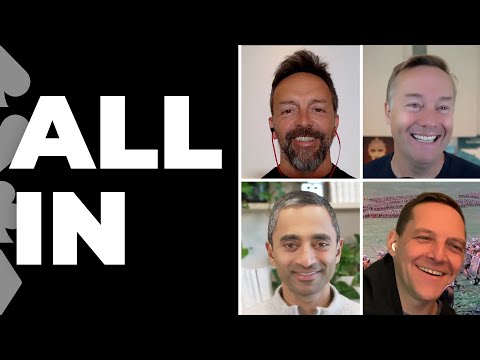
E133: Market melt-up, IPO update, AI startups overheat, Reddit revolts & more with Brad Gerstner
Chamath Palihapitiya (host), Jason Calacanis (host), David Friedberg (host), Narrator, David Sacks (host), Brad Gerstner (guest), Brad Gerstner (guest), Brad Gerstner (guest), Jason Calacanis (host), Jason Calacanis (host), Jason Calacanis (host)
In this episode of All-In Podcast, featuring Chamath Palihapitiya and Jason Calacanis, E133: Market melt-up, IPO update, AI startups overheat, Reddit revolts & more with Brad Gerstner explores market melt-up, AI mania, and Reddit’s user revolt dissected The episode blends light banter about high-stakes poker and wellness hacks with a dense discussion of markets, AI, venture capital behavior, and platform power dynamics.
Market melt-up, AI mania, and Reddit’s user revolt dissected
The episode blends light banter about high-stakes poker and wellness hacks with a dense discussion of markets, AI, venture capital behavior, and platform power dynamics.
Brad Gerstner and Chamath Palihapitiya analyze the tech-led market rally, the Fed’s rate pause, SoftBank’s ARM IPO plans, and why mega-cap tech and AI stocks may be priced to perfection.
They debate whether today’s AI startup funding frenzy is rational, highlighting overfunded ‘compute CAPEX’ seed rounds, the likely fall in model-training costs, and where durable moats might actually form.
The group also examines Reddit’s API revolt as a turning point in user-generated content economics and closes with Friedberg debunking misinformation about “Gates’ GMO mosquitoes,” using it to argue for scientific literacy and nuanced views on engineering nature.
Key Takeaways
Markets have rebounded, but big-tech and AI names are dangerously concentrated and priced to perfection.
The NASDAQ is up ~30%, driven heavily by 7–8 mega-cap tech stocks whose earnings yields are now well below government bond yields; excluding those, the equal-weighted S&P looks weak, suggesting concentration risk and limited upside without earnings catch-up.
Get the full analysis with uListen AI
The AI trade is real on chips and infra now, but much of the equity rally is ahead of fundamentals.
Nvidia and other AI-adjacent names have seen parabolic moves as data-center expectations flipped from decline to explosive growth; Gerstner advocates staying long high-quality names but selling calls or otherwise hedging after huge multiple expansion.
Get the full analysis with uListen AI
Training frontier AI models is CAPEX, not magic IP, and today’s massive ‘seed’ rounds are structurally bad bets.
Chamath argues that when 70–80% of a $100M+ round goes to GPUs and servers, VCs are subsidizing commoditizing compute rather than owning durable differentiation; as training costs collapse 10–100x over a few years, today’s big-check seed investors likely get poor risk-adjusted returns.
Get the full analysis with uListen AI
The real AI opportunity may lie higher in the stack: domain-specific tools and applications, not another ‘better GPT-4.’
Friedberg and Gerstner note that moats are likelier where AI is embedded into vertical workflows (finance, life sciences, legal, manufacturing) and data flywheels, rather than in yet another expensive general-purpose model that must fight hyperscalers on compute and distribution.
Get the full analysis with uListen AI
Search and the web’s $20T advertising funnel are being re-architected toward conversational agents and ‘intimacy.’
They expect a shift from ‘10 blue links’ to agentic interfaces: either one powerful personal assistant that knows you well and delegates to vertical specialists, or a constellation of domain agents; in either case, Google’s current search model faces cannibalization even if Google wins the AI race.
Get the full analysis with uListen AI
Reddit’s API fight highlights a new balance of power: creators and moderators will increasingly demand a share of platform economics.
As Reddit tries to charge for API access (partly to capture AI-training value), mods and users showed they can shut the platform down; the hosts argue platforms will need to share revenue and respect data ownership, or risk migration of communities and legal/political backlash.
Get the full analysis with uListen AI
Scientific literacy matters: not all ‘engineering nature’ is dangerous, and blanket fear can block high-impact health interventions.
Friedberg debunks RFK Jr. ...
Get the full analysis with uListen AI
Notable Quotes
“Rates are going to be higher than you want, and they’re going to be around for longer than you like.”
— Chamath Palihapitiya
“When you put $100 million into a startup to buy compute, you’re not buying whiz-bang next-generation IP—you’re subsidizing CAPEX.”
— Chamath Palihapitiya
“Constraint makes for great art. Constraint makes for great startups.”
— Jason Calacanis
“We’re still trading below the 10-year average, but you have to start paying attention now to individual stocks that have likely gotten ahead of themselves.”
— Brad Gerstner
“This is the sort of misinformation that both creates scientific illiteracy and damages some of the significant progress that can be made in medicine and science.”
— David Friedberg (on RFK Jr.’s mosquito claims)
Questions Answered in This Episode
If AI model-training costs fall by 10–100x in the next few years, what kinds of AI businesses funded today will still retain a moat?
The episode blends light banter about high-stakes poker and wellness hacks with a dense discussion of markets, AI, venture capital behavior, and platform power dynamics.
Get the full analysis with uListen AI
How should long-term investors balance the current AI-fueled enthusiasm for mega-cap tech with the risk that these stocks are already ‘priced to perfection’?
Brad Gerstner and Chamath Palihapitiya analyze the tech-led market rally, the Fed’s rate pause, SoftBank’s ARM IPO plans, and why mega-cap tech and AI stocks may be priced to perfection.
Get the full analysis with uListen AI
What concrete revenue-sharing or governance models could platforms like Reddit adopt to fairly compensate moderators and content creators without destroying their IPO economics?
They debate whether today’s AI startup funding frenzy is rational, highlighting overfunded ‘compute CAPEX’ seed rounds, the likely fall in model-training costs, and where durable moats might actually form.
Get the full analysis with uListen AI
In a world of agentic AI interfaces, what specific parts of Google’s business model are most vulnerable, and how might Google successfully cannibalize itself?
The group also examines Reddit’s API revolt as a turning point in user-generated content economics and closes with Friedberg debunking misinformation about “Gates’ GMO mosquitoes,” using it to argue for scientific literacy and nuanced views on engineering nature.
Get the full analysis with uListen AI
Where should society draw the line between responsible ‘engineering of nature’ for public health (like Wolbachia mosquitoes) and interventions that pose unacceptable systemic risks?
Get the full analysis with uListen AI
Transcript Preview
I'm so fucking tired. I've slept six hours in three and a half days. Six hours-
So wait, wait, you went-
... maybe seven hours.
... to the World Series-
Fuck.
... of Poker with Helmuth? So you spent-
No, no, no. First of all, I flew public. Took Southwest.
What?
Yeah, cost me $49.
You were on a Southwest flight?
Yeah, it cost... I got a ticket for 49 bucks. It's like, so fucking incredible.
Oh, did you sit in seat A1, also known as J Cows res- reserve seat? It has my name on it.
Well, I was in the front row.
Okay.
Y- y- it's great. Like, Southwest has these numbers, and what they do is-
Hold on, you were in first class on Southwest?
No, no, no, no. Premium Plus.
He was in the front row.
No, there's like, these signs that, that like, have a number that attaches to your ticket, and then you stand in that line, and then you go on in this orderly way. And so I was... I had like, A5 or something, so I was like, the fifth person on, and then I sat in the front and I put my bags-
Mm-hmm.
... up top.
Yeah. You carried your bags, yeah.
An hour later, I was in Vegas. It was so easy. Southwest is phenomenal. And then I flew back. Anyways, and after, after losing as much money as I did, it felt good to fly for $49. I gotta be honest with you.
Well, austerity measures have-
Oh my god.
... their benefits. You can sleep better at night with austerity measures. And did you go to the all-you-can-eat buffet and take it to go as well?
No, I never do that.
Let your winners ride. Rain man, David Sacks. We're going all in. As I said. We open source it to the fans and they've just gone crazy with it. Love you guys. Queen of Kinwah. Going all in.
Why did you fly Southwest?
Why did I fly Southwest? Well, the plane's in Europe with Matt. That's number one. And then two, I just wanted some flexibility to get in and out depending on when I busted these tournaments. So let me tell you about these tournaments.
Hmm.
The 100K is literally like a murderer's row of like, every great poker pro. So it was like, 96 of us or something.
Hmm.
I gotta be honest with you, it was so much fun.
Hmm.
So much fun.
Why? How so?
You know, the... we play 40-minute levels and you have to really get the chips moving, which means that there's only so much like, you know, game theory optimal poker you can play, and at some point, you just gotta gamble it up and you gotta take-
Install uListen to search the full transcript and get AI-powered insights
Get Full TranscriptGet more from every podcast
AI summaries, searchable transcripts, and fact-checking. Free forever.
Add to Chrome