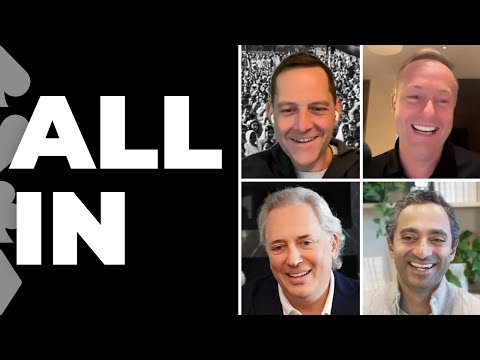
E150: Israel/Gaza escalating or not? EU censorship regime, Penn donors revolt, GLP-1 hype cycle
David Sacks (host), Jason Calacanis (host), Chamath Palihapitiya (host), David Friedberg (host), Guest (guest), David Sacks (host), Narrator, Narrator
In this episode of All-In Podcast, featuring David Sacks and Jason Calacanis, E150: Israel/Gaza escalating or not? EU censorship regime, Penn donors revolt, GLP-1 hype cycle explores israel-Gaza tensions, campus backlash, EU censorship, and Ozempic mania The hosts open with an emotional, nuanced discussion of the Israel–Hamas war, debating whether the conflict is actually escalating and exploring how misinformation, social media, and long-standing grievances fuel a global tinderbox.
Israel-Gaza tensions, campus backlash, EU censorship, and Ozempic mania
The hosts open with an emotional, nuanced discussion of the Israel–Hamas war, debating whether the conflict is actually escalating and exploring how misinformation, social media, and long-standing grievances fuel a global tinderbox.
They examine internal Israeli and regional politics, the collapse of the two‑state peace process, the distinction between legitimate pro‑Palestinian advocacy and antisemitism, and the risk of forcing everyone to “pick a side.”
The conversation then shifts to donor revolts and free-speech hypocrisy at elite U.S. universities, before turning to Europe’s Digital Services Act as a de facto centralized censorship regime likely to shape global internet norms.
They close by dissecting the GLP‑1 weight-loss drug boom (Ozempic, Wegovy, Mounjaro), contrasting medical reality with market hype and warning that current valuations and expectations resemble the AI hype cycle.
Key Takeaways
The Israel–Gaza conflict is volatile but not yet spiraling into regional war.
While fears of World War III surged after the hospital explosion and protests across the Middle East, the hosts point to delayed Israeli ground operations, Iranian signals through the UN, and U. ...
Get the full analysis with uListen AI
Misinformation and entrenched narratives are driving confirmation bias on both sides.
The hospital blast illustrates how initial narratives (“Israel bombed a hospital”) were rapidly adopted as proof of preexisting beliefs, with later evidence having minimal impact; the hosts argue facts matter morally but often don’t matter practically once the ‘tinderbox’ is lit.
Get the full analysis with uListen AI
Resolving deep, long-term grievances is impossible without first de‑escalating anger.
They liken the conflict to personal betrayal: you can’t address hurt while rage is dominant, so active de‑escalation (pausing ground war, humanitarian aid, back-channel talks) is a necessary precondition to any serious discussion of Palestinian and Israeli historical harms.
Get the full analysis with uListen AI
Forcing binary ‘pick a side’ positions blocks nuanced, empathetic solutions.
The group criticizes a culture where being pro-Israel is framed as anti-Palestinian (and vice versa), arguing that moral progress requires separating legitimate concern for Palestinian rights from antisemitism, and acknowledging Israel’s right to exist alongside Palestinian self‑determination.
Get the full analysis with uListen AI
Elite universities are being exposed as selectively intolerant, not principled defenders of free speech.
Survey data shows top schools scoring at the bottom on free-speech metrics; donors see administrations that long suppressed disfavored speech suddenly invoking ‘academic freedom’ to defend speakers praising or justifying atrocities, prompting major funding pullbacks.
Get the full analysis with uListen AI
The EU Digital Services Act centralizes content control and may export a censorship model globally.
By empowering an EU commission to define and order removal of ‘illegal’ and ‘disinformation’ content—with huge fines—the DSA effectively outsources platform moderation to Brussels, and companies may standardize these controls worldwide for simplicity, pressuring free-speech norms elsewhere.
Get the full analysis with uListen AI
GLP‑1 weight-loss drugs are medically powerful but financially overhyped.
The hosts note strong clinical effects and public-health potential, but stress concerns about muscle loss, weight regain after stopping, behavioral dependence, and a market trade (GLP‑1 winners vs. ...
Get the full analysis with uListen AI
Notable Quotes
“There is a tinderbox ready to be lit, and whether it’s this match or the next match, there’s gonna be a match.”
— David Friedberg
“We’re not allowed to say, ‘I’m looking out for the Palestinians, but I believe Israel should have a state.’”
— David Friedberg
“These elite universities are essentially asset management businesses that have an education fig leaf wrapped around them.”
— Chamath Palihapitiya
“Free speech is not a value they’ve been respecting; free speech is a value they’ve been imposing.”
— David Sacks
“The GLP‑1 hype cycle is as overextended as the AI hype cycle.”
— Chamath Palihapitiya
Questions Answered in This Episode
If both sides in the Israel–Palestine conflict believe they’re morally right, what concrete steps could realistically de‑escalate anger enough to address long-term grievances?
The hosts open with an emotional, nuanced discussion of the Israel–Hamas war, debating whether the conflict is actually escalating and exploring how misinformation, social media, and long-standing grievances fuel a global tinderbox.
Get the full analysis with uListen AI
How can policymakers and media distinguish between legitimate advocacy for Palestinian rights and rhetoric that slides into antisemitism or calls for ‘decolonization’ as a euphemism for expulsion?
They examine internal Israeli and regional politics, the collapse of the two‑state peace process, the distinction between legitimate pro‑Palestinian advocacy and antisemitism, and the risk of forcing everyone to “pick a side.”
Get the full analysis with uListen AI
Given the DSA’s vague definitions of ‘illegal content’ and ‘disinformation,’ what safeguards—if any—can prevent it from becoming a political censorship tool in Europe and beyond?
The conversation then shifts to donor revolts and free-speech hypocrisy at elite U. ...
Get the full analysis with uListen AI
Are GLP‑1 drugs reshaping human behavior toward food and exercise, or mostly offering a temporary biochemical workaround that people will be dependent on indefinitely?
They close by dissecting the GLP‑1 weight-loss drug boom (Ozempic, Wegovy, Mounjaro), contrasting medical reality with market hype and warning that current valuations and expectations resemble the AI hype cycle.
Get the full analysis with uListen AI
What structural reforms to universities would be needed to move them from selective speech enforcement toward genuine institutional neutrality and viewpoint diversity?
Get the full analysis with uListen AI
Transcript Preview
Well, you're talking about three very different actors there.
Wait. David, David behind you is your security cameras are on. Do you want to turn those off?
Yeah, I don't know how that ...
(laughs)
All right. Hold on a second. Let me...
You sit there and watch those all day? (laughs)
Security apparatus. (laughs)
Jesus Christ. What is this guy, the Batman? (laughs)
He sits in that couch all day and watches his security.
Bruce Wayne, hey.
Did you see that behind him? It was so dystopian. Oh my gosh.
You must have caught some crazy shit on those security cameras, Sax. What do you do with that footage? 50s R&B music plays ]
We're going all in. Let your winners ride.
Rain Man, David Sax.
I'm going all in.
NSN.
We open source it to the fans and they've just gone crazy with it.
Love you NSN.
Queen of Quinoa.
I'm going all in.
Okay, everybody. Welcome to episode 150 of the All-In Podcast. Yes, we've made it to 150 episodes somehow talking about technology, business, and of course politics. And this week we will continue our discussion, tragically, about the situation in Israel, uh, and the war with Hamas, and a lot of the downstream effects of what's going on here, and try to make sense of the world as we do. We gave a disclaimer last week, we're not experts. And I suspect many of you are not experts on this, but we're going to try to talk about the hard topic here and do it in good faith, and then we will move on to topics that don't have to do with the war in Gaza, uh, that could, by the time you read this, again, another disclaimer, by the time you listen to this podcast, a ground invasion may or may not have started. We tape these on Thursdays and you listen to them, generally speaking, on Saturdays and Sundays. With me again this week, Chamath Palihapitiya, David Sax, and of course, David Friedberg. And, uh, gentlemen, I'm just going around the horn here quick before I tee up the first topic, how's everybody feeling about the events, uh, in, in the 10 days since 10/7 and the terrorist attack that occurred in Israel?
I skipped last week. I was too emotional to do the show, just so folks know. It was, uh, difficult to see what I saw on the internet and the reporting. I think I was m- really moved, uh, because I thought a lot about the, like, how lucky we are, and m- I thought about my children and seeing what I saw. And being a parent, um, it's really different.
Mm-hmm.
I remember 9/11, it was really shocking. I was really upset from 9/11 as well, but when I saw the events last week, it immediately projected onto my kids and the care I try and take for my kids in thinking about the experience of other people i- in this situation. I was also, I'll be honest, really moved and saddened because of the bombing of children in Gaza, and I was really saddened that there were innocent children suffering there as well. And the whole thing just felt so horrific to me. I don't think about the justification or the morality of one side over another, I was just more moved because I felt really sad about the experience of a lot of families and a lot of children caught in the middle, uh, caught in this, in this environment. So I was, I was pretty hurt last week. I was in a really bad state and I couldn't do the show. I think, you know, time has allowed me to kind of become a bit rational about things and try and understand where things are headed, and it's a really complicated, confusing situation, and it's really sad. I worry a lot about where things are headed, not just in the Middle East, but also domestically coming out of this conflict. So that's where I'm at.
Install uListen to search the full transcript and get AI-powered insights
Get Full TranscriptGet more from every podcast
AI summaries, searchable transcripts, and fact-checking. Free forever.
Add to Chrome