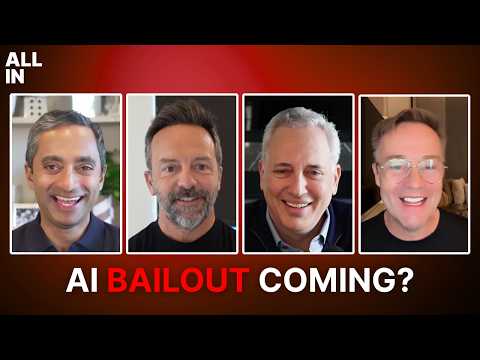
Does OpenAI Need a Bailout? Mamdani Wins, Socialism Rising, Filibuster Nuclear Option
Jason Calacanis (host), David Sacks (host), Brad Gerstner (guest), Chamath Palihapitiya (host), Sam Altman (guest), Host (host), David Friedberg (host), Host (host), Narrator, Narrator
In this episode of All-In Podcast, featuring Jason Calacanis and David Sacks, Does OpenAI Need a Bailout? Mamdani Wins, Socialism Rising, Filibuster Nuclear Option explores openAI Panic, AI Bubble Fears, and Socialism’s Surprising U.S. Surge The episode opens with the market backlash to Sam Altman’s BG2 interview and OpenAI’s eye‑popping $1.4 trillion infrastructure plans, exploring whether the AI boom is a bubble or a rational long‑term bet. The Besties dissect OpenAI CFO Sarah Friar’s much-criticized ‘backstop’ comment, clarifying why there will be no federal bailout for AI while arguing for faster private‑sector buildout and regulatory reform on power and permitting.
OpenAI Panic, AI Bubble Fears, and Socialism’s Surprising U.S. Surge
The episode opens with the market backlash to Sam Altman’s BG2 interview and OpenAI’s eye‑popping $1.4 trillion infrastructure plans, exploring whether the AI boom is a bubble or a rational long‑term bet. The Besties dissect OpenAI CFO Sarah Friar’s much-criticized ‘backstop’ comment, clarifying why there will be no federal bailout for AI while arguing for faster private‑sector buildout and regulatory reform on power and permitting.
They broaden out to U.S. market conditions: rising delinquencies, consumer stress, risk‑off sentiment, and the political fallout as voters punish Republicans for a government shutdown and stubborn inflation, even as a handful of mega‑cap AI names pull indices higher. A major thread is the political and regulatory fight over AI: federal versus 50‑state rules, ‘DEI’ in algorithms, and how doomer narratives and job‑loss fears are shaping public opinion.
In the back half, they analyze the election of socialist New York mayor Zohran Mamdani as a warning signal about a ‘broken generational compact’—student debt, housing unaffordability, and young voters turning hard left. The group debates student loan forgiveness, domestic policy priorities, and whether Republicans should scrap the filibuster to deliver results before socialist movements gain more ground.
Key Takeaways
OpenAI’s $1.4T capex figure is huge but misunderstood and spread over years.
Brad Gerstner explains that the $1. ...
Get the full analysis with uListen AI
There is no realistic path to a federal ‘bailout’ of OpenAI or any AI lab.
David Sacks stresses that the U. ...
Get the full analysis with uListen AI
The market is entering a ‘risk‑off’ phase even as AI fundamentals remain strong.
Chamath and Brad frame recent sell‑offs in Microsoft, Nvidia, Oracle, and others as part of a broader de‑risking and year‑end rebalancing, not a direct reaction to any single comment by Sam Altman or Sarah Friar. ...
Get the full analysis with uListen AI
AI regulation will likely be decided at the federal level—or ceded to blue states.
Sacks argues forcefully for a single federal AI framework that preempts a patchwork of 50 state rules. ...
Get the full analysis with uListen AI
Doomer narratives and AI bubble fear are both overblown—and often funded.
Sacks notes that some of the loudest AI doomer narratives are funded by a handful of wealthy donors (via outfits like Open Philanthropy) who have poured hundreds of millions into ‘safety’ think tanks. ...
Get the full analysis with uListen AI
Student debt and housing are radicalizing young voters and fueling socialism.
Using Zohran Mamdani’s New York mayoral win and Brad’s ‘ban the billionaires’ debate at Stanford, the group argues there’s a genuine ‘fight for the soul of America’ over whether the system still offers economic mobility. ...
Get the full analysis with uListen AI
Republicans must pivot to domestic economic wins and may need to kill the filibuster.
Sacks and Chamath contend that Republicans are losing ground on affordability and domestic policy, even as they win on foreign policy and border issues. ...
Get the full analysis with uListen AI
Notable Quotes
“We are talking about buildout, not bailout. That should be our motto here.”
— David Sacks
“This $1.4 trillion is kind of a fake, made‑up number… only a portion of that is borne by OpenAI and I'm certain there's flexibility in all of those deals.”
— Brad Gerstner
“If one has no stake in the capitalist system, then one may well turn against it.”
— Chamath Palihapitiya (quoting Peter Thiel)
“This was the first moment in years where I have now become sympathetic to this idea of student loan forgiveness.”
— Chamath Palihapitiya
“The Democratic Party is gradually becoming a party of Mamdanis and Katie Porters and genuine socialist revolutionaries.”
— David Sacks
Questions Answered in This Episode
If OpenAI’s projected $100B+ annual revenue fails to materialize by mid‑decade, what specific contractual levers or renegotiation strategies would you expect them and their cloud partners to use to resize that $1.4T capex plan without triggering a credit crisis?
The episode opens with the market backlash to Sam Altman’s BG2 interview and OpenAI’s eye‑popping $1. ...
Get the full analysis with uListen AI
How exactly would a single federal AI framework you’re advocating differ in concrete terms from California’s ‘algorithmic discrimination’ proposals, and can you outline a model statute that prevents genuine bias without sliding back into the DEI‑style ideological capture you’re warning about?
They broaden out to U. ...
Get the full analysis with uListen AI
You argued that doomer narratives and AI bubble talk are both astroturfed and mutually contradictory—what evidence or metrics (model capabilities, enterprise adoption, unit economics) should a skeptical observer track over the next 12–24 months to independently validate that AI is neither a scam nor an imminent superintelligence?
In the back half, they analyze the election of socialist New York mayor Zohran Mamdani as a warning signal about a ‘broken generational compact’—student debt, housing unaffordability, and young voters turning hard left. ...
Get the full analysis with uListen AI
Given your growing openness to student loan forgiveness, what detailed reform package would you support that simultaneously (a) unwinds existing unsustainable debt, (b) prevents future bad lending to low‑ROI degrees, and (c) doesn’t amount to a one‑time windfall for universities that helped create the problem?
Get the full analysis with uListen AI
If Republicans do ‘go nuclear’ on the filibuster to push through a pro‑growth AI and domestic agenda now, how would you mitigate the risk that a future Democratic trifecta could use the same simple‑majority rules to rapidly implement the kind of socialist or decarceral program you fear from figures like Zohran Mamdani?
Get the full analysis with uListen AI
Transcript Preview
Brad Gerstner's here joining us, hot after crashing the stock market and popping the AI bubble. Well done, Brad. We're gonna get into it. (laughs)
(laughs)
(laughs)
All of our portfolios, thank you, (laughs) were all down 15% this week.
Can we ask OpenAI to just put a moratorium on any more public (laughs) statements or appearances-
Yeah, right.
... for another couple months?
Good jo- good job, Brad. You, you decided you'd be a podcaster, you're like, "Hey, let me ask-"
Hmm.
Hmm.
... "a couple of hard questions here," and you popped an AI bubble. (laughs)
(laughs)
(laughs) Yeah, something like that.
Do as I say, not as I do.
Are we getting into it? 'Cause I think it is interesting, actually.
Oh, it's super interesting.
Yeah.
Super interesting. Let's get into it.
So Sam, uh, um, um, of course, if you're not in the industry, Sam Altman appeared on the fabulous BG2 podcast last Friday and, um, it got a little frisky when our fifth bestie here asked what I thought was a completely-
Totally reasonable question.
... legitimate, you know, totally mundane question, "Hey, you're making 13 billion."
Mundane. It's actually a, a, a softball question, to be honest.
It was an underhanded pitch.
The way that it was asked, I think you did a very reasonable job of asking a good question in a very fair way.
So let's just show this, uh, clip here and then I, I wanna go behind the pod with you, Brad.
(laughs) So I think the single biggest question I've heard all week and, and hanging over the market is how, you know, how can a company with 13 billion in revenues make 1.4 trillion of spend commitments? You know, and, and, and you've heard the criticism, Sam.
First of all, we're doing well more revenue than that.
Yeah.
Second of all, Brad, if you wanna sell your shares, I'll find you a buyer
(laughs)
I, I just-
Ooh.
... enough. Like, you know, people are-
Enough?
I, I think there's a lot of people who would love to buy OpenAI shares. I don't, I don't think you want to sell, but-
Including myself.
(laughs)
Including myself.
... people who talk with a lot of, like, breathless concern about our compute stuff or whatever that would be thrilled to buy shares. Uh, so I think we, we could sell, you know, your shares or anybody else's to some of the people who are making the most noise on Twitter, whatever, about this very quickly. We do plan for revenue to grow steeply. Revenue is growing steeply. We are taking a forward bet that it's gonna continue to go- grow. There are not many times that I want to be a public company, but one of the rare, uh, times it's appealing is when those people that are writing these ridiculous OpenAI is about to go out of business and, you know, whatever, I would love to tell them they could just short the stock and I would love to see them get burned on that.
Install uListen to search the full transcript and get AI-powered insights
Get Full TranscriptGet more from every podcast
AI summaries, searchable transcripts, and fact-checking. Free forever.
Add to Chrome