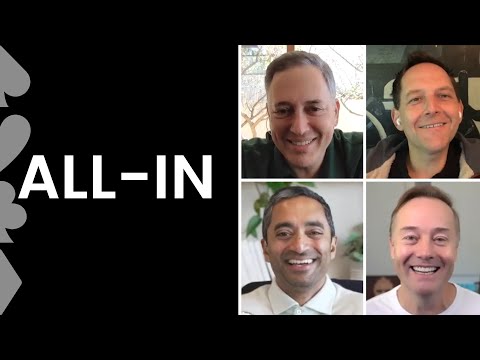
E78: VC fund metrics that matter, private market update, recession, student loans, Bill Hwang arrest
David Friedberg (host), Jason Calacanis (host), David Sacks (host), Narrator, Jason Calacanis (host), Chamath Palihapitiya (host), Narrator, David Sacks (host), Chamath Palihapitiya (host), Narrator
In this episode of All-In Podcast, featuring David Friedberg and Jason Calacanis, E78: VC fund metrics that matter, private market update, recession, student loans, Bill Hwang arrest explores vC metrics, looming recession, student loans, censorship, and leverage risk The episode opens with banter and then dives into how VC and private equity funds report performance, exposing how non-standard metrics and capital-call credit lines can be used to “juice” IRR and mislead LPs. The conversation broadens into a macro discussion about negative GDP growth, inflation, supply-chain constraints, and the odds of a recession, paired with practical advice for founders fundraising in a down market.
VC metrics, looming recession, student loans, censorship, and leverage risk
The episode opens with banter and then dives into how VC and private equity funds report performance, exposing how non-standard metrics and capital-call credit lines can be used to “juice” IRR and mislead LPs. The conversation broadens into a macro discussion about negative GDP growth, inflation, supply-chain constraints, and the odds of a recession, paired with practical advice for founders fundraising in a down market.
They then dissect the student-loan crisis: how federal guarantees inflated tuition, why blanket forgiveness is politically fraught and regressive, and what structural reforms (market-based lending, accountability for universities, bankruptcy reform) are needed before or alongside any forgiveness.
Later, they unpack the Archegos/Bill Hwang blow-up as an example of opaque leverage and regulatory blind spots in equity derivatives, contrasting it with the grinding, decade-long work required to achieve real 2x fund returns.
Finally, they debate the DHS “Disinformation Governance Board,” Elon Musk’s acquisition of Twitter, and the boundaries of content moderation, arguing for First-Amendment-inspired rules, algorithmic transparency, and user responsibility instead of partisan “Ministry of Truth” style censorship.
Key Takeaways
Insist on standardized fund metrics to see through VC ‘cheerleading’.
LPs should demand a simple, comparable table showing gross and net IRR, TVPI (total value to paid-in capital), and DPI (distributions to paid-in capital). ...
Get the full analysis with uListen AI
For most investors, broad public indexes often beat private funds on a risk‑adjusted basis.
Top-tier private equity and venture funds might deliver ~2x over a decade-plus, which often translates into single-digit to low-teens IRRs—worse than long-run S&P performance, with far less liquidity and higher risk. ...
Get the full analysis with uListen AI
Downturns expose which fund managers can convert paper gains into real DPI.
The last five years made it easy to raise and deploy capital; the next phase will reveal who can actually exit positions and distribute cash in a market where public tech multiples have compressed 50–60% and private marks lag reality.
Get the full analysis with uListen AI
Founders should prioritize survival and runway over optimal pricing in a tightening market.
VCs report that growth rounds are much harder, investors are focused on time-to-breakeven and real traction, and founders who turned away capital at high valuations now regret it. ...
Get the full analysis with uListen AI
Student-loan forgiveness without structural reform risks repeating and amplifying the bubble.
Federal guarantees enabled universities—especially private and for-profit—to massively raise tuition, creating a $1. ...
Get the full analysis with uListen AI
Opaque leverage and regulatory gaps can turn family offices into systemic risks.
Archegos used total return swaps at multiple prime brokers to lever a few billion into ~$160B of exposure, effectively cornering several stocks. ...
Get the full analysis with uListen AI
Content moderation should be rule-based, transparent, and grounded in established speech doctrine.
Instead of ad hoc ‘misinformation’ labels and partisan enforcement, they argue social platforms should mirror First Amendment case law: ban fraud, direct incitement, defamation, bots, and slurs as ‘fighting words,’ while allowing contentious debate (e. ...
Get the full analysis with uListen AI
Notable Quotes
“It’s really, really, really hard to actually make money. You can see who has skill after a decade and a couple of up and down cycles.”
— Chamath Palihapitiya
“If you have the option to invest in a private fund, you need to realize two things: it’s illiquid for 10–16 years, and the failure rates are high. You need a real premium over the S&P 500 to justify that.”
— Chamath Palihapitiya
“The federal government created a bubble in education cost, and that bubble has now overburdened 15% of American adults with student loans many will never be able to pay back.”
— David Friedberg
“This is basically a bailout of the woke professional class. The majority of the country is working class, and they’re going to have to pay for that bailout.”
— David Sacks
“The PRD for content moderation already exists. It’s called the Constitution. Nobody’s taken the effort to write code that maps to it.”
— Chamath Palihapitiya (paraphrasing David Sacks’s argument)
Questions Answered in This Episode
How should LPs and sophisticated angels push the venture industry toward standardized reporting so that IRR, TVPI, and DPI are no longer selectively gamed?
The episode opens with banter and then dives into how VC and private equity funds report performance, exposing how non-standard metrics and capital-call credit lines can be used to “juice” IRR and mislead LPs. ...
Get the full analysis with uListen AI
If long-term public index investing often beats private funds for individuals, in what specific situations does it still make sense for a non-institutional investor to allocate to VC or PE?
They then dissect the student-loan crisis: how federal guarantees inflated tuition, why blanket forgiveness is politically fraught and regressive, and what structural reforms (market-based lending, accountability for universities, bankruptcy reform) are needed before or alongside any forgiveness.
Get the full analysis with uListen AI
What concrete policy mechanisms could tie university access to federal loans to demonstrable student outcomes without unfairly penalizing low-income or non-traditional students?
Later, they unpack the Archegos/Bill Hwang blow-up as an example of opaque leverage and regulatory blind spots in equity derivatives, contrasting it with the grinding, decade-long work required to achieve real 2x fund returns.
Get the full analysis with uListen AI
How far should regulators go in extending post-2008-style clearinghouse requirements from credit derivatives into equity derivatives to prevent another Archegos-type blowup?
Finally, they debate the DHS “Disinformation Governance Board,” Elon Musk’s acquisition of Twitter, and the boundaries of content moderation, arguing for First-Amendment-inspired rules, algorithmic transparency, and user responsibility instead of partisan “Ministry of Truth” style censorship.
Get the full analysis with uListen AI
What would a Twitter content-moderation framework, explicitly modeled on Supreme Court First Amendment case law, look like in practice for contentious topics like pandemics or elections?
Get the full analysis with uListen AI
Transcript Preview
Is there gonna be an open mic night in (beep) ?
We were gonna have you speak, Friedberg, but we realize you're not capable, so...
We want the show to be entertaining.
(laughs) Yeah, it's not, no, that's not personal, Friedberg. (laughs)
You guys are missing out. I'll tell you guys what makes my stand-up comedy so good.
Oh, God, here we go.
Oh, my God, we're back on this. Jesus Christ. It's my creative sensibility. So if I have some time to prep and write my script and read my own creative insights...
Yeah, okay, bring one joke next week.
J-Cal, for all the time we've spent together on this podcast, you know so little about me. It's so, it's so depressing, I gotta be honest.
Well, you know, here's the thing about friendship, it's a two-way street. You gotta open up a little bit.
We gotta go out and get drunk one night.
Absolutely.
(laughs)
Let your winner slide. Rain Man, David Sachs. I'm going all in. And I said. We opened source it to the fans and they have just gone crazy with it. Love you guys. Queen of quinoa. I'm going all in.
I just wanna give a shout out to this guy, Andrew Lacy.
Okay.
Okay?
Shout out.
He is the CEO of a company called Prenuvo.
Oh, yeah.
Can you just flash it on the screen?
Prenuvo.
I went to Prenuvo, and what they do is they do a head-to-toe MRI scan in 45 minutes and they use a bunch of machine learning and image recognition to help a radiologist interpret these MRIs in real time beside you. It's a service that you have to pay a few thousand dollars for. There's a location in Silicon Valley in Redwood City, and a couple of others. And we mentioned it, but the reason I'm bringing this up is he sent me an email yesterday and he said, "I just wanna thank you and the Besties for mentioning Prenuvo-" Mm. "... because we had a bunch of people come." Mm-hmm. And he said, "We found no less than 11-" 11. "... life-saving diagnoses." 11.
11 people.
11 individual listening to the pod-
Pod saves lives.
... went to Prenuvo after hearing about it, had a head-to-toe MRI, found, you know, all, all kinds of issues-
Yeah.
... from brain tumor and brain cancer to stomach cancer and other things, and, uh, was able to get the care that they needed.
Amazing.
Anyways, I just wanna give a shout out to him for, for doing a lot of really important work, and for f- the folks that are listening that have some money set aside and can afford to do this, I would just really encourage you. We have no financial stake in it, nothing other than we are users of it, but, uh, check out prenuvo.com and, uh, shout out to Andrew and his team there.
Install uListen to search the full transcript and get AI-powered insights
Get Full TranscriptGet more from every podcast
AI summaries, searchable transcripts, and fact-checking. Free forever.
Add to Chrome