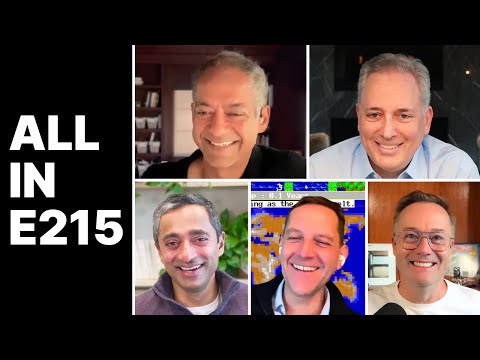
JD Vance's AI Speech, Techno-Optimists vs Doomers, Tariffs, AI Court Cases with Naval Ravikant
Jason Calacanis (host), Naval Ravikant (guest), Chamath Palihapitiya (host), David Friedberg (host), Narrator, David Sacks (host), Guest (unidentified, brief interjections) (guest), JD Vance (guest), Narrator, Narrator, Jason Calacanis (host), Narrator, Narrator, Narrator, Narrator
In this episode of All-In Podcast, featuring Jason Calacanis and Naval Ravikant, JD Vance's AI Speech, Techno-Optimists vs Doomers, Tariffs, AI Court Cases with Naval Ravikant explores naval, JD Vance, AI Jobs, Tariffs, and Techno-Optimist America This All-In episode features an extended, freewheeling conversation with Naval Ravikant that ranges from his product-building journey and parenting philosophy to AI, immigration, tariffs, and copyright in the age of LLMs.
Naval, JD Vance, AI Jobs, Tariffs, and Techno-Optimist America
This All-In episode features an extended, freewheeling conversation with Naval Ravikant that ranges from his product-building journey and parenting philosophy to AI, immigration, tariffs, and copyright in the age of LLMs.
They dissect JD Vance’s Paris AI speech, positioning it as a turning point away from ‘AI safety’ doom toward American-led AI opportunity, while debating techno-optimism vs. techno-pessimism and the risk of AI centralization.
The group argues AI is far more likely to create new industries and productivity than to destroy net jobs, but warns about regulatory capture, concentration of AI power, and the need for targeted, high-skill immigration.
Later, they explore tariffs in a world of network-effect businesses, the first big US AI copyright ruling, OpenAI’s nonprofit–for‑profit structure, and close with Naval and Chamath’s practical takes on sleep, health, and life design.
Key Takeaways
AI policy is shifting from ‘safety only’ to ‘opportunity first’ in the US.
JD Vance’s Paris speech centered on AI opportunity rather than safety, breaking with the UK/EU emphasis on preemptive regulation. ...
Get the full analysis with uListen AI
AI is more likely to be a massive productivity amplifier than a net job destroyer.
Across multiple segments, Naval, Friedberg, Sacks, and Chamath reject AI ‘doomerism’ about mass unemployment. ...
Get the full analysis with uListen AI
The real AI risk is power centralization, not machine apocalypse.
Naval is not afraid of AI itself; he’s afraid of ‘a very small number of people who control AI’ and what they might do ‘for our own good. ...
Get the full analysis with uListen AI
High-skill, assimilative immigration is critical; open borders for low-skill labor are economically and politically destabilizing.
Naval, Sacks, and Chamath distinguish sharply between targeted, legal, high‑IQ immigration and uncontrolled mass migration. ...
Get the full analysis with uListen AI
Classical free-trade theory breaks down in network-effect and strategic industries, justifying selective tariffs and re-shoring.
Naval critiques Ricardo-style comparative advantage when applied to modern, winner‑take‑most sectors. ...
Get the full analysis with uListen AI
AI training on open web content raises serious fair-use issues; ‘compress and remix’ isn’t a legal free pass.
Using the Thomson Reuters v. ...
Get the full analysis with uListen AI
Intentional life design—what you build, how you parent, and how you sleep—matters as much as wealth.
Naval downplays ‘investor’ as his identity, describing investing as a ‘side job’ and focusing instead on building things he personally wants, even if they fail (as with AirChat). ...
Get the full analysis with uListen AI
Notable Quotes
“I’m not scared of AI. I’m scared of what a very small number of people who control AI do to the rest of us—for our own good, because that’s how it always works.”
— Naval Ravikant
“AI won’t take your job. It’s someone using AI that will take your job, because they know how to use it better than you.”
— David Sacks (paraphrasing Richard Baldwin)
“If you really think you’re going to create God, do you want to put God on a leash with one entity controlling God?”
— Naval Ravikant
“Those who can harness and govern the things that are technologically superior will win, and it will drive economic vibrancy and military supremacy, which then creates safe, strong societies.”
— Chamath Palihapitiya
“Technology is going to happen. Trying to stop it is like ordering the tides to stop… Whether you’re an optimist or a pessimist, the question is: is it going to happen or not? And the answer is yes, so we want to control it.”
— David Sacks
Questions Answered in This Episode
Naval, you argued the real AI danger is centralization of power, not AI itself. Practically, what governance or technical structures would you implement to prevent a handful of US or Chinese entities from ‘putting God on a leash’?
This All-In episode features an extended, freewheeling conversation with Naval Ravikant that ranges from his product-building journey and parenting philosophy to AI, immigration, tariffs, and copyright in the age of LLMs.
Get the full analysis with uListen AI
For Friedberg: you described AI enabling ‘large technical projects’ like ocean or space habitation that are currently infeasible. Can you walk through a concrete example of such a project and how, step-by-step, AI would change its economics or engineering constraints?
They dissect JD Vance’s Paris AI speech, positioning it as a turning point away from ‘AI safety’ doom toward American-led AI opportunity, while debating techno-optimism vs. ...
Get the full analysis with uListen AI
To Sacks and Chamath: you frame wage pressure as the core driver of anti–open-borders sentiment. Given your support for high-skill immigration, what specific visa or points-based system would you design so that American workers actually share in AI-driven productivity gains rather than being undercut?
The group argues AI is far more likely to create new industries and productivity than to destroy net jobs, but warns about regulatory capture, concentration of AI power, and the need for targeted, high-skill immigration.
Get the full analysis with uListen AI
Naval, your ‘Taking Children Seriously’ approach leans heavily on persuasion and agency. Where, if anywhere, do you draw a hard line—are there domains (health, safety, schooling) where you would override a child’s preferences, and how do you reconcile that with Deutsch’s philosophy?
Later, they explore tariffs in a world of network-effect businesses, the first big US AI copyright ruling, OpenAI’s nonprofit–for‑profit structure, and close with Naval and Chamath’s practical takes on sleep, health, and life design.
Get the full analysis with uListen AI
On AI copyright: if courts ultimately require LLMs to pay a Spotify-like revenue share to content owners, how should that money be allocated in practice—by training token contribution, by attribution in outputs, or via collective licensing—and what unintended consequences do you foresee for smaller creators and open-source projects?
Get the full analysis with uListen AI
Transcript Preview
Great job, Naval. You rocked it.
Maybe I should have said this on air, but that was literally the most fun podcast I've ever recorded. (laughs)
Whoa, that's on air. Cut that in.
Yeah, put it in the show. Put it in the show.
I had my theory on why you were number one, but now I have the realization.
What's the actual reason? You know us for long enough.
Yeah, what was your theory? What's the reality?
My theory was that my problem with going on podcasts is usually the person I'm talking to is not that interesting. They're just asking the same questions and they're dialing it in and they're not that interesting. It's not like we're having a peer level, actual conversation so that's why I wanted to do AirChat and Clubhouse and things like that, because you can actually have a conversation.
Ah, I see.
Right? And what you guys have, very uniquely, is four people, you know, of whom at least three are intelligent. No, I'm kidding.
(laughing)
How could you say that? Sax isn't here!
How did you- Yeah. (laughs)
What, wait, Sax isn't even here and you say that, Naval? That is so cold.
Oh my god. That's the best. The best.
Right, of whom at least three are intelligent-
(laughs)
... and all of you get along, and you can have an ongoing conversation. That's a very high hit rate. Normally in a podcast you only get one interesting person, and now you've got three, maybe four, right?
(laughs)
Okay, so that to me was why All-In was successful.
Who invited this guy? Who are you talking to who's number four?
We don't know. It will remain mysterious forever. Of the four, right, the, the problem is if you get people together to talk, two is a good conversation, three possibly, four is the max. That's why at a dinner table at a restaurant, four top, right? You don't do five or six because then it splits into multiple conversations. So you had four people who were capable of talking, right? That I thought was a secret, but there's another secret. The sec- the other secret is you guys are having fun. You're talking over each other, you're making fun of each other. You're actually having fun.
Yeah.
So that's why I'm saying this is the most fun podcast I've ever been on. That's-
Awesome.
That's why you'll be successful.
Welcome back any time, Naval.
Thank you.
No problem.
Welcome back.
Keep it fun.
Yes, absolutely.
Yeah.
Keep it fun, guys. Thanks for having me.
Being here with one idiot and three smart guys, can't believe it.
(laughing)
I can't even believe you'd say that about Sax. He's not even here to defend himself.
Sorry, David.
Install uListen to search the full transcript and get AI-powered insights
Get Full TranscriptGet more from every podcast
AI summaries, searchable transcripts, and fact-checking. Free forever.
Add to Chrome