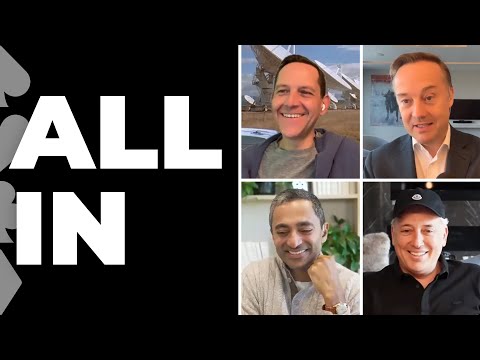
E129: Sam Altman plays chess with regulators, AI's "nuclear" potential, big pharma bundling & more
Jason Calacanis (host), David Friedberg (host), Chamath Palihapitiya (host), David Sacks (host), Narrator, Jason Calacanis (soundboard / clips) (host)
In this episode of All-In Podcast, featuring Jason Calacanis and David Friedberg, E129: Sam Altman plays chess with regulators, AI's "nuclear" potential, big pharma bundling & more explores all-In dives into AI regulation chess, pharma bundling, and chaos The episode blends humor and Reddit-driven ‘performance reviews’ with substantive debates on AI regulation, big pharma consolidation, real estate stress, and social disorder in major U.S. cities.
All-In dives into AI regulation chess, pharma bundling, and chaos
The episode blends humor and Reddit-driven ‘performance reviews’ with substantive debates on AI regulation, big pharma consolidation, real estate stress, and social disorder in major U.S. cities.
A major portion centers on Sam Altman’s Senate testimony, with the besties arguing over whether his pro-regulation stance is principled caution, regulatory capture, or a political pressure-release valve amid rapidly commoditizing open-source AI.
They also dissect the FTC’s move to block Amgen’s acquisition of Horizon Therapeutics as a test case in targeting anti-competitive pharma bundling versus stifling biotech M&A incentives.
The conversation rounds out with commentary on Twitter’s new CEO, Apple’s AR headset ambitions, collapsing office markets in SF, and high-profile vigilante-style incidents in New York and San Francisco tied to crime and mental health failures.
Key Takeaways
AI licensing could entrench incumbents while barely constraining open-source models.
Altman’s call for a dedicated AI regulator and licensing regime is seen as smart ‘chess’ to shape rules and moat OpenAI’s position, but Friedberg and Sacks argue that small, open-source models running on edge devices will be nearly impossible to police, making heavy-handed regulation both impractical and innovation-chilling.
Get the full analysis with uListen AI
Regulate harmful tactics, not all mergers, in both tech and pharma.
The hosts distinguish between blocking acquisitions outright and targeting specific anti-competitive behaviors like bundling (in both operating systems and drug portfolios); overbroad M&A hostility can cripple exits and dampen early-stage investment, especially in capital-intensive biotech.
Get the full analysis with uListen AI
AI’s upside is vast, but a tiny set of catastrophic use cases merits serious safeguards.
Chamath frames AI as analogous to nuclear technology: overwhelmingly beneficial in most uses but with a small subset (e. ...
Get the full analysis with uListen AI
U.S. political elites are largely fear-driven and technically shallow on AI.
Reports from DC suggest the White House and key senators are ‘rabidly negative’ and focused on hobbyhorses (copyright, bias, Section 230) rather than how existing laws already cover many harms; this fosters vibe-based regulation and invites a new AI-regulatory-industrial complex.
Get the full analysis with uListen AI
Pharma price inflation often stems from intermediaries and bundling, not just R&D economics.
Friedberg highlights that Amgen’s leverage comes from multi-drug bundling with insurers, while Chamath points to PBMs as dominant drivers of drug inflation; both imply that targeted action on contracting practices and PBMs may be more effective than blocking late-stage biotech acquisitions.
Get the full analysis with uListen AI
Housing and office markets are freezing, threatening mobility and bank balance sheets.
High mortgage rates combined with sunk 3% loans make homeowners reluctant to move, reducing geographic mobility; in SF, a ~35% office vacancy rate, ‘zombie’ towers, and weak demand foretell large write-downs for banks holding commercial real estate loans.
Get the full analysis with uListen AI
Crime, weak prosecution, and mental health failures are converging into vigilantism flashpoints.
The subway death of Jordan Neely and a fatal SF shoplifting incident are framed as predictable outcomes of decayed law enforcement and nonexistent mental health infrastructure; the group argues that scaled mental health services and more consistent prosecution would prevent such tragedies.
Get the full analysis with uListen AI
Notable Quotes
“Sam just went straight for the end game here, which is regulatory capture.”
— David Sacks
“This is the first time in modern history I can remember where we’ve invented something, and the people in Silicon Valley are more circumspect than the folks on Wall Street.”
— Chamath Palihapitiya
“AI is like nuclear weapons: 99.9% of use cases are positive, but the 0.1% destroys humanity.”
— Chamath Palihapitiya (paraphrasing Warren Buffett’s framing)
“We’re going to replace permissionless innovation with the need to develop some relationship in Washington to get your project approved.”
— David Sacks
“If you don’t want industry to be in this negative loop where you only work on small diseases, you need to allow these kinds of [biotech M&A] transactions to happen.”
— Chamath Palihapitiya
Questions Answered in This Episode
How can policymakers design AI oversight that targets genuinely catastrophic risks without locking in today’s incumbents or crushing open-source innovation?
The episode blends humor and Reddit-driven ‘performance reviews’ with substantive debates on AI regulation, big pharma consolidation, real estate stress, and social disorder in major U. ...
Get the full analysis with uListen AI
What would a practical KYC-style regime for large-scale AI training actually look like in cloud environments, and who should run it?
A major portion centers on Sam Altman’s Senate testimony, with the besties arguing over whether his pro-regulation stance is principled caution, regulatory capture, or a political pressure-release valve amid rapidly commoditizing open-source AI.
Get the full analysis with uListen AI
In pharma, is there a regulatory model that curbs abusive bundling and PBM-induced price inflation while preserving strong M&A incentives for early-stage biotech R&D?
They also dissect the FTC’s move to block Amgen’s acquisition of Horizon Therapeutics as a test case in targeting anti-competitive pharma bundling versus stifling biotech M&A incentives.
Get the full analysis with uListen AI
Given the visible failures in mental health and public safety, what specific nationwide infrastructure or funding shifts would most quickly reduce vigilante-style incidents?
The conversation rounds out with commentary on Twitter’s new CEO, Apple’s AR headset ambitions, collapsing office markets in SF, and high-profile vigilante-style incidents in New York and San Francisco tied to crime and mental health failures.
Get the full analysis with uListen AI
If AR glasses become the primary interface to AI, how should society think about privacy, constant surveillance, and the cognitive effects of ‘Terminator mode’ overlays on reality?
Get the full analysis with uListen AI
Transcript Preview
I have a little surprise for my besties. Everybody's been getting incredible adulation. People have been getting incredible feedback on the podcast. It is a phenomenon, as we know. And I thought it was time for us to do performance reviews of each bestie. Now I, as executive producer-
(laughs) Oh, God.
... I'm not in a position to do, uh, your performance reviews. I too need to have a performance review. So I thought I would let the audience do their performance reviews. So we went and we're debuting a new feature today at this very moment. It's called Reddit Performance Reviews.
Oh, God.
Cue some music here. (instrumental music plays) Some graphics. Reddit Performance Reviews. And so we'll start off-
Oh, God.
... with you, David Friedberg.
This proves why you haven't been successful in life so far. (laughs)
(laughs)
I haven't been? Are you kidding me? I'm on house money.
When you're trying to build a successful enterprise, instead of keeping the judgment to yourself, which is what all elite performers do-
Yes.
... you turned it over to a bunch of mids on Reddit-
Yes.
... to tell you how to run something?
No, they were already doing it. They were already doing it. We just collected it.
What elucidation were you going to get from Reddit?
Yeah, really.
Let's not ruin the bit.
Do you think Elon does 360 performance reviews?
(laughs) On Reddit? On Reddit?
On Reddit of all things?
(laughs)
You know how many 360 performance reviews I've done in my life? Zero.
Of course. And that's why this will be so entertaining.
Fucking zero.
Okay, go, go. Start off with me. Let's hear it. Okay, okay.
But here's how it's going to work. You are going to be presented with the candid feedback that you've gotten in the last 30 days on Reddit, but for the first time. And you have to read it out loud to the class. Friedberg, you'll go first. Here's your first piece of candid feedback in your 360 from the Reddit incels. Go ahead, Friedberg. Read it out loud.
David Friedberg deserves more hate. He and the others have made it their mission to convince us that reforming Social Security is the only way forward to survive. He hides behind this nerdy apolitical persona-
Hmm.
... and then goes hard right out of nowhere.
Kinda true.
If Sachs fearmongered about the deficit as an excuse to restructure entitlement programs, we would see that as the partisan right-wing take it is.
Okay.
When Friedberg does it, we're supposed to act like he has no skin in this game, he's just the science guy.
(laughs)
No. He's a rich guy who would rather work your grandparents to death than pay an extra 5% tax.
Install uListen to search the full transcript and get AI-powered insights
Get Full TranscriptGet more from every podcast
AI summaries, searchable transcripts, and fact-checking. Free forever.
Add to Chrome