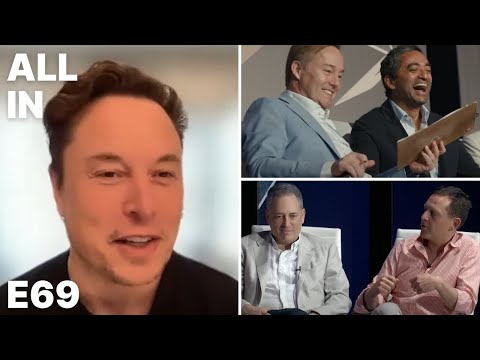
Elon Musk: Twitter's bot problem, SpaceX's grand plan, Tesla stories & more
Jason Calacanis (host), Chamath Palihapitiya (host), Elon Musk (guest), David Sacks (host), David Friedberg (host), Narrator, Jason Calacanis (host), Narrator, Chamath Palihapitiya (host), Narrator, David Sacks (host), Narrator, Narrator, Narrator, David Friedberg (host), Narrator, Narrator
In this episode of All-In Podcast, featuring Jason Calacanis and Chamath Palihapitiya, Elon Musk: Twitter's bot problem, SpaceX's grand plan, Tesla stories & more explores elon Musk on Twitter bots, free speech, Mars, and American decline Elon Musk discusses his attempt to acquire Twitter, arguing its real human user base is overstated and that a transparent, politically balanced 'digital town square' is essential for free speech and democracy.
Elon Musk on Twitter bots, free speech, Mars, and American decline
Elon Musk discusses his attempt to acquire Twitter, arguing its real human user base is overstated and that a transparent, politically balanced 'digital town square' is essential for free speech and democracy.
He outlines how Tesla functions as multiple companies in one—cars, software, AI, chips, insurance, charging, and robotics—and recounts how both Tesla and SpaceX narrowly survived early near‑bankruptcies.
On SpaceX, Musk explains using launch services and Starlink profits to finance a self-sustaining Mars city and permanent Moon base, framing multi‑planetary life as insurance against extinction and a source of inspiration.
He comments on U.S. politics, regulation, China’s rise, immigration, demographic decline, inflation, and recession risk, arguing America must recommit to hard work, top-talent immigration, and reducing self‑inflicted regulatory and political dysfunction.
Key Takeaways
Accurately measuring and disclosing bot prevalence is critical to Twitter’s value.
Musk argues Twitter’s claim of <5% fake/spam accounts is implausible, suggesting at least ~20% and possibly far higher, which materially affects advertising effectiveness, revenue reliability, and any acquisition price.
Get the full analysis with uListen AI
A credible digital town square requires transparency, neutrality, and identity integrity.
He advocates open‑sourcing Twitter’s ranking algorithms, clearly labeling any manual interventions like shadow bans, and aggressively removing bots so real, politically diverse people can debate without hidden manipulation.
Get the full analysis with uListen AI
Tesla’s edge comes from deep vertical integration and building missing technologies in‑house.
From batteries and drive units to operating systems, AI, custom chips, superchargers, and even insurance, Tesla internalizes what traditional automakers outsource, letting it move faster, reduce complexity, and capture more value.
Get the full analysis with uListen AI
Usage-based, real-time insurance can both lower costs and improve safety.
Tesla prices insurance on how you actually drive in near real time rather than crude demographics, rewarding safer behavior and closing the loop so drivers can actively lower premiums by improving their driving score.
Get the full analysis with uListen AI
SpaceX’s long-term goal is a self-sustaining city on Mars funded by pragmatic near-term businesses.
Launch services and Starlink’s global internet revenue are designed to finance a permanent Moon base and eventually a Martian city that can survive even if Earth resupply stops, passing a key ‘great filter’ for civilization.
Get the full analysis with uListen AI
Economic booms misallocate capital; recessions act as a necessary reset.
Musk likens recessions to an “economic enema” that clears out unproductive companies funded in easy-money periods, advising founders to watch cash, avoid running at the edge, and reach positive cash flow to survive downturns.
Get the full analysis with uListen AI
America’s future competitiveness hinges on talent recruitment, work ethic, and reduced self‑sabotage.
He warns that China’s larger, harder‑working workforce will soon power an economy 2–3x the size of the U. ...
Get the full analysis with uListen AI
Notable Quotes
“They say the number of bots is as unknowable as the human soul.”
— Elon Musk (on Twitter’s bot estimates)
“Free speech only matters when it’s someone you don’t like saying something you don’t like.”
— Elon Musk
“Tesla’s not a company—it's like six companies inside a company.”
— Elon Musk
“Life can’t just be about solving one miserable problem after another; it has to be about what’s inspiring and exciting.”
— Elon Musk (on making humanity multi-planetary)
“We better stop punching ourselves in the face because there’s a new kid on the block that’s going to be two to three times our size.”
— Elon Musk (on China’s rise and American competitiveness)
Questions Answered in This Episode
If Musk built a new social platform from scratch instead of buying Twitter, what architecture and governance model would best deliver his vision of a transparent, politically neutral digital town square?
Elon Musk discusses his attempt to acquire Twitter, arguing its real human user base is overstated and that a transparent, politically balanced 'digital town square' is essential for free speech and democracy.
Get the full analysis with uListen AI
How should regulators and advertisers independently verify bot and fake-account levels on major social networks to avoid the kind of information asymmetry Musk highlights?
He outlines how Tesla functions as multiple companies in one—cars, software, AI, chips, insurance, charging, and robotics—and recounts how both Tesla and SpaceX narrowly survived early near‑bankruptcies.
Get the full analysis with uListen AI
To what extent is Tesla’s extreme vertical integration a model other industries should copy, and where might it introduce new risks or inefficiencies?
On SpaceX, Musk explains using launch services and Starlink profits to finance a self-sustaining Mars city and permanent Moon base, framing multi‑planetary life as insurance against extinction and a source of inspiration.
Get the full analysis with uListen AI
Is Musk’s Starlink-and-launch-funded path to a self-sustaining Mars city economically realistic, or will it ultimately require massive government or multinational support?
He comments on U. ...
Get the full analysis with uListen AI
How can the U.S. redesign its immigration and regulatory systems to attract “aces” from around the world while preserving social stability and addressing domestic political backlash?
Get the full analysis with uListen AI
Transcript Preview
So, uh, live from an undisclosed location with the sultry filter on. (audience cheering)
(laughs)
Very sultry filter on.
Yeah.
Having a great hair day.
Yeah, that is a good hair day for me.
Great hair day.
(laughs)
My pal and your favorite CEO and Twitterer, Mr. Elon Musk. How're you doing, pal?
Nick. (audience cheering)
Let your winners ride.
Rain Man, David Sa-
I'm going all in. And I said-
We open sourced it to the fans and they've just gone crazy with it.
Love you, bestie.
I'm going all in.
Queen of quinoa.
I'm going all in.
Appreciate you, uh, uh, coming to the event, and, um, or, or coming, uh, Zooming in, um-
Yeah.
(laughs)
Uh, what's new in your world?
Um.
(laughing)
Well, let's see. Um, I guess right now, uh, I'm sort of debating the number of bots on Twitter, uh-
(laughs)
Ah.
... with, with Para on Twitter. Um, and, um, the... Currently, I'd like to... What I, what's, what I'm being told is that the, uh, there's just no way to know the number of bots. It's like as unknowable as the human soul, basically. Like... (laughs)
(laughs)
(laughs)
(laughs)
(laughs)
So-
You have no idea what level of witchcraft and alchemy is needed to determine these, what is bot percentage. (laughs)
Have you determined-
I said, like, "Why, why not try calling people?" But I haven't got a response. You know, like, t- have, have you tried calling people or something, you know? Like, maybe... (laughs) Try that.
If they answer, it's not a bot.
Oh, no. It d- no. I don't know, but I, I think, like, that would be one of the things to do to say, like, "Have you tried calling them?" As opposed to, like, trying to read the tea leaves here. That's, like, impossible, you know? Uh, obviously, you could have an account that looks exactly like a, a human account or is being operated by where one person's operating 1,000 accounts or something. Um, but that person can only buy one toaster. They're not gonna buy 1,000 toasters. So you care about, like, number of unique real people, uh, that are on the system. It's extremely fundamental. And anyone who uses Twitter is well aware that, uh, the, (laughs) the comment thr- the c- the comment threads are, are full of spa- spam, scam, and, and, um, well, just a lot of, you know, fake accounts. So, um, it, it s- it seems, uh, beyond, beyond reasonable for Twitter to c- claim that the number of, uh, uh, essentially the number of re- said another way, the number of real unique humans, uh, that you see making comments on a daily basis on Twitter, um, is above 95%. That is what they're claiming. Does anyone have that experience?
Install uListen to search the full transcript and get AI-powered insights
Get Full TranscriptGet more from every podcast
AI summaries, searchable transcripts, and fact-checking. Free forever.
Add to Chrome