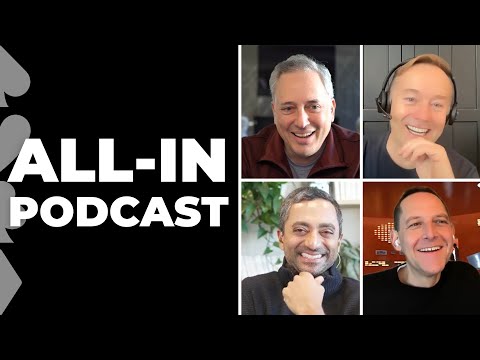
E113: DOJ tries to break up Google, vaccine questions, Ukraine escalation & more
Jason Calacanis (host), David Sacks (host), Chamath Palihapitiya (host), David Friedberg (host), David Friedberg (host), Chamath Palihapitiya (host), Jason Calacanis (host), Jason Calacanis (host), Unknown guest at Davos questioning Pfizer CEO (guest)
In this episode of All-In Podcast, featuring Jason Calacanis and David Sacks, E113: DOJ tries to break up Google, vaccine questions, Ukraine escalation & more explores all-In breaks down Google antitrust, vaccine fallout, Ukraine escalation, aging science This All-In episode covers four major threads: the DOJ’s new antitrust case against Google’s ad business and the EU probe into Microsoft’s bundling of Teams; a long, contentious reassessment of COVID vaccines, mandates, and institutional trust; mounting escalation and endgame scenarios in the Ukraine–Russia war; and breakthrough aging research around epigenetics and Yamanaka factors. The besties mostly argue that the Google ad suit is ill-targeted, but see more merit in regulating specific anti-competitive tactics like bundling and opaque enterprise licenses. On COVID, they agree the vaccines were over‑sold on transmission, mandates were overreach, and the fallout is eroding trust in authorities. They close with cautious optimism that aging-reversal therapies will create real health and investment opportunities over the coming decades.
All-In breaks down Google antitrust, vaccine fallout, Ukraine escalation, aging science
This All-In episode covers four major threads: the DOJ’s new antitrust case against Google’s ad business and the EU probe into Microsoft’s bundling of Teams; a long, contentious reassessment of COVID vaccines, mandates, and institutional trust; mounting escalation and endgame scenarios in the Ukraine–Russia war; and breakthrough aging research around epigenetics and Yamanaka factors. The besties mostly argue that the Google ad suit is ill-targeted, but see more merit in regulating specific anti-competitive tactics like bundling and opaque enterprise licenses. On COVID, they agree the vaccines were over‑sold on transmission, mandates were overreach, and the fallout is eroding trust in authorities. They close with cautious optimism that aging-reversal therapies will create real health and investment opportunities over the coming decades.
Key Takeaways
The DOJ’s Google ad-tech lawsuit likely mis-defines the market and targets the wrong monopoly.
Chamath and Friedberg argue that if you define the market as all digital advertising, Google’s ~26% share with strong competition from Meta and Amazon doesn’t look monopolistic, and that focusing on ad-tech auctions—where publishers opt in and Google pays high rev shares—makes it hard to show monopoly rents or consumer harm.
Get the full analysis with uListen AI
Regulators should focus on actual monopolies and specific anti-competitive tactics, not retroactive breakups.
The group is broadly aligned that going after 10-year-old Google acquisitions creates chilling uncertainty for M&A, and that real antitrust energy would be better spent on areas like the App Store duopoly and Google Search, plus clarifying rules around bundling, transfer pricing, and enterprise license transparency.
Get the full analysis with uListen AI
Microsoft’s bundling strategy with Teams exposes a structural problem for SaaS competition.
Using Slack vs. ...
Get the full analysis with uListen AI
COVID vaccines were oversold on stopping transmission, and mandates damaged trust.
Across the vaccine segment, they acknowledge that initial claims about preventing transmission did not hold, benefits waned quickly, myocarditis risks (especially in young males) are real though rare, and forcing an EUA product through mandates—while suppressing open debate—has deepened skepticism toward public health and expert institutions.
Get the full analysis with uListen AI
Future emergency-use medical products should be voluntary, with clearer cost–benefit framing.
They broadly converge that emergency-use pathways are valuable to cut red tape, but should not be paired with mandates; instead patients and doctors should decide based on individual risk, and any future pandemic response should be more transparent about uncertainties and trade-offs rather than enforced by social or legal coercion.
Get the full analysis with uListen AI
Ukraine is drifting into a grinding war of attrition with escalating risks but unclear offramps.
With the West now shipping advanced tanks and floating support for attacks on Crimea, the hosts worry about a Franz Ferdinand–style escalation and Russian tactical nuclear use, while also noting that degrading Russia’s economic and geopolitical power appears to be an implicit Western objective, complicating prospects for a negotiated ‘golden bridge’ exit.
Get the full analysis with uListen AI
Aging may be driven more by epigenetic information loss than DNA mutations, opening new therapeutic paths.
Friedberg explains new Harvard-led work showing that DNA in cells remains largely intact while epigenetic ‘software’ degrades, and that partial reprogramming with Yamanaka factors can reverse biological age and improve healthspan in mice—suggesting nearer-term, tissue-specific therapies (e. ...
Get the full analysis with uListen AI
Notable Quotes
“Just because something is successful in a marketplace doesn’t mean it’s a monopoly.”
— David Friedberg
“If the government is gonna have a problem with an acquisition, state it upfront, but then once they approve it, you’re approved, you’re done.”
— David Sacks
“We were all herded into this idea of being an early adopter of a product, and now we’re finding out that it certainly didn’t do what it said.”
— David Sacks
“There’s a tremendous amount of post-activity rationalization going on… the consequences of not being willing to say that you were wrong may be far greater than the consequences of making this change.”
— David Friedberg
“This paper is gonna be one of the seminal papers that really illustrates and proves the point that this epigenome is the driver of aging.”
— David Friedberg
Questions Answered in This Episode
If regulators shifted focus from breaking up big tech to enforcing transparent bundling and enterprise licensing, how would that change the SaaS and startup landscape over the next decade?
This All-In episode covers four major threads: the DOJ’s new antitrust case against Google’s ad business and the EU probe into Microsoft’s bundling of Teams; a long, contentious reassessment of COVID vaccines, mandates, and institutional trust; mounting escalation and endgame scenarios in the Ukraine–Russia war; and breakthrough aging research around epigenetics and Yamanaka factors. ...
Get the full analysis with uListen AI
Given what we now know about waning efficacy and myocarditis risk, how should the medical community rebuild trust around vaccines without undermining legitimate vaccination programs for other diseases?
Get the full analysis with uListen AI
What concrete diplomatic steps could the US and Europe take today to create a credible ‘golden bridge’ off-ramp for Russia in Ukraine without rewarding aggression or emboldening future invasions?
Get the full analysis with uListen AI
How might epigenetic reprogramming therapies realistically enter the clinic in the next 5–10 years, and which specific diseases or tissues are the most plausible first targets?
Get the full analysis with uListen AI
In hindsight, what guardrails should exist around emergency-use authorizations so that speed in crisis doesn’t translate into long-term erosion of civil liberties and institutional legitimacy?
Get the full analysis with uListen AI
Transcript Preview
Sacksy-poo, how much heat and momentum has Nikki Haley gotten this week?
Oh my God. Stop trying to make Nikki Haley happen. Fetch is not happening. Stop trying to make fetch happen.
Stop trying to make fetch happen! (laughs)
It's happening.
Is it happening because it's tomorrow? (laughs) What?
This is like my long Google short Facebook spread trade of last year.
That's so great!
It's happening.
Fetch is not happening, okay? Stop trying to make fetch happen.
Don't let your winner slide. Rain Man David Sacks. I'm going all in. And I said- We open sourced it to the fans and they've just gone crazy with it. Love you, ... queen of kinwah. I'm going all in.
Just as a, um, programming note, we did a Twitter survey and you selected Sacks as the person you wanted to moderate the pod most next. So welcome to Fox News Sunday.
(laughs)
And here's your host, David Sacks.
You're really chafed about this, aren't you, J-Cal?
No, I am excited for it! (laughs) I am so excited.
Just to save a keyboard warrior the time, I will never, ever, ever moderate this thing.
(laughs)
So I'm here to talk.
All right, three, two... Welcome to The All In Pod. I am your host, the Rain Man, David Sacks. The famous Doomsday Clock that atomic scientists use to measure the threat of nuclear annihilation has never been closer to midnight, not even during the Cold War. But since the besties think it's more important to discuss their stock portfolios-
(laughs)
... we're gonna save Ukraine for later in the show. Priorities, right gentlemen?
(laughs)
And why not? Who says you can't take it with you? The dictator, Chamath Palihapitiya is planning to be entombed with his money like an Egyptian pharaoh.
(laughs)
And with his sweaters too, even though it certainly won't be cold where he's going.
(laughs)
And of course, he'll throw in the world's greatest moderator, Jason Calacanis, in the tomb to be his servant in the afterlife. It's the role J-Cal has been preparing for all his life by sucking up to every tech founder and VC he can get in a room with.
(laughs)
I give better odds to the Sultan of Science, David Friedberg. He's just paranoid enough to survive with me in the bunker, even though he still won't be questioning the Davos elites that got us here.
(laughs) How much did that intro cost?
(laughs)
(laughs)
Does it come with a money back refund? (laughs) You guys are laughing. You guys are laughing.
I'm laughing. I don't know, I'm laughing. Yeah. Yeah, yeah. Are they with you or at you? (laughs)
(laughs) That's good.
The funniest part was when you almost read aloud, like, it's like you were like, "And then David Friedberg..." Insert pause here. (laughs)
Install uListen to search the full transcript and get AI-powered insights
Get Full TranscriptGet more from every podcast
AI summaries, searchable transcripts, and fact-checking. Free forever.
Add to Chrome