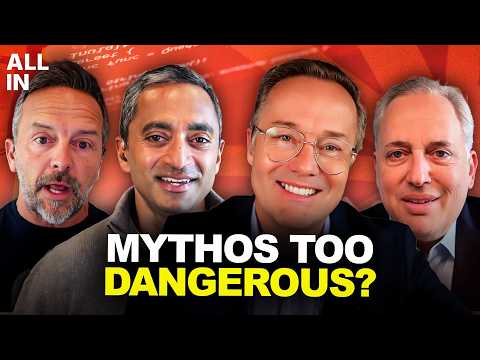
Anthropic’s $30B Ramp, Mythos Doomsday, OpenClaw Ankled, Iran War Ceasefire, Israel's Influence
Jason Calacanis (host), Brad Gerstner (guest), David Sacks (host), Chamath Palihapitiya (host)
In this episode of All-In Podcast, featuring Jason Calacanis and Brad Gerstner, Anthropic’s $30B Ramp, Mythos Doomsday, OpenClaw Ankled, Iran War Ceasefire, Israel's Influence explores anthropic’s security hold, agent wars, revenue explosion, and Iran ceasefire debate The hosts debate whether Anthropic withholding its Mythos model is responsible security practice or fear-based marketing, concluding the cyber-risk is plausible even if the presentation is theatrical.
Anthropic’s security hold, agent wars, revenue explosion, and Iran ceasefire debate
The hosts debate whether Anthropic withholding its Mythos model is responsible security practice or fear-based marketing, concluding the cyber-risk is plausible even if the presentation is theatrical.
They unpack the OpenClaw cutoff controversy, framing it as a potential anti-competitive move (or rational repricing) as Anthropic launches first-party managed agents that compete directly with third-party agent frameworks.
They analyze Anthropic’s reported ~$30B revenue run-rate surge as evidence that AI—especially coding/agentic workflows—has crossed a capability threshold with an enormous “TAM for intelligence,” while arguing about how soon profitability matters.
They describe a “major vibe shift” where Anthropic appears to be executing sharply while OpenAI faces narrative and morale pressure, yet several speakers caution that the market is non-zero-sum and OpenAI/Meta/Google remain formidable.
They review the Iran-war ceasefire and regional diplomacy, then argue over whether US involvement reflects Israeli influence versus US sovereign decision-making, emphasizing domestic political risk and Israel’s declining US favorability as a strategic concern.
Key Takeaways
Frontier coding gains translate directly into cyber offense and defense.
As models get better at code, they inevitably get better at finding and chaining vulnerabilities; the group expects a short window where defenders must patch legacy bugs before similar capabilities diffuse broadly (including via China/open source).
Get the full analysis with uListen
A pre-release “sandbox” period can be a pragmatic safety valve without a government moratorium.
Gerstner frames Anthropic’s 100-day coalition approach as industry-led hardening (Apple/Microsoft/Google/etc. ...
Get the full analysis with uListen
Anthropic’s safety announcements are perceived as partly credible and partly go-to-market muscle.
Sacks argues Anthropic has a pattern of headline-grabbing doom studies, but credits this cyber case as more logically grounded; Chamath calls it mostly theater, citing GPT-2-era precedent.
Get the full analysis with uListen
OpenClaw’s cutoff illustrates how platform owners can reshape markets via pricing and product cloning.
Forcing heavy users off flat-rate subscriptions and onto metered APIs can kneecap third-party agent frameworks; if first-party agents remain effectively “bundled” while competitors pay metered rates, it raises bundling/anti-competitive questions (depending on equivalence and market power).
Get the full analysis with uListen
Coding share today matters because agents likely depend on coding flywheels.
Sacks argues the leader in coding tokens may gain data-scale advantages that carry into agents, making “clean” competitive behavior important before regulators later scrutinize discriminatory pricing or tying.
Get the full analysis with uListen
The “TAM for intelligence” may be materially larger than past software TAMs.
Gerstner claims demand is being pulled by enterprises treating AI as labor augmentation/replacement rather than an IT line item, implying revenue can scale faster than prior enterprise SaaS ramps.
Get the full analysis with uListen
Markets treated the Iran escalation as a contained event, but political legitimacy is fragile.
Panelists note limited index drawdowns and quick rebounds suggest traders expect an off-ramp; they also highlight rising US skepticism about Israel’s role, which Israeli politicians themselves (e. ...
Get the full analysis with uListen
Notable Quotes
“Anthropic has proven that it's very good at two things. One is product releases. The second is scaring people.”
— David Sacks
“I think it's mostly theater.”
— Chamath Palihapitiya
“We have no choice but to treat it that way.”
— David Sacks
“It turns out that the TAM for intelligence is radically different than anything that we've seen before.”
— Brad Gerstner
“If you land the plane on those things... the market could really take off.”
— Brad Gerstner
Questions Answered in This Episode
What exactly is Anthropic measuring when it claims Mythos found “thousands of vulnerabilities,” and how reproducible are those results by independent security teams?
The hosts debate whether Anthropic withholding its Mythos model is responsible security practice or fear-based marketing, concluding the cyber-risk is plausible even if the presentation is theatrical.
Get the full analysis with uListen AI
Which specific patches or upstream PRs does the 100-day “Project Glasswing” coalition expect to deliver, and how will success be audited publicly?
They unpack the OpenClaw cutoff controversy, framing it as a potential anti-competitive move (or rational repricing) as Anthropic launches first-party managed agents that compete directly with third-party agent frameworks.
Get the full analysis with uListen AI
If Anthropic launches first-party managed agents, will their token pricing be metered like the API or effectively bundled— and how will they ensure third-party frameworks aren’t disadvantaged?
They analyze Anthropic’s reported ~$30B revenue run-rate surge as evidence that AI—especially coding/agentic workflows—has crossed a capability threshold with an enormous “TAM for intelligence,” while arguing about how soon profitability matters.
Get the full analysis with uListen AI
What evidence supports the claim that Anthropic provides >50% of “coding tokens,” and how should “market share” be defined in such an early, fast-changing category?
They describe a “major vibe shift” where Anthropic appears to be executing sharply while OpenAI faces narrative and morale pressure, yet several speakers caution that the market is non-zero-sum and OpenAI/Meta/Google remain formidable.
Get the full analysis with uListen AI
How much of Anthropic’s reported run-rate is gross vs net (hyperscaler channel commissions), and what does that imply about true unit economics and durability?
They review the Iran-war ceasefire and regional diplomacy, then argue over whether US involvement reflects Israeli influence versus US sovereign decision-making, emphasizing domestic political risk and Israel’s declining US favorability as a strategic concern.
Get the full analysis with uListen AI
Transcript Preview
How many PRs you think are gonna get pushed to the core structural internet in 100 days? What's the over under number? 'Cause I'll give you a number.
You're gonna say zero. My, my answer to that is-
No, no, no. I'll, I'll say, like, 10,000, but it's gonna be a meaningless thing.
But if it prevents your browser history from being released to everybody in the world-
Mm
... Chamath, that may be something that you're willing to, you know, let 100 days pass on.
I think you got Chamath's attention when you said browser history.
What about the dick pics?
[laughs]
[laughs]
[laughs]
As Chamath is... He's gonna release them himself. [upbeat music]
You let your winners ride.
Rain Man David Sacks.
And I said-
We open sourced it to the fans, and they've just gone crazy with it.
W.S. I-
Queen of Ken Rob. All right, everybody, welcome back to the number one podcast in the world. David Friedberg is out this week, but in his place, the one, the only, our fifth bestie, Brad Gerstner.
I mean, what, don't you ever brother puts a little namaste in your payday anymore?
Absolutely.
You used to be Sabby.
You know what? I'll bring, I'm gonna bring back the intros.
You used to be the greatest moderator, but now it's just, it's kind of lame.
No, I'll do the intros. You know what? These guys beat me up. They beat me up, and they just beat the, the joy out of me doing this program.
[laughs]
[laughs]
It's because you're a Ro Khanna apologist now.
No. I-
[laughs]
We- we'll get into it, okay? Save it for the [beep] show. [laughs] I'm no Khanna apologist. Just 'cause I said, like, "Hey, they've stopped retard maxing, and they've started doing, like, some logical things"? Uh, yeah, okay. Here we go.
Well, it's great to be here. Great to be here.
Good to have you. Good to have you here. And of course, uh, we have David Sacks is back.
I'm back.
Everybody wants to hear from David Sacks. We missed you last week, bestie.
We didn't beat the joy out of you. We just tried to beat some of the hot air.
Oh. [laughs]
[laughs]
Any, any fluff that you can put on the show that just involves you talking and saying nothing is-
[laughs]
That's the stuff we gotta-
Okay, fair enough. Fair enough. Yeah
... gotta cut out
Fair enough. Okay, yeah. We'll cut it right out.
[laughs]
Um, yeah, we'll cut it out, and then we'll just put a promo in for thesyndicate.com. Thank you.
Oh, Jesus.
Uh, also with us, Chamath Palihapitiya is here. H- how's your retard maxing going since last week? Did you have a, a, a, a retard maxing full weekend? Did you have-
I w-
... a good full weekend of just smoking cigars in the back deck and not ruminating about all the chaos you've caused in the last 20 years?
Install uListen to search the full transcript and get AI-powered insights
Get Full TranscriptGet more from every podcast
AI summaries, searchable transcripts, and fact-checking. Free forever.
Add to Chrome