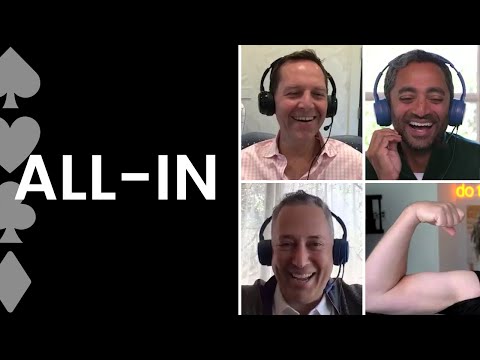
E32: Behind the scenes of Elon hosting SNL, CDC failures, America's real-time UBI experiment & more
David Friedberg (host), Chamath Palihapitiya (host), Chamath Palihapitiya (host), Jason Calacanis (host), Narrator, David Sacks (host), David Friedberg (host), Chamath Palihapitiya (host), Jason Calacanis (host)
In this episode of All-In Podcast, featuring David Friedberg and Chamath Palihapitiya, E32: Behind the scenes of Elon hosting SNL, CDC failures, America's real-time UBI experiment & more explores elon’s SNL, CDC missteps, inflation fears, and bioengineering the future The hosts open with a behind-the-scenes look at Elon Musk’s week hosting Saturday Night Live, detailing writers’ room negotiations, joke punch‑ups, and how the Asperger’s monologue line landed emotionally with staff and viewers. They then pivot to COVID policy, criticizing CDC guidance on outdoor transmission and masks, and arguing that fear, politics, and union pressure have distorted public‑health decisions and prolonged school closures. From there, they connect those institutional failures to macroeconomics, highlighting Stan Druckenmiller’s warnings about Fed policy, inflation, labor shortages, and what they call an implicit nationwide UBI experiment via stimulus and extended unemployment. The episode closes with optimism about synthetic biology and stem‑cell therapies as world‑changing technologies, alongside a call for more “reasonable,” centrist politics that supports science and productive capitalism instead of ideological extremes.
Elon’s SNL, CDC missteps, inflation fears, and bioengineering the future
The hosts open with a behind-the-scenes look at Elon Musk’s week hosting Saturday Night Live, detailing writers’ room negotiations, joke punch‑ups, and how the Asperger’s monologue line landed emotionally with staff and viewers. They then pivot to COVID policy, criticizing CDC guidance on outdoor transmission and masks, and arguing that fear, politics, and union pressure have distorted public‑health decisions and prolonged school closures. From there, they connect those institutional failures to macroeconomics, highlighting Stan Druckenmiller’s warnings about Fed policy, inflation, labor shortages, and what they call an implicit nationwide UBI experiment via stimulus and extended unemployment. The episode closes with optimism about synthetic biology and stem‑cell therapies as world‑changing technologies, alongside a call for more “reasonable,” centrist politics that supports science and productive capitalism instead of ideological extremes.
Key Takeaways
Elon’s SNL appearance was tightly negotiated and more emotionally significant than it seemed on air.
Jason Calacanis describes serving as Musk’s informal writer and negotiator, pushing for edgier material (e. ...
Get the full analysis with uListen AI
Comedy on network TV now operates under overlapping vetoes—legal, political, and emotional—which narrows what can be aired.
The hosts recount sketches that were toned down or killed due to standards, legal risk, or staff sensitivities, arguing that SNL must balance artistic risk with the preferences of a small but powerful minority inside the institution.
Get the full analysis with uListen AI
CDC mask and outdoor-transmission guidance lags both data and common sense, undermining trust.
They highlight New York Times and Atlantic reporting that casual outdoor spread is vanishingly rare (<1%, likely <0. ...
Get the full analysis with uListen AI
Extended stimulus and enhanced unemployment benefits are functioning as a real-time UBI experiment with mixed economic effects.
Examples like restaurant labor shortages, high Uber driver wages, and states like Montana opting out of federal bonuses illustrate how generous benefits can disincentivize work, constraining reopening and fueling wage and price inflation.
Get the full analysis with uListen AI
Aggressive Fed and fiscal policy risk stoking inflation and crowding out productive investment.
Quoting Stan Druckenmiller and recent CPI data, they argue that post-crisis money printing, debt issuance, and big new spending/tax plans are driving up input costs, spooking growth-stock markets, and may turn a potential post‑COVID boom into a stagflationary bust.
Get the full analysis with uListen AI
Current political and media institutions are seen as captured by special interests and ideology, pushing people toward “going direct.”
The hosts criticize teachers’ unions’ influence on CDC school guidance and journalists’ hostility to their podcast’s direct reach, framing both as examples of intermediaries resistant to losing gatekeeping power.
Get the full analysis with uListen AI
Synthetic biology and stem-cell therapies could redefine manufacturing, agriculture, and medicine this century.
Friedberg and Chamath describe companies like Ginkgo, Zymergen, and Pivot Bio, the drop in DNA costs, mRNA platforms, and induced pluripotent stem cells, arguing these tools will let us ‘program biology’ to make materials, reduce emissions, fix vision, and treat disease—if capital is steered toward science instead of wasteful programs.
Get the full analysis with uListen AI
Notable Quotes
“It was one of the happiest times I’ve ever seen in Elon’s life, and I’ve been with him for 20 years.”
— Jason Calacanis
“We’re in a race between technological acceleration and social and political deterioration.”
— David Sacks
“This is not taking COVID seriously. This is basically an irrational fear of COVID.”
— David Sacks
“Clinging to an emergency after the emergency has passed is what the Fed behavior indicates right now.”
— Summary of Stan Druckenmiller’s view, paraphrased by the hosts
“Nothing drives me more nuts than when I see money not going to science.”
— David Friedberg
Questions Answered in This Episode
How should comedy institutions like SNL balance creative risk, social sensitivity, and legal/brand constraints without becoming bland or politicized?
The hosts open with a behind-the-scenes look at Elon Musk’s week hosting Saturday Night Live, detailing writers’ room negotiations, joke punch‑ups, and how the Asperger’s monologue line landed emotionally with staff and viewers. ...
Get the full analysis with uListen AI
To what extent did Elon Musk’s public mention of Asperger’s actually shift public perceptions of neurodiversity versus simply being received as a joke?
Get the full analysis with uListen AI
What structural reforms could make the CDC more responsive to emerging data while insulating it from political and interest-group capture?
Get the full analysis with uListen AI
Where is the tipping point at which generous safety nets start to meaningfully suppress labor-force participation and economic dynamism—and how can policy be tuned around that?
Get the full analysis with uListen AI
Which synthetic-biology applications (materials, food, medicine, climate) are most likely to hit large-scale, profitable deployment first, and what new regulatory or ethical frameworks will they require?
Get the full analysis with uListen AI
Transcript Preview
(singing) Look at this red on my stock screen.
(laughs)
(laughs)
I can't believe what is going on.
(laughs)
Stocks are down.
I'm laughing now.
Doesn't mean I'm a loser. I don't know. I need some self-worth now.
(laughs)
Oh, God.
In three, two-
I'm going all in. Let your winners ride.
Rain Man, David Sachs.
I'm going all in.
And I said we open sourced it to the fans and they've just gone crazy with it.
Love you, bestie.
Queen of quinoa.
I'm going all in.
Hey, everybody. Hey, everybody. Welcome back. The All In podcast is back. Apologies about last week, I had a personal emergency.
Are we, are we allowed to say why?
Of course. I mean, uh, we-
You can say it. Go say it. Say it. Say it.
Anyway-
It's a humble brag.
With us today on the program-
Say it and you know the program-
Explain it. Explain.
Say it. Explain why. Stop.
... is the queen of quinoa, David Freiberg, Chamath Palihapitiya, The Dictator-
Oh, my God.
... and the Rain Man himself, David Sachs. I was on a world tour.
Can you please-
I was on a world tour.
No, no, no. Come on.
All right, just... I'll, I'll tell the story. Obviously, I don't like to talk about a certain friend of mine-
No. (laughs)
... because he's very high profile and I don't talk about it in public.
Just flex. Just flex.
Just flex. Just do it and move on.
It's okay.
I have been lifting. I just wanna let people know the gun show's back.
No, weird.
No, you were backstage at SNL helping, uh, Elon with, uh, the SNL appearance. Were you not?
This is true.
Tell us what that was like. Tell us about the backstage experience at SNL.
Yeah, tell us about the backstage experience. I mean, we were, we were living it out in real time with you guys, but tell us what it was really like. Okay.
First, first tell us why, why Elon recruited you to do it.
(laughs)
Uh, yeah.
Are you Elon's funniest friend?
(laughs)
Arguably. Uh, well, I mean, he know... I mean, he's got a lot of
(laughs)
Guys, hold on. I... Don't you remember the joke in the... at Sax's roast five years ago? Remember when Elon was late and I had that ad lib joke? There were two jokes that I landed at Sax's thing, which I thought were the two fun-
No, my thing.
No, Jason, my thing. I... And I, I, my, my-
Wait, when I was being roasted?
No. Wait, was it Jason's party? Sachs'. Oh, yeah, yeah.
Install uListen to search the full transcript and get AI-powered insights
Get Full TranscriptGet more from every podcast
AI summaries, searchable transcripts, and fact-checking. Free forever.
Add to Chrome